In an intense conflict India Declares Future Terror Attacks Will Be Treated as Acts of War Amid Escalating Tensions with Pakistan. In a bold and unprecedented move, India has declared that any future act of terrorism traced back to Pakistani elements will be considered an act of war, according to top government sources. The stern warning follows a series of drone and missile attacks by Pakistan on northern Indian regions and comes in the wake of the deadly Pahalgam terror attack that killed 26 tourists on April 22. This shift marks a significant escalation in India’s national security posture and signals the Modi government’s intent to firmly retaliate against any further cross-border terrorism.
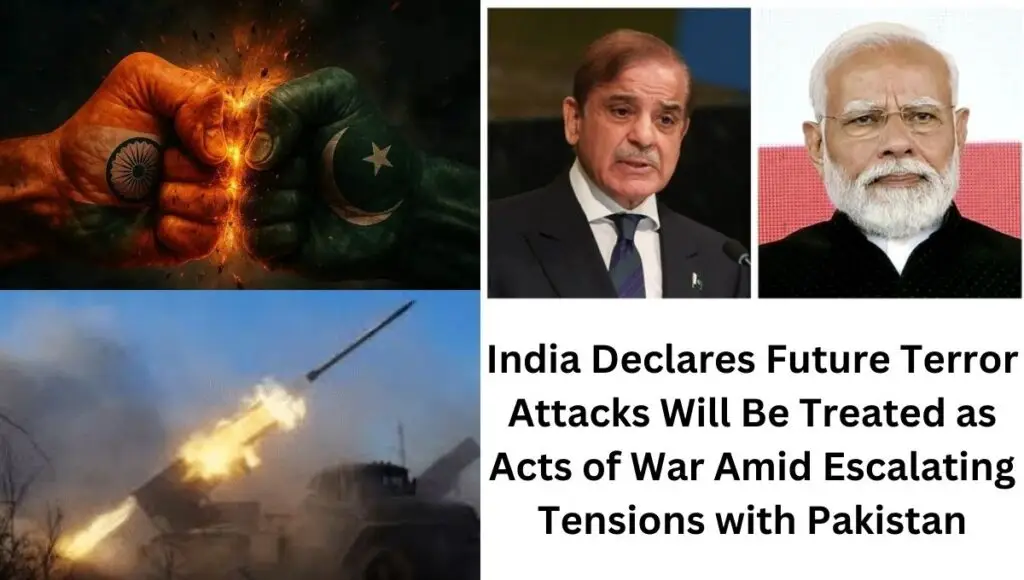
India Declares Future Terror Attacks Will Be Treated as Acts of War Amid Escalating Tensions with Pakistan
Pakistan Launches Drone and Missile Strikes Following Pahalgam Attack
Over the past three nights, Pakistan has launched multiple drone and missile attacks targeting Indian military installations and civilian areas across Jammu and Kashmir, Punjab, Rajasthan, and Gujarat.
The Indian air defence network successfully intercepted most of these attacks, preventing substantial damage to critical infrastructure, including airports and airbases.
According to India’s Ministry of Defence, eight missiles were intercepted near the Jammu airport on Thursday evening alone, underscoring the gravity of the threat and the preparedness of Indian defence forces.
Operation Sindoor: India Strikes Back
In a direct response to the Pahalgam massacre, the Indian armed forces launched precision cruise missile strikes targeting terror camps in Pakistan and Pakistan-Occupied Jammu and Kashmir (PoJK) under Operation Sindoor.
The operation aimed at dismantling terror infrastructure and sending a strong message to those who harbor or support such groups.
Top military sources confirmed that the targeted sites were linked to terrorist groups operating under the protection of Pakistan’s Inter-Services Intelligence (ISI) and the Pakistan Army.
ISI and Pakistan Army Accused of Direct Involvement
Indian intelligence sources have revealed irrefutable evidence that elements within the Pakistan Army and ISI have been actively supporting terrorist operations across the border.
Reports indicate that several terror camps are located dangerously close to Pakistani military installations, reinforcing suspicions of collusion and logistical support.
“Terrorists were observed using military infrastructure as cover and enjoyed unrestricted access to high-security areas,” a senior intelligence official said.
“This level of access is not possible without official sanction or passive tolerance, which amounts to active collaboration.”
Defining Red Lines: India’s New Rules of Engagement
India’s latest stance makes clear that any act of terror involving cross-border elements including bombings, firing, hijackings, cyberattacks, or chemical and biological attacks will now be interpreted as an act of war.
This also includes attacks on government buildings, military bases, and vital public infrastructure.
“This is a clear red line,” said a top government official. “Whether carried out by state or non-state actors, any such action will meet with a swift and proportional military response.”
High-Level Security Meeting Signals Unified Stand
Prime Minister Narendra Modi chaired a high-level security meeting at his official residence in New Delhi following India’s retaliatory strikes. Present were Defence Minister Rajnath Singh, National Security Advisor Ajit Doval, the Chief of Defence Staff (CDS), and the chiefs of the Indian Army, Navy, and Air Force.
According to sources, the meeting focused on operational readiness, escalation scenarios, and the international diplomatic fallout of the evolving situation.
Pakistan Responds: De-escalation Conditional on Indian Halt
In response to India’s strikes, Pakistan stated it would consider de-escalation if India halts further military actions. Pakistani Foreign Minister Ishaq Dar, after a phone conversation with US Secretary of State Marco Rubio, told Geo News that continued Indian strikes would invite proportional retaliation.
India, however, appears firm in its stance. “The burden of peace lies with Pakistan. Terrorism is not diplomacy,” a senior Indian diplomat said.
India to Expose Pakistan’s Global Duplicity
India is also working to internationally expose Pakistan’s dual role—positioning itself as a responsible global player while simultaneously nurturing violent non-State actors. Indian officials are engaging with key allies and international organizations to highlight Pakistan’s complicity and push for stricter global action.
Conclusion: A New Era of Deterrence
The declaration that any future terror act will be treated as an act of war marks a watershed moment in India’s counter-terrorism doctrine. With both nuclear-armed nations now on high alert, the international community watches closely as the region teeters on the edge of wider conflict.
India’s message is unambiguous: there will be zero tolerance for cross-border terrorism, and any provocation will be met with decisive force.
Also Read: US Monitors India-Pakistan “Every Single Day,” says Rubio Amid Trump’s Ceasefire Claim
Also Read: Act of War: What India’s latest warning to Pakistan means under international law
Related Posts:
- Afghanistan–Pakistan War 2025: Inside the 48-Hour Ceasefire

- 5 Major Takeaways from the US Supreme Court's…

- 3 Explosive Conditions Iran Sets to End War with US…

- 7 Powerful Measures: Trump Sanctions Russian Oil…

- 7 Heartbreaking Facts About Venezuela's Earthquake Disaster

- 7 Powerful Facts About Ayatollah Ali Khamenei’s…