3 Afghan Cricketers Killed in Pakistan Airstrikes: Facts Behind ACB’s Shocking Exit from the Pakistan-hosted Tri-Nation T20 series. The Afghanistan Cricket Board (ACB) announced on Saturday its withdrawal from the upcoming Tri-Nation T20 International Series involving Pakistan and Sri Lanka.
The decision followed airstrikes in Afghanistan’s Paktika province that killed at least ten civilians, including three Afghan domestic cricketers. The players — identified as Kabeer, Sibghatullah, and Haroon — were killed when air raids, allegedly carried out by Pakistan’s military, struck residential areas in the Urgun and Barmal districts. The incident has reignited tensions between the two neighboring countries amid ongoing border clashes and a fragile ceasefire.
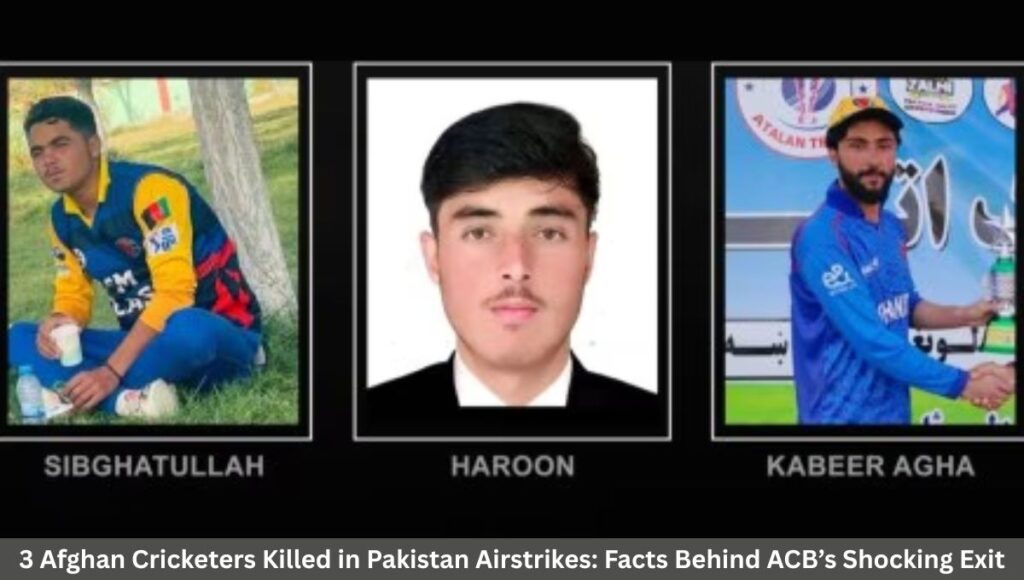
3 Afghan Cricketers Killed in Pakistan Airstrikes: Facts Behind ACB’s Shocking Exit
‘Cowardly Attack’: ACB Condemns Strikes in Strongly Worded Statement
In a statement posted on social media, the Afghanistan Cricket Board described the attack as “a cowardly attack carried out by the Pakistani regime,” announcing the immediate withdrawal of its team from the November tri-series.
“The Afghanistan Cricket Board expresses its deepest sorrow and grief over the tragic martyrdom of the brave cricketers from Urgun District in Paktika Province, who were targeted this evening in a cowardly attack carried out by the Pakistani regime,” the ACB said.
“In this heartbreaking incident, three players (Kabeer, Sibghatullah and Haroon) alongside 5 other fellow countrymen from Urgun District were martyred, and seven others were injured,” the statement continued.
The board confirmed that the players had earlier traveled to Sharana, the provincial capital, to participate in a friendly cricket match. They were killed later that evening upon returning home.
“The players had earlier traveled to Sharana, the capital of Paktika province, to participate in a friendly cricket match. After returning home to Urgun, they were targeted during a gathering,” the ACB noted.
The board also announced its formal decision to withdraw from the series as “a gesture of respect to the victims.”
“In response of this tragic incident and as a gesture of respect to the victims, the Afghanistan Cricket Board has decided to withdraw from participating in the upcoming Tri-Nation T20I Series involving Pakistan, scheduled to be played in late November,” the statement added.
Rashid Khan Condemns ‘Barbaric and Immoral’ Strikes
Afghanistan’s T20I captain Rashid Khan, one of the most recognizable faces in world cricket, issued a powerful condemnation of the airstrikes and expressed solidarity with the victims’ families.
“I am deeply saddened by the loss of civilian lives in the recent Pakistani aerial strikes on Afghanistan. A tragedy that claimed the lives of women, children, and aspiring young cricketers who dreamed of representing their nation on the world stage,” he said.
“It is absolutely immoral and barbaric to target civilian infrastructure. These unjust and unlawful actions represent a grave violation of human rights and must not go unnoticed.”
“In light of the precious innocent souls lost, I welcome the ACB’s decision of withdrawing from upcoming fixtures against Pakistan. I stand with our people at this difficult time, our national dignity must come before all else,” Rashid said in his statement posted on X (formerly Twitter).
Fellow player Fazalhaq Farooqi also supported the decision, sharing a message of solidarity and national pride on social media.
Tensions Escalate Along the Durand Line
The deadly incident comes amid a sharp escalation in hostilities between Pakistan and Afghanistan, which have traded accusations over cross-border violence since October 11. Fierce clashes erupted after Afghan forces reportedly attacked Pakistani military posts along the Durand Line, prompting Pakistan to retaliate with air and drone strikes.
A temporary 48-hour ceasefire was agreed upon earlier this week but was breached when Pakistan allegedly conducted new airstrikes on Friday night in Afghanistan’s Paktika province, killing civilians and destroying homes.
The Taliban condemned the attacks as a “violation of the truce”, accusing Pakistan of undermining peace efforts even as both sides held talks in Doha aimed at de-escalating tensions.
Pakistan Cricket Board Seeks ICC’s Help Amid Fallout
Following Afghanistan’s withdrawal, the Pakistan Cricket Board (PCB) confirmed that it remains committed to hosting the tournament and is in discussions with the International Cricket Council (ICC) to find a replacement team.
A PCB spokesperson told Hindustan Times:
“The tri-series is still on and the third team will be finalised shortly.”
According to PTI, PCB chairman Mohsin Naqvi had already written to the ICC earlier this week when cross-border tensions began to escalate.
“The PCB chairman, Mohsin Naqvi, has asked the International Cricket Council to start working on an alternate plan as he wants the Tri-Series to go ahead,” a source was quoted as saying.
However, finding a replacement may prove difficult, as Australia, England, and South Africa are all engaged in bilateral series during November. The tri-series is scheduled from November 17 to 29 in Lahore and Rawalpindi.
Also Read: PCB confirms tri-series will start on time despite Afghanistan pulling out
Blow to Pakistan’s Efforts to Revive International Cricket
Afghanistan’s withdrawal represents a significant diplomatic and sporting setback for Pakistan’s efforts to revive international cricket on home soil.
This would have been Afghanistan’s second visit to Pakistan this year, following their participation in the Champions Trophy, hosted under a hybrid model.
Pakistan’s cricket calendar has already faced disruptions due to political instability and security concerns. India, one of cricket’s major powers, has refused to play bilateral series against Pakistan since 2012–13, facing them only in ICC or multi-nation tournaments.
In September, India defeated Pakistan in the Asia Cup final, held months after the Pahalgam terror attack and subsequent retaliatory operations by Indian forces. The tournament was marred by tension, with reports of cold interactions between players and allegations of provocative gestures from some Pakistani cricketers.
Regional and Political Reactions: Anger and Condemnation
The attack and its aftermath have drawn condemnation both within Afghanistan and internationally.
Former Afghan parliamentarian Mariam Solaimankhil, speaking to NDTV from the United States, called the strikes “cowardly and barbaric” and accused Pakistan’s military of “systematic terrorism.”
“We are not surprised. This is the same pattern of violence the ISI and the Pakistan Army have unleashed for decades from India to Afghanistan. But to see young cricketers, babies, and mothers being killed, it’s heartbreaking,” she said.
Solaimankhil linked the latest aggression to Afghanistan’s recent diplomatic outreach to India, including Foreign Minister Amir Khan Muttaqi’s visit to New Delhi, suggesting Pakistan’s military establishment views closer India-Afghanistan ties as a threat.
“Whenever Afghanistan moves closer to India, our brotherly, historic partner, it threatens Pakistan’s military establishment. Their entire economy thrives on war and destruction. They cannot tolerate peace between Afghans and Indians,” she added.
She also directed a pointed message to Pakistan’s Army Chief General Asim Munir, saying:
“You reap what you sow. For decades, you’ve bred terrorists and used them as weapons. Don’t be surprised when the fire you started burns your own home.”
Solaimankhil further accused Pakistan of running a “propaganda machine” to justify civilian casualties under the guise of targeting TTP (Tehrik-i-Taliban Pakistan) militants.
“They say they’re targeting terror camps, but not a single TTP member has been named or shown. What we have are pictures of Afghan babies murdered in cold blood.”
Indian Politician Priyanka Chaturvedi Slams Pakistan, Backs ACB’s Decision
In India, Shiv Sena (UBT) MP Priyanka Chaturvedi praised Afghanistan’s decision to withdraw, calling it an act of “national dignity.”
“Pakistan establishment is made up of a bunch of cowards who thrive on the blood of their innocent victims and get thrashed at the borders. Shame on them,” she said in a social media post.
“Good to see Afghanistan Cricket Board call off their series matches with Pakistan, maybe BCCI and GoI can take tips on how to prioritise nation over sports,” she added.
Chaturvedi also urged Sri Lanka to withdraw from the tri-series in solidarity with Afghanistan, citing the 2009 terror attack on the Sri Lankan team in Lahore.
“Hope Sri Lanka team will withdraw from this tri series too, in solidarity with the Afghanistan Team. Not to forget even their team was attacked in 2009 by terrorists when on Pakistan tour,” she posted.
Her remarks reignited debate over whether sports should continue amid political and military crises. Opposition figures in India have previously accused the BCCI and central government of prioritizing commercial interests over national security by continuing to play against Pakistan in multinational events.
Ceasefire Fragility and Humanitarian Concerns
The violation of the short-lived ceasefire and the ensuing airstrikes have raised fresh humanitarian concerns in Afghanistan. Local reports from Tolo News and AFP confirmed that at least 10 civilians, including two children, were killed and 12 others wounded in the Paktika attacks.
The Taliban government’s spokesperson condemned the strikes and warned that Pakistan’s actions could further destabilize the already volatile border region.
Diplomatic sources say talks in Doha between Afghan and Pakistani delegations are ongoing but face significant hurdles amid mutual accusations and deep mistrust.
Also Read: Afghanistan–Pakistan War 2025: Inside the 48-Hour Ceasefire
Cricket and Conflict: A Bitter Intersection
The deaths of the three young cricketers — all from Afghanistan’s domestic circuit — highlight how conflict continues to affect the nation’s fragile sports infrastructure.
For Afghanistan, cricket has long been a symbol of national unity and hope. Since the fall of the Taliban’s first regime, the sport has grown rapidly, producing stars like Rashid Khan, Mohammad Nabi, and Mujeeb Ur Rahman.
Saturday’s tragedy has therefore struck an emotional chord within the Afghan cricketing community. Players, fans, and officials alike have called the airstrikes not just a loss of lives, but a blow to the morale of a nation that has long found solace in the game.
What Lies Ahead for the Series and Regional Diplomacy
With Afghanistan’s withdrawal, Pakistan faces renewed scrutiny from the international cricket community. While the PCB insists the Tri-Nation T20 Series will proceed, uncertainty surrounds who will fill Afghanistan’s slot.
For the International Cricket Council, the situation underscores the difficulty of keeping politics and warfare separate from sport, especially in regions where the two are deeply intertwined.
Meanwhile, analysts warn that the incident could derail any prospects for lasting peace along the Afghanistan-Pakistan border. The escalation not only risks more civilian casualties but could also drag the two nations into a prolonged military and diplomatic confrontation.
Conclusion
The deaths of Kabeer, Sibghatullah, and Haroon have reverberated far beyond the cricket field. Their tragic loss underscores how fragile peace remains in the region — and how sport, often a bridge between nations, can quickly become another casualty of conflict. For now, Afghanistan’s stance is clear: no cricket amid bloodshed. As Rashid Khan said, “Our national dignity must come before all else.”