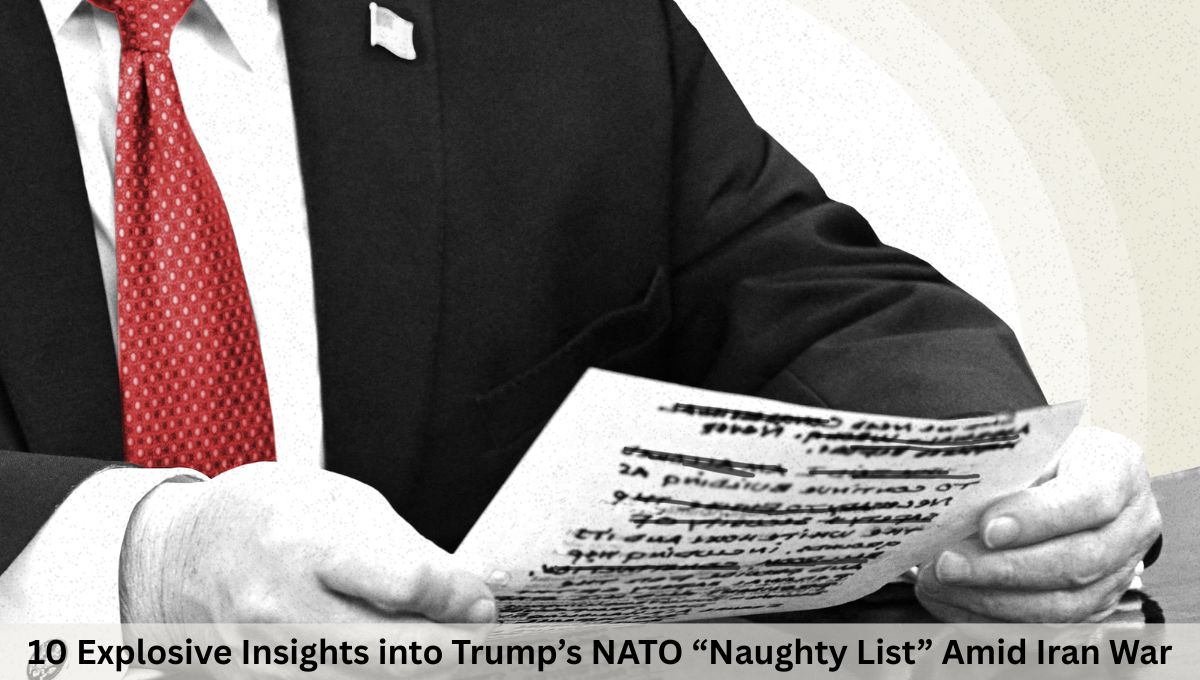
10 Explosive Insights into Trump’s NATO “Naughty List” Amid Iran War — New flashpoint in global geopolitics. The transatlantic alliance is facing one of its most serious tests in recent history. Reports that the administration of Donald Trump has created a “naughty and nice” list ranking NATO allies based on their contributions—and more controversially, their support during the Iran conflict—have sparked concern across global diplomatic circles.
The move, if fully implemented, could fundamentally reshape how the United States engages with its allies, introducing a transactional model that rewards compliance and penalizes divergence.
At a time when the world is already grappling with instability in the Middle East, rising energy prices, and fragile ceasefires, this development adds another layer of complexity to global geopolitics.
10 Explosive Insights into Trump’s NATO “Naughty List” Amid Iran War
What Is the “Naughty and Nice” List?
At its core, the reported list is a tiered classification system for members of the NATO.
Countries are evaluated based on:
- Their defense spending and contributions
- Their strategic cooperation with the United States
- Their willingness to support US-led military actions, particularly in the Iran conflict
The concept reflects a broader shift in US foreign policy—one that prioritizes measurable contributions and alignment over traditional alliance norms.
The list was reportedly prepared ahead of a key visit by NATO Secretary General Mark Rutte to Washington, signaling that the issue was intended to be part of high-level diplomatic discussions.
Origins of the Idea
The framework is not entirely new. It builds on earlier remarks by US Defense Secretary Pete Hegseth, who had proposed distinguishing between “model allies” and those falling short of expectations.
Hegseth’s Doctrine
Hegseth outlined a clear philosophy:
- Allies that “step up” would receive preferential treatment
- Those failing to meet obligations could face consequences
This approach reflects a more hardline stance on alliance management—one that emphasizes accountability but risks increasing friction.
Why the Iran Conflict Matters
The ongoing tensions involving Iran have become a critical benchmark for evaluating allies.
A Divisive Issue
While the United States pursued military operations and enforced a naval blockade, most NATO members chose not to participate directly.
This divergence has:
- Frustrated Washington
- Exposed cracks within the alliance
- Triggered debates over collective defense responsibilities
Strategic Importance
The conflict, centered around key regions like the Strait of Hormuz, has global implications:
- Energy supply disruptions
- Increased oil prices
- Heightened military risks
In this context, the US expected stronger backing from its allies—support that largely did not materialize.
Who’s on the “Nice” List?
Although no official list has been released, reports suggest certain countries are viewed favorably.
Key Supporters
Poland
Poland is widely recognized for its strong defense spending and commitment to NATO objectives.
It has consistently met or exceeded spending targets and hosts a significant US military presence.
Romania
Romania has reportedly allowed US forces to use its airbases for operations linked to the Iran conflict, positioning itself as a key strategic partner.
Baltic States
Countries like Lithuania, Latvia, and Estonia are often cited for their proactive defense policies and alignment with US priorities.
Who Might Be on the “Naughty” List?
On the other side, several countries face scrutiny for their stance during the Iran crisis.
Reluctant Allies
Spain
Spain has resisted increased defense spending targets and shown reluctance to support US military initiatives.
France and the United Kingdom
While traditionally close allies, both countries reportedly declined or limited their involvement in the Iran conflict, contributing to tensions.
Broader Trend
Most NATO members opted to stay out of direct military engagement, reflecting:
- Domestic political constraints
- Strategic caution
- Differing views on the conflict
Potential Consequences for Allies
One of the most controversial aspects of the list is the potential for tangible rewards and punishments.
Possible Rewards
- Increased military cooperation
- Priority access to US defense technology
- Expanded joint exercises
Possible Penalties
- Relocation of US troops
- Reduced military collaboration
- Restrictions on defense sales
However, experts caution that such measures could backfire.
The Strategic Dilemma
Reducing troop presence in Europe, for example, might weaken US influence more than it pressures allies. Similarly, limiting cooperation could undermine collective security.
Trump’s Growing Frustration with NATO
The reported list reflects deeper frustrations within the Trump administration.
Public Criticism
Trump has repeatedly criticized NATO allies for:
- Insufficient defense spending
- Lack of support during critical operations
- Over-reliance on US military power
In a recent speech, he expressed disappointment with NATO’s delayed response to the Strait of Hormuz crisis, stating that their support came too late to be meaningful.
A Shift Toward Self-Reliance
Trump has emphasized the need for the US to rely less on allies and more on its own capabilities—a stance that challenges the very foundation of NATO.
Impact on Transatlantic Relations
The introduction of a ranking system could have far-reaching consequences.
Erosion of Trust
Alliances are built on mutual trust and shared values.
A “grading” system risks:
- Creating divisions among members
- Undermining unity
- Encouraging competition rather than cooperation
Strategic Realignment
Countries may reconsider their positions within the alliance, exploring alternative partnerships or strengthening regional defense mechanisms.
The Economic and Security Fallout
The implications extend beyond diplomacy.
Defense Industry Impact
Restrictions on defense sales could affect:
- Military modernization programs
- Defense contractors
- Technological collaboration
Global Security Risks
A weakened NATO could struggle to respond effectively to emerging threats, from regional conflicts to cyber warfare.
Criticism and Skepticism
Not everyone is convinced the plan is viable.
Lack of Clarity
Officials have acknowledged that:
- Specific criteria for ranking remain unclear
- Concrete actions tied to the list are not well-defined
Risk of Self-Harm
Some analysts argue that punitive measures could harm US interests more than those of its allies.
The Role of Diplomacy Moving Forward
Despite tensions, diplomatic engagement remains crucial.
NATO Leadership’s Challenge
Mark Rutte faces the difficult task of:
- Maintaining unity
- Addressing US concerns
- Preventing escalation
Need for Dialogue
Open communication and compromise will be essential to preserving the alliance’s effectiveness.
Broader Geopolitical Context
The NATO dispute is part of a larger global shift.
Multipolar World
Rising powers and regional conflicts are reshaping international relations.
Changing Alliances
Traditional partnerships are being tested, with countries reassessing their strategic priorities.
What Happens Next?
Several scenarios could unfold:
Scenario 1: Implementation of the List
The US could formalize the ranking system, leading to tangible policy changes.
Scenario 2: Diplomatic Resolution
Negotiations within NATO could address concerns and prevent escalation.
Scenario 3: Continued Tensions
The issue could remain unresolved, contributing to ongoing friction.
Conclusion
The reported “naughty and nice” list marks a significant moment in the evolution of NATO and US foreign policy. By introducing a performance-based framework for alliances, the Trump administration is challenging long-standing norms of cooperation and solidarity.
While the approach aims to increase accountability, it also risks deepening divisions at a time when global unity is more important than ever. As tensions with Iran continue and geopolitical uncertainties grow, the future of transatlantic relations hangs in the balance.
For global audiences, the message is clear:
the dynamics of international alliances are shifting, and the consequences will be felt far beyond the corridors of power in Washington and Brussels.
Also Read: 9 Explosive Reasons Donald Trump Slams NATO Over Hormuz Crisis
Also Read: Trump’s team has created a ‘naughty and nice’ list to punish NATO nations that don’t back his plans
Related Posts:
- 5 Shocking Reasons Trump Paused Iran Strikes and…

- 7 Shocking Facts About Trump’s $1 Million Gold Card…

- 11 Explosive Facts as Trump Declares Iran War ‘Over’…
- 7 Powerful Shifts: Trump’s New H-1B Rules Shake Up India

- 7 Shocking Impacts of Iran’s ‘Tehran Tollbooth’ on…

- 10 Explosive Strikes That Forced Trump to Rethink…