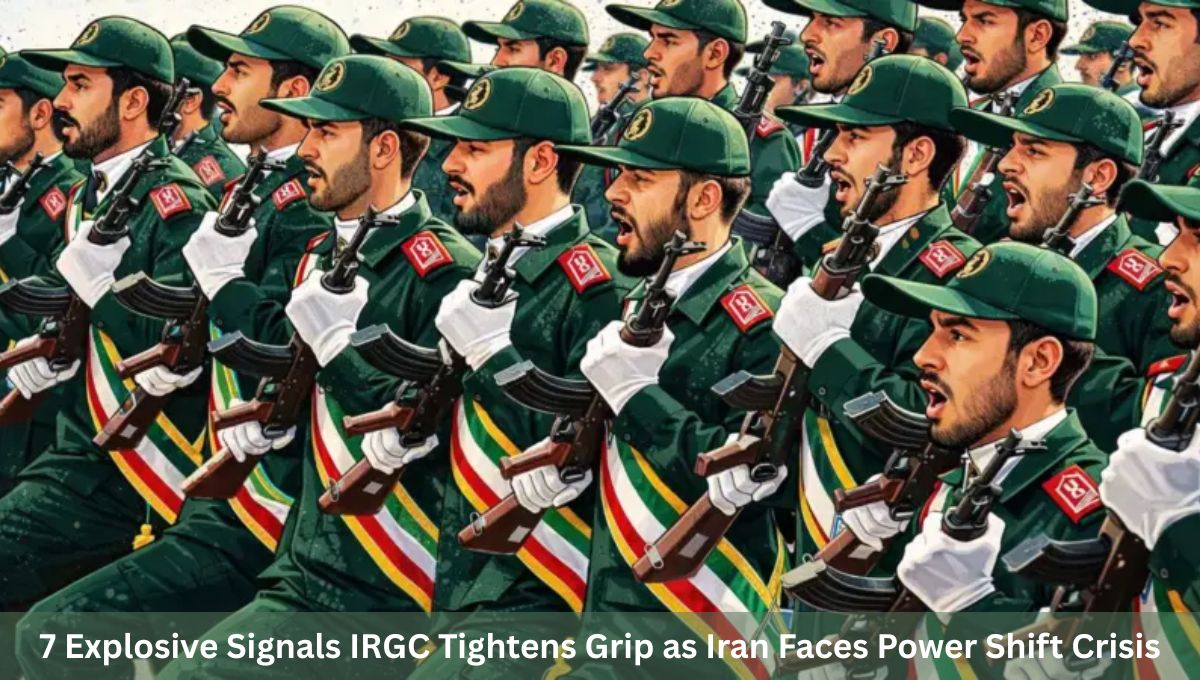
7 Explosive Signals IRGC Tightens Grip as Iran Faces Power Shift Crisis and restricts access to Mojtaba Khamenei. Iran is witnessing one of the most consequential internal power transformations in decades. Reports suggest that the Islamic Revolutionary Guard Corps (IRGC) has moved beyond its traditional military role to assert sweeping control over the country’s political and security apparatus.
Thank you for reading this post, don't forget to subscribe!This shift comes amid growing uncertainty surrounding Mojtaba Khamenei and signals a potential restructuring of governance in Tehran.
At the heart of this unfolding crisis is a widening gap between Iran’s civilian leadership and its powerful military-security establishment.
President Masoud Pezeshkian appears increasingly constrained, while IRGC commanders—particularly Ahmad Vahidi—are emerging as dominant decision-makers.
This article breaks down the evolving situation, the actors involved, and the broader geopolitical implications.
7 Explosive Signals IRGC Tightens Grip as Iran Faces Power Shift Crisis
The IRGC’s Expanding Role: From Military Force to Power Center
Originally formed after the 1979 Islamic Revolution, the IRGC was designed to protect the regime.
Over time, it evolved into a multi-dimensional institution with influence spanning:
- Military operations
- Intelligence networks
- Economic enterprises
- Regional proxy alliances
Today, analysts increasingly describe Iran not as a state controlling a military—but as a military-security system shaping the state.
The IRGC’s reach extends into:
- Domestic enforcement via the Basij militia
- Foreign operations through the Quds Force
- Strategic influence across Iraq, Syria, Lebanon, and Yemen
Decades of sanctions and conflict have paradoxically strengthened the IRGC, allowing it to build parallel structures that rival formal government institutions.
Civilian Leadership Under Pressure
President Masoud Pezeshkian’s administration is reportedly facing a “complete political deadlock.”
The clearest example came when his attempt to appoint a new intelligence minister was blocked.
IRGC Blocks Key Appointment
According to multiple reports:
- All proposed candidates, including Hossein Dehghan, were rejected
- IRGC leadership insisted on direct control over sensitive positions
- Wartime conditions were cited as justification
This move underscores a critical shift: decision-making authority is increasingly bypassing civilian channels.
In Iran’s political framework, the president typically operates with the Supreme Leader’s approval.
But with uncertainty surrounding Mojtaba Khamenei, that chain of authority appears disrupted.
Where Is Mojtaba Khamenei?
One of the most pressing questions remains unanswered:
Where is Mojtaba Khamenei, and how much control does he actually wield?
Reports indicate:
- He has not appeared publicly for weeks
- Access to him is tightly controlled by a military-security circle
- Communication with government officials is severely restricted
Some sources even suggest that he may be incapacitated, though no official confirmation exists.
This opacity has fueled speculation that real power has shifted away from the Supreme Leader’s office to a collective military leadership.
The Rise of a “Military Council”
Emerging reports point to the existence of a de facto governing structure composed of senior IRGC officials.
Key Features of This Power Structure:
- Controls access to the Supreme Leader
- Filters information reaching top leadership
- Blocks civilian decision-making
- Oversees critical appointments
This council-like mechanism resembles a centralized command system, where military priorities override political considerations.
Ahmad Vahidi: The Man at the Center
At the core of this transformation is Ahmad Vahidi, widely seen as the most influential figure in Iran today.
Why Vahidi Matters:
- Former Quds Force commander
- Deep ties to Iran’s regional proxy networks
- Strong advocate of hardline policies
- Key player in strategic decision-making
Vahidi’s influence now extends beyond military operations into:
- Diplomatic strategy
- Ceasefire negotiations
- Domestic political control
Analysts argue that he effectively defines Iran’s “red lines,” including:
- Preservation of missile capabilities
- Continuation of nuclear enrichment
- Maintenance of regional alliances
Internal Power Struggles Intensify
Iran’s leadership is not unified. Instead, multiple factions are competing for influence.
Hardliners vs Pragmatists
Hardliners (IRGC-aligned):
- Oppose negotiations with the United States
- Advocate continued confrontation
- View military pressure as leverage
Pragmatic Camp:
- Includes President Pezeshkian and Foreign Minister Abbas Araghchi
- Supports diplomacy to ease economic strain
- Seeks negotiated solutions
This divide has become increasingly visible in recent developments, particularly around negotiations and the Strait of Hormuz.
The Strait of Hormuz Crisis: A Case Study in Power Conflict
The Strait of Hormuz has become a focal point of Iran’s internal power struggle.
What Happened:
- Iran initially signaled the strait would remain open
- Civilian leadership supported this stance
- Military leadership reversed the decision
- The strait was effectively closed again
This rapid policy reversal highlights the limited authority of civilian officials.
It also demonstrates how strategic decisions are increasingly dictated by military priorities rather than diplomatic considerations.
Economic Pressures Driving the Crisis
Iran’s internal tensions are compounded by severe economic challenges:
- Ongoing US sanctions
- Disruptions to oil exports
- Inflation and unemployment
- Public dissatisfaction
The IRGC’s strategy appears focused on leveraging control over critical assets—especially oil routes—to counter external pressure.
Key Vulnerability: Oil Exports
Much of Iran’s economy depends on:
- Crude oil exports
- Shipping routes through the Strait of Hormuz
- Infrastructure like Kharg Island
Any disruption to these channels has immediate economic consequences.
Leadership Vacuum After Ali Khamenei
The reported death of Ali Khamenei has left a significant vacuum.
Historically, the Supreme Leader acted as:
- Final arbiter of disputes
- Unifying authority across factions
- Central figure in decision-making
Without that stabilizing force, Iran’s system is showing signs of fragmentation—or reconfiguration.
Is This a Coup?
Experts caution against labeling the situation as a traditional coup.
Instead, they describe it as:
- A gradual consolidation of power
- A long-term trend reaching its peak
- A structural shift rather than sudden takeover
The IRGC has been expanding its influence for years. Current developments may simply represent the culmination of that trajectory.
Impact on US-Iran Relations
The power shift has major implications for negotiations with the United States.
Key Challenges:
- Unclear decision-making authority
- Multiple competing power centers
- Reduced influence of diplomats
For the US, the central question is:
Who speaks for Iran?
Even if talks resume, reaching a binding agreement becomes significantly harder when authority is fragmented.
Regional Implications
A more dominant IRGC could reshape the Middle East in several ways:
Likely Outcomes:
- Increased military assertiveness
- Greater support for proxy groups
- Reduced willingness to compromise
- Escalation in regional conflicts
Countries across West Asia are closely watching these developments, as they could alter the balance of power.
Social and Political Changes Inside Iran
Beyond elite power struggles, subtle shifts are emerging within Iranian society:
- Changing protest dynamics
- Increased visibility of women in public demonstrations
- Growing dissent despite crackdowns
These trends suggest that internal pressures are not limited to the political elite.
The Role of the Supreme National Security Council
Another key institution gaining prominence is the Supreme National Security Council (SNSC).
Its Importance:
- Coordinates military and diplomatic strategy
- Includes both civilian and military leaders
- Acts as a central decision-making body
However, with IRGC influence rising, the council itself may be tilting toward hardline positions.
Future Scenarios
Several possible trajectories could emerge from the current crisis:
1. Full IRGC Dominance
The military consolidates complete control, sidelining civilian institutions entirely.
2. Hybrid Governance Model
A balance between military and civilian leadership, though heavily tilted toward the IRGC.
3. Internal Fragmentation
Power struggles intensify, leading to instability and competing factions.
4. Strategic Compromise
Economic pressures force a return to diplomacy and partial power-sharing.
Global Implications
The situation in Iran is not just a domestic issue—it has global consequences.
Key Areas of Impact:
- Oil prices and energy markets
- International shipping routes
- Nuclear non-proliferation efforts
- Regional security dynamics
Any escalation could ripple across global markets and geopolitical alignments.
Conclusion: A System Being Rewritten
Iran is not simply experiencing political instability—it is undergoing a fundamental transformation.
The rise of the IRGC as the dominant force signals a shift toward a more centralized, security-driven model of governance.
Civilian leadership, once the public face of the state, now appears increasingly constrained.
At the center of this transformation is uncertainty—around leadership, authority, and the future direction of the country.
Whether this leads to greater stability under military control or deeper internal divisions remains to be seen.
What is clear, however, is that Iran’s political system is being rewritten in real time—with consequences that will extend far beyond its borders.
Also Read: 7 Shocking Updates: IRGC Navy Chief Tangsiri Killed Amid Hormuz Crisis