
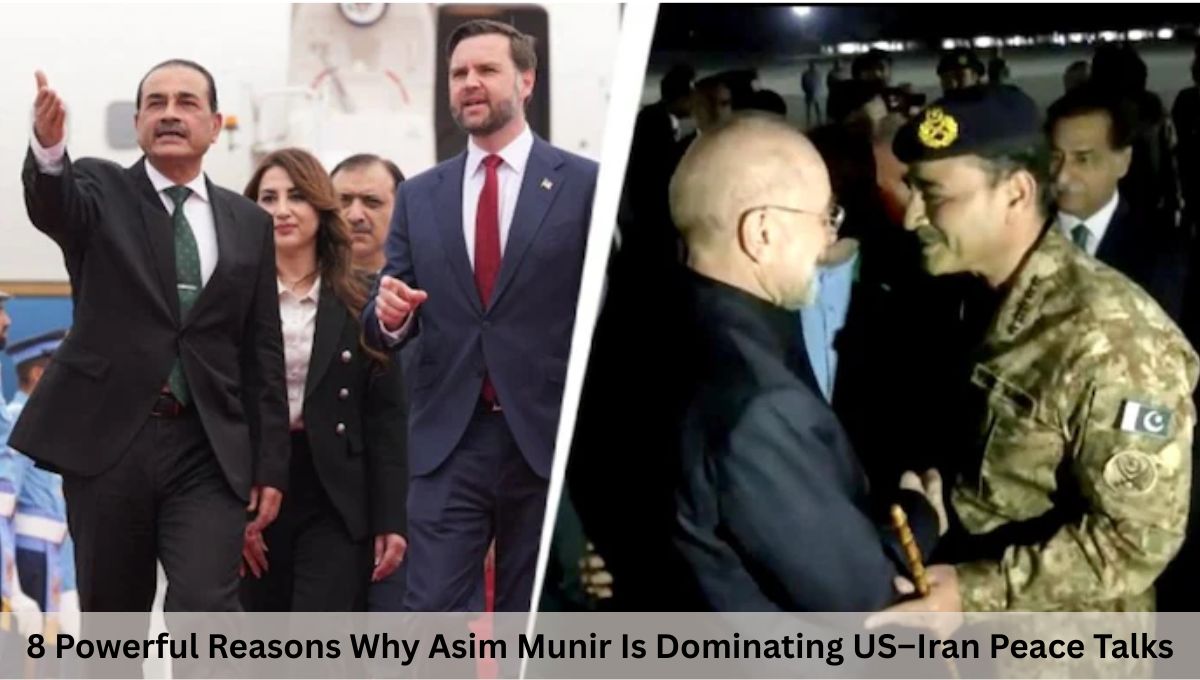
8 Powerful Reasons Why Asim Munir Is Dominating US–Iran Peace Talks and reshaping global diplomacy. In an unexpected geopolitical shift, Pakistan has emerged as a central mediator in one of the most high-stakes conflicts of recent times—the ongoing tensions between the United States and Iran.
At the heart of this diplomatic push stands Pakistan’s Army Chief, Asim Munir, who has rapidly transformed into a pivotal figure shaping negotiations between Washington and Tehran.
What makes this development particularly significant is not just Pakistan’s involvement, but the prominence of its military leadership in conducting diplomacy typically reserved for elected governments.
As the world watches closely, Munir’s role signals both an evolution in Pakistan’s foreign policy approach and a broader shift in global power dynamics.
8 Powerful Reasons Why Asim Munir Is Dominating US–Iran Peace Talks
Pakistan’s Rise as a Key Mediator
Pakistan’s emergence as a facilitator in US-Iran peace talks is both strategic and surprising.
Traditionally, such mediation roles have been dominated by global powers or neutral states with longstanding diplomatic channels.
However, Pakistan has leveraged:
- Its historical ties with Iran
- Strategic alignment with the United States
- Strong relationships with Gulf nations and China
This unique positioning has enabled Islamabad to act as a bridge between two deeply mistrustful adversaries.
Recent talks held in Islamabad marked the first direct engagement between US and Iranian officials in years, underscoring Pakistan’s growing diplomatic relevance.
Asim Munir: The Man at the Center
At the core of these developments is Asim Munir, whose influence extends far beyond traditional military responsibilities.
Key Highlights:
- Personally facilitated high-level meetings
- Engaged directly with US and Iranian leaders
- Led diplomatic outreach to Tehran
Munir’s presence at negotiations—greeting delegates, coordinating discussions, and conducting follow-up diplomacy—has positioned him as the primary interlocutor in the process.
His visit to Tehran further reinforced his central role, where he met senior Iranian leadership including Foreign Minister Abbas Araghchi and President Masoud Pezeshkian.
Trump’s Endorsement and Strategic Trust
US President Donald Trump has openly praised Munir, calling him a “great guy” and expressing confidence in his mediation efforts.
Trump’s remarks indicate:
- A strong personal rapport between the two leaders
- Trust in Pakistan’s ability to deliver results
- Willingness to elevate Pakistan’s diplomatic role
Notably, Trump has even suggested he might visit Islamabad if a deal is finalized there—an extraordinary signal of the importance being placed on Pakistan’s role.
The Islamabad Talks: A Turning Point
The recent 21-hour marathon talks in Islamabad marked a critical milestone in the peace process.
Outcomes:
- No immediate agreement reached
- Both sides agreed to continue negotiations
- Consideration of a ceasefire extension
Despite the lack of a breakthrough, the talks succeeded in narrowing differences and establishing a framework for future engagement.
Munir’s role during these discussions was widely acknowledged, as he facilitated communication and ensured continuity between the parties.
Shuttle Diplomacy in Action
Following the Islamabad talks, Pakistan intensified its diplomatic efforts through what analysts describe as “shuttle diplomacy.”
Munir’s visit to Tehran was part of this strategy:
- Delivering messages from Washington
- Exploring compromises on nuclear issues
- Building trust with Iranian leadership
Simultaneously, Pakistan’s civilian leadership engaged with Gulf countries, creating a multi-layered diplomatic approach aimed at securing regional support.
The Nuclear Sticking Point
At the heart of the negotiations lies Iran’s nuclear program—a deeply contentious issue.
Key Points of Disagreement:
- US proposal: 20-year enrichment freeze
- Iran’s position: 5-year limit
- Uranium stockpile: Approx. 440 kg of highly enriched material
Potential solutions being discussed include:
- Shipping uranium abroad
- Reducing enrichment levels
- Phased restrictions
Munir’s role has been crucial in bridging these gaps, with reports suggesting “major headway” in recent discussions.
Strait of Hormuz: The Economic Trigger
The conflict’s global impact is largely driven by tensions in the Strait of Hormuz.
This critical route handles:
- Around 20% of global oil supply
- Major shipping lanes for energy exports
Disruptions have led to:
- Surging oil prices
- Global inflation pressures
- Economic instability
A successful agreement could reopen the strait fully, offering immediate relief to global markets.
Power Dynamics Inside Pakistan
Munir’s prominence has also reignited debate over Pakistan’s internal power structure.
Observers note that:
- The military plays a dominant role in foreign policy
- Civilian leadership appears secondary in key decisions
- Strategic diplomacy is increasingly military-led
Visuals from Tehran—where Munir led the delegation and received top-level protocol—have reinforced perceptions of him as Pakistan’s de facto decision-maker.
Civil-Military Balance: A Longstanding Debate
Pakistan’s political system has long been characterized by a delicate balance between civilian governance and military influence.
Recent developments suggest a shift toward:
- Greater military involvement in diplomacy
- Centralized decision-making in security matters
- Reduced visibility of civilian leadership in high-stakes negotiations
While the government remains formally in charge, the execution of critical foreign policy initiatives appears increasingly driven by the military.
Global Reactions and Strategic Implications
Pakistan’s elevated role has drawn attention from global stakeholders.
Key Implications:
- Recognition as a credible mediator
- Strengthened ties with the US
- Enhanced influence in Middle Eastern affairs
However, challenges remain:
- Balancing relationships with competing powers
- Managing domestic political perceptions
- Ensuring neutrality in negotiations
Risks to the Peace Process
Despite optimism, several risks could derail progress:
1. Deep Mistrust
Decades of hostility between the US and Iran continue to hinder trust.
2. Nuclear Disagreements
Key differences on enrichment timelines remain unresolved.
3. Regional Tensions
Conflicts involving Israel and Hezbollah could complicate negotiations.
4. Economic Pressures
Sanctions and blockades add urgency but also increase tensions.
The Road Ahead
The coming weeks will be critical in determining the outcome of these negotiations.
Possible scenarios include:
- Extension of the ceasefire
- Breakthrough agreement on nuclear issues
- Collapse of talks and renewed escalation
Pakistan’s role, and Munir’s leadership, will be central to whichever path emerges.
Conclusion
The emergence of Asim Munir as a key figure in US-Iran peace talks marks a significant moment in global diplomacy.
It reflects not only Pakistan’s strategic positioning but also a shift in how international negotiations are conducted in times of crisis.
While challenges remain, the progress achieved so far suggests that a diplomatic resolution—once considered unlikely—may now be within reach.
Final Takeaway
Asim Munir’s rise from a relatively low-profile figure to a central player in global diplomacy underscores a broader truth:
in geopolitics, influence often lies not just in formal titles, but in the ability to build trust and deliver results.
If a breakthrough is achieved, it will not only reshape US-Iran relations but also redefine Pakistan’s role on the world stage.
Also Read: 9 Powerful Signals Behind Saudi Arabia Honoring Pakistan’s Army Chief
Also Read: Why Asim Munir is in Iran after failed Islamabad talks – What’s on agenda
Related Posts:
- 7 Powerful Facts About Ayatollah Ali Khamenei’s…
- 9 Explosive Claims as Trump Says US Winning Iran War

- 3 Explosive Conditions Iran Sets to End War with US…
- 5 Major Takeaways from the US Supreme Court's…

- 7 Shocking Reasons US Sees Asim Munir as a Strategic…
- Trump’s 20-Point Gaza Peace Plan Gains Urgent Global…
