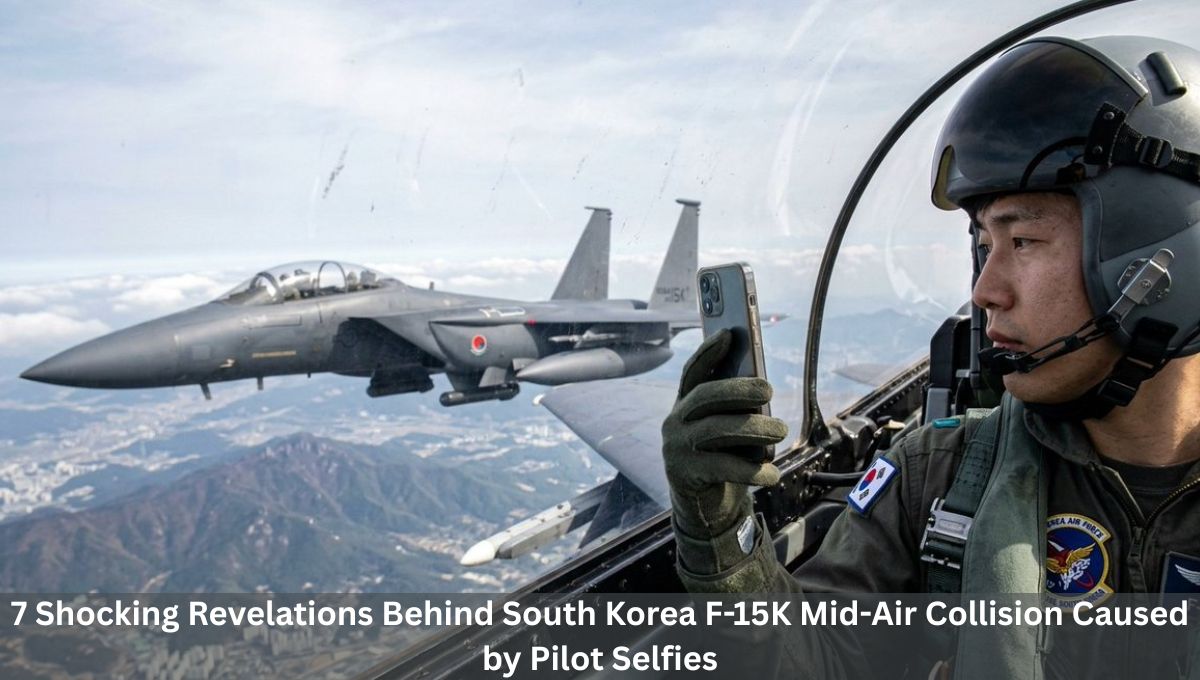
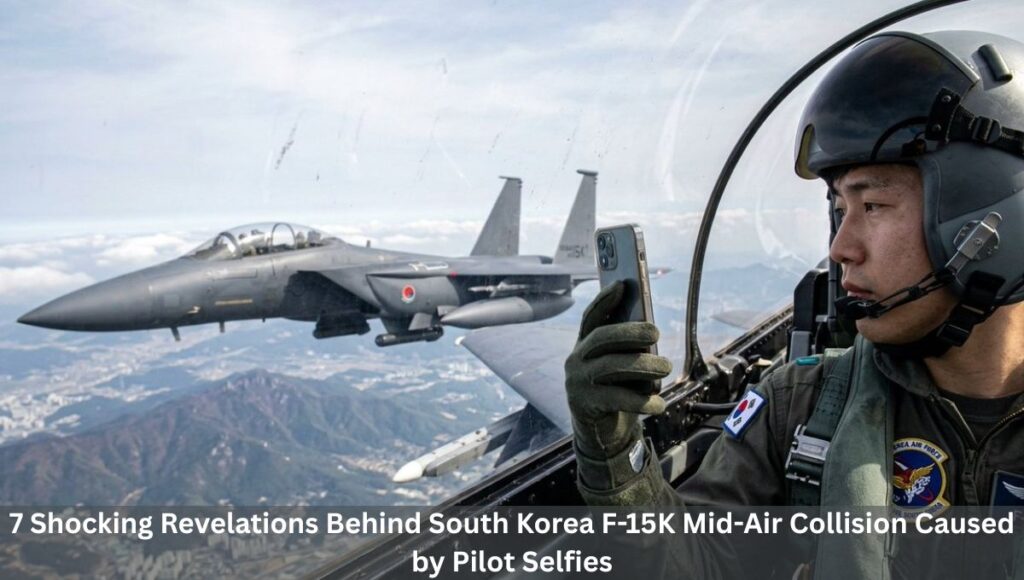
7 Shocking Revelations Behind South Korea F-15K Mid-Air Collision Caused by Pilot Selfies — air force apologizes. A startling revelation from South Korea has exposed how a moment of distraction at high altitude led to a costly and dangerous military aviation incident.
Thank you for reading this post, don't forget to subscribe!In what is now being described as a serious lapse in cockpit discipline, a 2021 mid-air collision between two advanced fighter jets was caused not by mechanical failure or combat stress—but by pilots attempting to take selfies and record videos mid-flight.
The findings, released by the Board of Audit and Inspection, have raised critical questions about operational discipline, safety protocols, and cultural practices within modern air forces.
7 Shocking Revelations Behind South Korea F-15K Mid-Air Collision Caused by Pilot Selfies
What Happened: A Routine Mission Turned Risky
The incident occurred in December 2021 during a routine formation flight involving two F-15K fighter jet aircraft near Daegu. The mission itself was standard—two jets flying in coordinated formation before returning to base.
However, the situation escalated when one of the pilots—flying as the wingman—decided to capture commemorative photos during what was reportedly his final flight before reassignment.
Key Timeline:
- Pre-flight: Pilot openly stated intention to take photos
- Mid-flight: Personal mobile phone used for photography
- Maneuver: Aircraft rolled and repositioned for better angle
- Result: Collision between tail stabilizer and wing
What followed was a chain reaction of poor judgment and miscommunication.
According to the audit report, the wingman pilot attempted to improve camera angles by performing an uncoordinated and risky maneuver. He sharply climbed and rolled the aircraft—at one point inverting it up to 137 degrees.
This was done without clearance or coordination with the lead aircraft. At speeds reaching approximately 578 km/h, even minor miscalculations can be catastrophic. In this case, the aircraft came dangerously close, leaving both crews with seconds to react.
Despite last-minute evasive actions:
- The wingman’s tail stabilizer struck the lead jet’s wing
- Both aircraft sustained structural damage
- Miraculously, both jets landed safely
Damage Without Casualties: A Costly Escape
While no lives were lost, the financial and operational damage was significant.
Damage Report:
- Total repair cost: ~880 million won (~$600,000)
- Wingman aircraft: 6 parts replaced
- Lead aircraft: 45 parts replaced
The absence of casualties does not diminish the severity of the incident. In military aviation, such close calls are treated as major failures of protocol.
Accountability: Who Was Responsible?
The audit placed primary responsibility on the wingman pilot, citing gross negligence. However, the findings did not stop there.
Pilot Consequences:
- Suspended from flying duties
- Subject to severe disciplinary action
- Ordered to pay ~88 million won (10% of damages)
- Eventually left military service
But the report also pointed to systemic issues.
Institutional Failure: A Culture of Cockpit Filming
One of the most concerning revelations was that in-flight photography was not an isolated act. The Republic of Korea Air Force was criticized for failing to regulate or prohibit personal filming during flights.
Audit Findings:
- In-flight photography was a “widespread practice”
- Lack of clear rules enabled risky behavior
- Supervisory oversight was insufficient
This suggests the incident was not just about one pilot’s mistake—but a broader cultural gap in enforcing discipline.
Why the Penalty Was Reduced
Initially, authorities ordered the pilot to pay the full repair cost. However, after appeal, the penalty was reduced to 10%.
Reasons for Reduction:
- Existing culture of cockpit photography
- Lack of strict enforcement by the Air Force
- Pilot’s prior clean service record
- Successful safe landing after collision
This nuanced judgment reflects shared responsibility between individual and institution.
Leadership Response: Apology and Reform
Following the report, the South Korean Air Force issued a public apology. “We sincerely apologise to the public for the concern caused by the accident.” More importantly, officials confirmed steps to tighten safety regulations.
Expected Reforms:
- Stricter bans on personal device usage in cockpit
- Enhanced flight discipline protocols
- Clearer chain-of-command communication rules
- Stronger accountability frameworks
Global Implications: A Wake-Up Call for Military Aviation
This incident resonates far beyond South Korea. Modern fighter jets are among the most advanced and expensive military assets in the world. Yet, even they are vulnerable to human error.
Key Lessons for Global Air Forces:
1. Technology Cannot Replace Discipline
Even with advanced avionics, pilot behavior remains critical.
2. Informal Practices Can Become Risks
What begins as harmless tradition—like commemorative photos—can escalate into safety hazards.
3. Clear Rules Are Non-Negotiable
Ambiguity in cockpit conduct leads to inconsistent decision-making.
4. Human Factors Still Dominate Aviation Risks
Distraction, overconfidence, and peer influence remain leading causes of incidents.
The Psychology Behind the Decision
From an aviation human factors perspective, this incident highlights classic risk behaviors:
- Normalization of deviance: Unsafe practices become accepted over time
- Mission completion bias: Task (photo) prioritized over safety
- Peer reinforcement: Lead pilot indirectly supported filming
These patterns are well-documented in both military and civilian aviation accident analyses.
Could This Have Been Prevented?
Yes—at multiple levels.
Prevention Points:
- Pre-flight command could have prohibited filming
- Clear SOPs (Standard Operating Procedures) could have stopped device use
- Better communication between pilots
- Strict enforcement of formation flight rules
This was not a technical failure—it was entirely preventable.
The Role of Leadership in Aviation Safety
Leadership plays a decisive role in shaping cockpit behavior.
In high-risk environments like fighter aviation:
- Rules must be explicit
- Violations must carry consequences
- Culture must prioritize safety over tradition
The audit’s finding that the Air Force bore partial responsibility is significant—it acknowledges that leadership gaps contributed to the incident.
A Broader Trend: Distraction in High-Stakes Environments
This case reflects a wider global issue—technology-driven distraction.
From commercial aviation to military operations, personal devices have introduced new risks:
- Unauthorized recordings
- Reduced situational awareness
- Divided attention during critical phases
Air forces worldwide are now reassessing policies on personal electronics in operational environments.
Final Takeaway: A Costly Lesson in Discipline
The 2021 F-15K collision stands as a powerful reminder that even elite pilots are not immune to poor judgment.
A single moment of distraction:
- Damaged multimillion-dollar assets
- Ended a military career
- Exposed institutional weaknesses
Yet, it also provides an opportunity. If acted upon seriously, this incident can strengthen aviation safety—not just in South Korea, but globally.
Conclusion
The mid-air collision involving South Korea’s F-15K jets was not just an accident—it was a systemic failure rooted in human behavior and organizational oversight. While the pilots walked away unharmed, the implications are far-reaching.
In an era where military precision is paramount, even small lapses can have outsized consequences.
The lesson is clear:
In aviation, discipline is not optional—it is survival.
Also Read: 7 Alarming Signals as North Korea Expands Nuclear Weapons Capacity
Also Read: $600K damage to fighter jets due to photo-taking pilot
Related Posts:
- Lufthansa Flight Flies Without Pilot for 10 Minutes…

- 7 Heartbreaking Facts About Venezuela's Earthquake Disaster
- 5 Major Takeaways from the US Supreme Court's…

- In 8 Moves, EU Targets China-Linked Refineries and…

- Afghanistan–Pakistan War 2025: Inside the 48-Hour Ceasefire

- 7 Powerful Facts About Ayatollah Ali Khamenei’s…