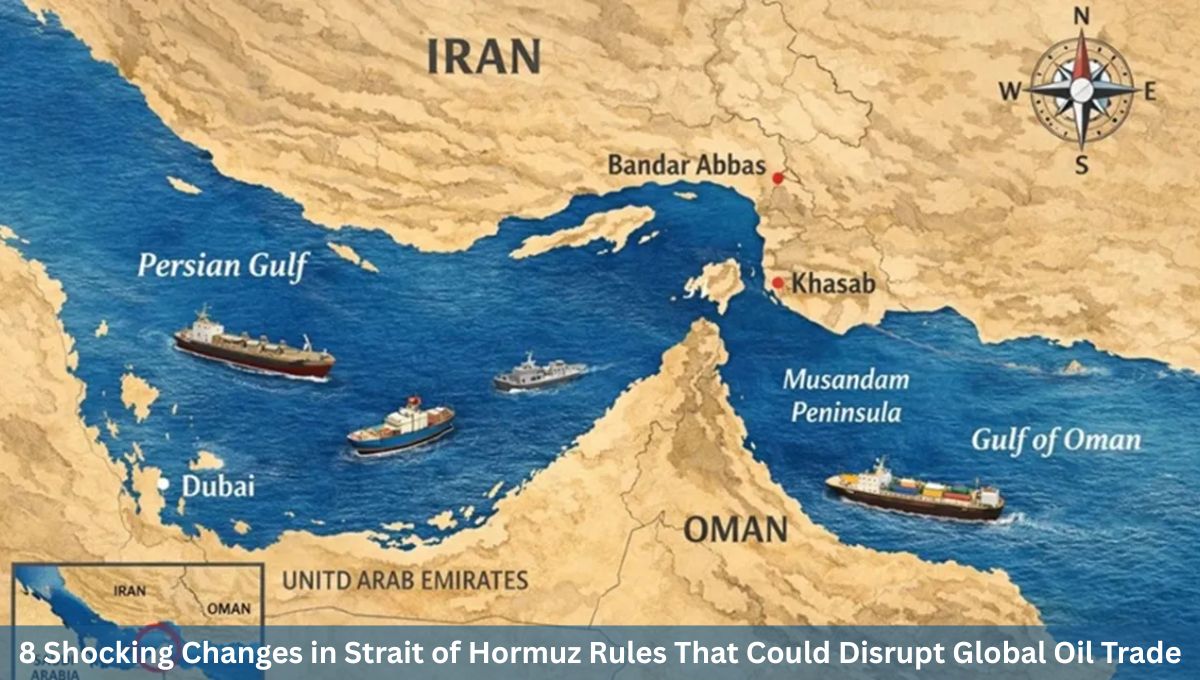
8 Shocking Changes in Strait of Hormuz Rules That Could Disrupt Global Oil Trade and shipping routes. The Strait of Hormuz, one of the world’s most critical energy chokepoints, is once again at the center of global attention—but this time, not because it is closed, but because of how it is being controlled.
Iran’s latest move to introduce security-linked transit fees and enforce tighter maritime rules signals a fundamental shift in how ships may operate through the narrow passage that carries nearly 20% of the world’s oil supply.
While Tehran has ruled out “traditional tolls,” the proposed system effectively reshapes access, raising serious questions for global trade, energy markets, and geopolitical stability.
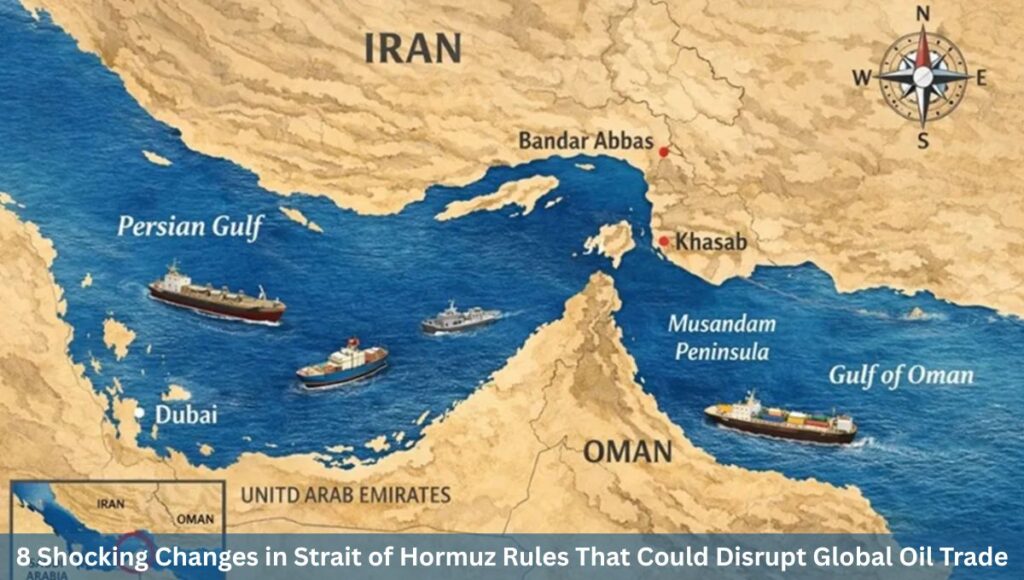
8 Shocking Changes in Strait of Hormuz Rules That Could Disrupt Global Oil Trade
What Exactly Is Iran Proposing?
Iran is drafting a new legal framework that would regulate ship movement through the Strait of Hormuz under stricter conditions.
Key Elements:
- No “traditional tolls” for passage
- New security-related fees for transit
- Mandatory coordination with Iranian authorities
- Passage limited to designated routes
- Authorization required before entry
According to Iranian officials, these measures are aimed at ensuring the “security” of the strait—but in practice, they give Tehran significant control over one of the world’s busiest shipping lanes.
A Controlled Strait, Not a Free Passage
Despite claims that the strait is “open,” the reality is more complex.
Iran has made it clear:
- Ships must follow routes defined by Tehran
- Transit requires prior approval
- Military vessels—especially from the US and Israel—are barred
Mohammad Bagher Ghalibaf emphasized that rules governing the strait will be determined “on the ground,” not by political statements.
This effectively transforms Hormuz from an international passage into a controlled corridor.
The “No Toll” Claim — What It Really Means
Iran insists it is not imposing traditional transit fees—but that distinction is largely semantic.
Reality Check:
- Fees may be charged under “security services”
- Reports suggest some ships already paid up to $2 million
- Charges could vary depending on cargo or origin
This model allows Iran to:
- Avoid violating international maritime norms directly
- Still generate revenue and enforce control
In effect, it behaves like a regulated toll system under a different name.
Three Key Conditions for Ships
Iran has laid out strict conditions for passage:
1. Only Commercial Vessels Allowed
Military ships are prohibited entirely.
2. No Links to “Hostile Nations”
Ships or cargo tied to adversaries may be denied entry.
3. Mandatory Coordination
All vessels must coordinate with Iranian authorities, including naval forces.
These conditions introduce political filtering into global trade routes, a major shift from standard maritime practice.
Impact on Global Oil Markets
The Strait of Hormuz is vital for transporting:
- Crude oil
- LNG (liquefied natural gas)
- LPG (liquefied petroleum gas)
Any restriction—even partial—has immediate consequences.
Likely Effects:
- Increased oil price volatility
- Supply chain disruptions
- Market uncertainty
Even after reopening, oil markets remain sensitive because the strait is no longer fully predictable.
Shipping Industry Faces New Risks
For global shipping companies, Iran’s policy introduces operational complexity.
Key Challenges:
- Delays due to authorization requirements
- Higher insurance premiums
- Risk of denial of passage
Shipping firms must now factor in:
- Political alignment risks
- Route compliance
- Additional costs
This could lead to:
- Reduced traffic
- Diversion to alternative routes (where possible)
- Higher global freight costs
The US-Iran Power Struggle Continues
The Strait of Hormuz remains a central battleground in the ongoing tensions between Donald Trump and Iranian leadership.
Conflicting Positions:
- US maintains naval blockade on Iran
- Iran rejects any US role in securing the strait
- Both sides claim influence over operations
This dual control narrative creates confusion for global shipping and undermines confidence in safe passage.
“Friendly vs Hostile” — A Dangerous Precedent
Iran’s classification of ships based on political alignment introduces a new risk.
Why It Matters:
- Trade routes become politicized
- Neutral shipping could face uncertainty
- Global commerce may fragment along geopolitical lines
This approach challenges long-standing principles of freedom of navigation.
Could Ships Use the Oman Route Instead?
Iran has floated a potential compromise:
- Allow ships to pass freely via the Omani side of the strait
Implications:
- Partial de-escalation
- Shared control of maritime flow
- Possible confidence-building measure
However, this depends heavily on:
- Progress in US-Iran negotiations
- Security assurances
- Removal of mines and risks
Economic Impact: Costs Will Rise
Even without formal tolls, costs are expected to increase.
Key Cost Drivers:
- Security coordination fees
- Insurance premiums
- Delays and rerouting
These costs will ultimately:
- Raise fuel prices
- Increase shipping rates
- Affect global inflation
Industries worldwide—from manufacturing to agriculture—will feel the impact.
A Shift in Maritime Power Dynamics
Iran’s new approach signals a broader strategic shift.
What It Means:
- Greater regional control over global trade routes
- Reduced Western influence in the Gulf
- Increased leverage in negotiations
The Strait of Hormuz is no longer just a transit route—it is becoming a strategic asset actively managed for political and economic gain.
Can Iran Legally Do This?
Under international law, straits used for global navigation are typically open to all vessels.
However:
- Enforcement depends on geopolitical realities
- Military presence shapes practical control
- Legal disputes take time to resolve
Iran’s approach sits in a grey zone—not fully compliant, but difficult to challenge in real time.
Market Reaction So Far
Markets initially reacted positively to the reopening:
- Oil prices dropped sharply
- Stocks rebounded
But uncertainty remains:
- Conflicting statements from both sides
- Continued military tensions
- Conditional access to the strait
This creates a volatile environment for investors and traders.
What Happens If Tensions Escalate Again?
Iran has warned it could close the strait again if:
- US naval blockade continues
- Ceasefire terms are violated
A renewed closure would:
- Trigger oil price spikes
- Disrupt global supply chains
- Increase geopolitical instability
The risk remains significant.
The Bigger Picture: A New Maritime Order?
Iran’s actions could signal the beginning of a new model of maritime governance in strategic chokepoints.
Emerging Trends:
- Conditional access
- Security-linked fees
- Political control over trade routes
If replicated elsewhere, this could reshape global shipping norms.
Conclusion
Iran’s decision to impose security-linked fees and tighter controls in the Strait of Hormuz marks a turning point in global trade dynamics.
While the strait is technically open, it is no longer free in the traditional sense. Instead, it operates under a controlled, conditional system that reflects shifting geopolitical realities.
For global markets, the implications are profound:
- Higher costs
- Increased uncertainty
- Greater political risk
The Strait of Hormuz has always been critical—but now, it is also contested, controlled, and strategically leveraged like never before.
Also Read: 10 Explosive Updates as Trump Orders Hormuz Blockade After Iran Talks Fail
Also Read: Iran reimposes restrictions on Strait of Hormuz over US blockade: What to know
Related Posts:
- 7 Critical Ways Iran’s Yuan Oil Plan Could Shake the…
- 9 Explosive Updates on Hormuz Transit Fees in…
- 10 Critical Risks if the Strait of Hormuz Closes…

- 7 Explosive Reasons Oil Prices Are Surging as Trump…
- 7 Critical Facts About Iran's Strait of Hormuz…
- 7 Powerful Reasons the U.S. Is Letting Countries Buy…