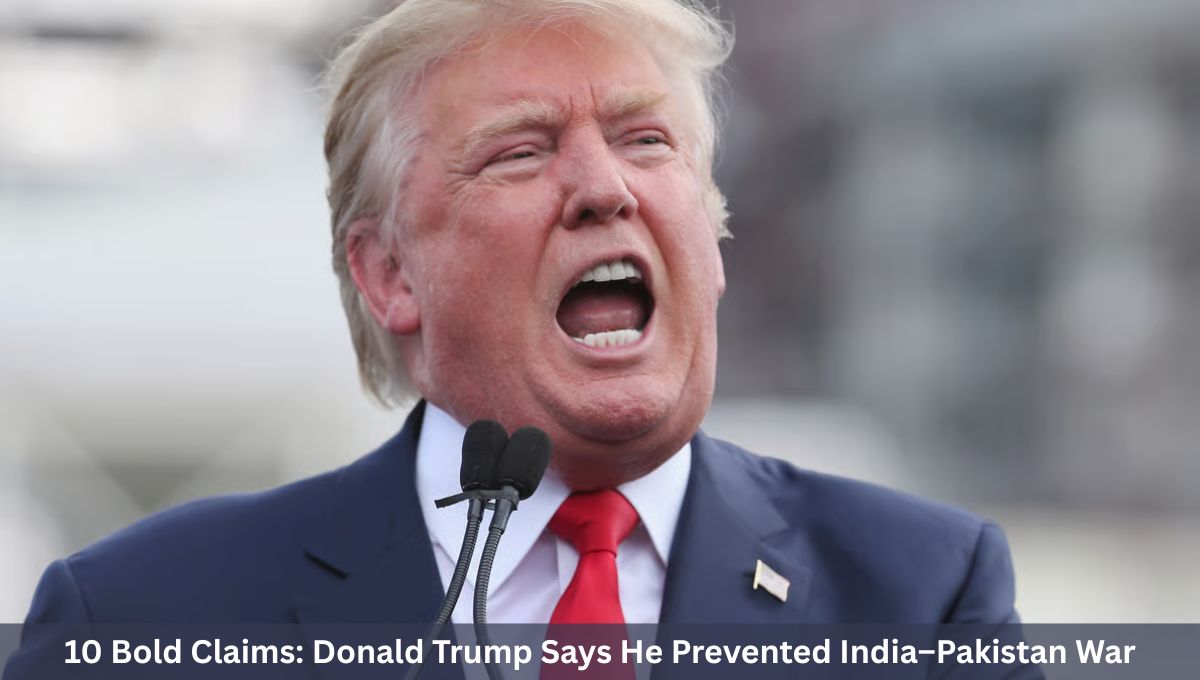
10 Bold Claims: Donald Trump Says He Prevented India–Pakistan War and ended global conflicts. In a fresh wave of controversial remarks, United States President Donald Trump has once again positioned himself as a global “peacemaker,” claiming credit for stopping multiple wars—including a potentially catastrophic conflict between India and Pakistan.
Thank you for reading this post, don't forget to subscribe!Speaking at a public event in Arizona, Trump asserted that his intervention prevented a war that could have resulted in the deaths of “30 to 50 million people.”
The statement has reignited debate across diplomatic and political circles, especially as neither India nor Pakistan has acknowledged any such external mediation.
These claims come at a time when global tensions remain high—from West Asia to Eastern Europe—and as new diplomatic efforts, including US-Iran talks, continue to unfold.
10 Bold Claims: Donald Trump Says He Prevented India–Pakistan War
Trump’s Expanding “Peacemaker” Narrative
Trump’s rhetoric has evolved over months. Initially claiming he had ended “eight wars,” he has now expanded that number to ten, including conflicts involving Iran and Lebanon.
“I am the peacemaker… I settled a war that would have killed 30 to 50 million people—India-Pakistan.”
This narrative has become a central part of his political messaging, portraying his leadership as uniquely effective in crisis resolution.
Key Conflicts Trump Claims to Have Influenced
Trump has repeatedly listed multiple global flashpoints where he claims to have played a role:
- India–Pakistan tensions
- Armenia–Azerbaijan conflict
- Serbia–Kosovo disputes
- Israel–Iran escalation
- Egypt–Ethiopia tensions
- Democratic Republic of Congo–Rwanda conflict
- Cambodia–Thailand tensions
- Israel–Lebanon ceasefire
By adding Iran and Lebanon, Trump now frames his record as “10 wars ended.”
India’s Firm Rejection of Mediation
Despite Trump’s repeated assertions, India has maintained a consistent and firm stance:
All issues with Pakistan are strictly bilateral.
New Delhi has historically rejected third-party mediation, especially from external powers, including the United States.
Why India Rejects External Mediation
- Sovereignty concerns
- Precedent in diplomatic policy
- Sensitivity around Kashmir
- Preference for direct bilateral engagement
There has been no official confirmation from Indian authorities supporting Trump’s claims.
Pakistan’s Silence and Strategic Position
Unlike India’s clear stance, Pakistan has not formally endorsed Trump’s statements either.
However, Pakistan has historically been more open to international mediation in disputes with India.
Even so, the absence of official validation suggests:
- No direct acknowledgment of US intervention
- Diplomatic caution amid evolving global dynamics
- Focus on broader strategic partnerships
The Context: Operation Sindoor and Regional Tensions
Trump’s remarks appear to reference tensions following Operation Sindoor, a period marked by heightened military activity between India and Pakistan.
What Happened?
- Escalation following a major attack
- Military responses from both sides
- Global concern over nuclear-armed neighbors
While tensions were serious, no public evidence confirms US-led mediation as decisive in de-escalation.
The Numbers Debate: Reality vs Rhetoric
Trump’s claim that 30–50 million lives were at stake has drawn scrutiny.
Expert Perspective
- India and Pakistan are nuclear powers, making escalation dangerous
- However, such casualty estimates are considered highly speculative
- Strategic deterrence often prevents full-scale war
Analysts argue that while risks were real, the numbers cited are politically exaggerated.
“Peace President” Branding
Trump has leaned heavily into the image of a global stabilizer.
On social media, he amplified a post labeling him:
“The Peace President”
This branding strategy aligns with his broader narrative:
- Strong leadership
- Deal-making ability
- Crisis resolution
However, critics argue this is more political messaging than verified diplomacy.
Contradictions in Global Claims
While Trump claims to have ended multiple conflicts, facts on the ground tell a more complex story.
Examples:
- Thailand–Cambodia tensions resurfaced after his claimed intervention
- Congo–Rwanda conflict remains unresolved
- Serbia–Kosovo did not experience a war during his term
This raises questions about whether these were truly “wars” or diplomatic tensions.
The Middle East Factor
Trump’s claims extend beyond South Asia into West Asia, where tensions remain volatile.
Iran and Lebanon
Trump recently stated:
- A ceasefire between Israel and Lebanon was achieved
- Progress is being made with Iran
However, regional actors—including Iran—have offered contradictory statements, particularly on issues like control of the Strait of Hormuz.
US–Iran Talks and Pakistan’s Role
Interestingly, Trump’s remarks coincide with:
- Upcoming US–Iran talks in Islamabad
- Pakistan’s growing role as a mediator
This adds another layer to the narrative:
- Trump praises Pakistan’s leadership
- Positions the US as central to global diplomacy
Yet again, outcomes remain uncertain.
Military Pressure vs Diplomacy
Despite projecting himself as a peacemaker, Trump has also issued strong military warnings.
Key Contradictions:
- Advocates diplomacy with Iran
- Maintains naval blockades
- Warns of military escalation if talks fail
This dual strategy reflects a mix of:
- Hard power
- Negotiation leverage
Global Reactions: Mixed and Skeptical
Trump’s claims have triggered varied reactions globally.
Supporters Say:
- He prioritizes negotiation over conflict
- His approach reduces escalation risks
Critics Argue:
- Claims are exaggerated
- Lack of independent verification
- Oversimplifies complex conflicts
The Strategic Importance of India–Pakistan Relations
The India–Pakistan relationship is one of the most sensitive in global geopolitics.
Why It Matters:
- Both are nuclear-armed nations
- Long-standing disputes, especially over Kashmir
- Frequent border tensions
Any claim of preventing war in this context carries significant weight—and scrutiny.
Media and Public Perception
Trump’s statements dominate headlines, shaping public perception.
Key Observations:
- High media visibility amplifies claims
- Social media accelerates narrative spread
- Fact-checking often lags behind
This creates a gap between perception and verified reality.
Political Strategy Behind the Claims
Trump’s assertions are not just diplomatic—they are political.
Possible Motivations:
- Strengthening leadership image
- Appealing to global stability voters
- Reinforcing “deal-maker” persona
This aligns with his broader communication style:
bold, direct, and often controversial.
The Risk of Overstatement
While projecting confidence can be politically effective, overstatement carries risks:
- Undermining credibility
- Straining diplomatic relations
- Creating unrealistic expectations
In international diplomacy, precision matters.
The Reality of Conflict Resolution
Ending wars typically involves:
- Multilateral negotiations
- Long-term diplomacy
- Ground-level agreements
Rarely does a single leader “end” a conflict unilaterally.
What Experts Say
Geopolitical analysts emphasize:
- Conflicts cited by Trump are complex
- Many remain unresolved
- Diplomatic credit is usually shared
This suggests a need for balanced interpretation of such claims.
The Bigger Picture: Global Stability
Trump’s statements highlight a broader issue:
The Fragility of Global Peace
- Rising geopolitical tensions
- Competing power blocs
- Economic and security pressures
Even small escalations can have global consequences.
Conclusion
Donald Trump’s renewed claim that he prevented an India–Pakistan war adds to his growing list of assertions about ending global conflicts.
While the narrative reinforces his image as a decisive leader, it remains largely unverified by the countries involved.
For global audiences, the key takeaway is this:
- Diplomacy is complex and multi-layered
- Claims of unilateral success should be critically evaluated
- Regional stability depends on sustained, collaborative efforts
As new negotiations—from South Asia to West Asia—continue to unfold, the world will be watching not just the rhetoric, but the real outcomes on the ground.
Also Read: 7 Shocking Reasons FIFA’s Peace Prize for Trump Sparks Outrage
Also Read: Extraordinary men: Trump lauds Munir, Sharif over India-Pakistan ceasefire credit
Related Posts:
- Can the EU and NATO Impose Tariffs on India and…

- Trump’s 20-Point Gaza Peace Plan Gains Urgent Global…

- Trump’s 2025 Gaza Peace Plan Signing and Historic…

- 10 Powerful Revelations from the Trump–Putin Call on…
- 7 Shocking Reasons FIFA’s Peace Prize for Trump…

- Trump Says He Deserves Nobel Peace Prize for Ending…