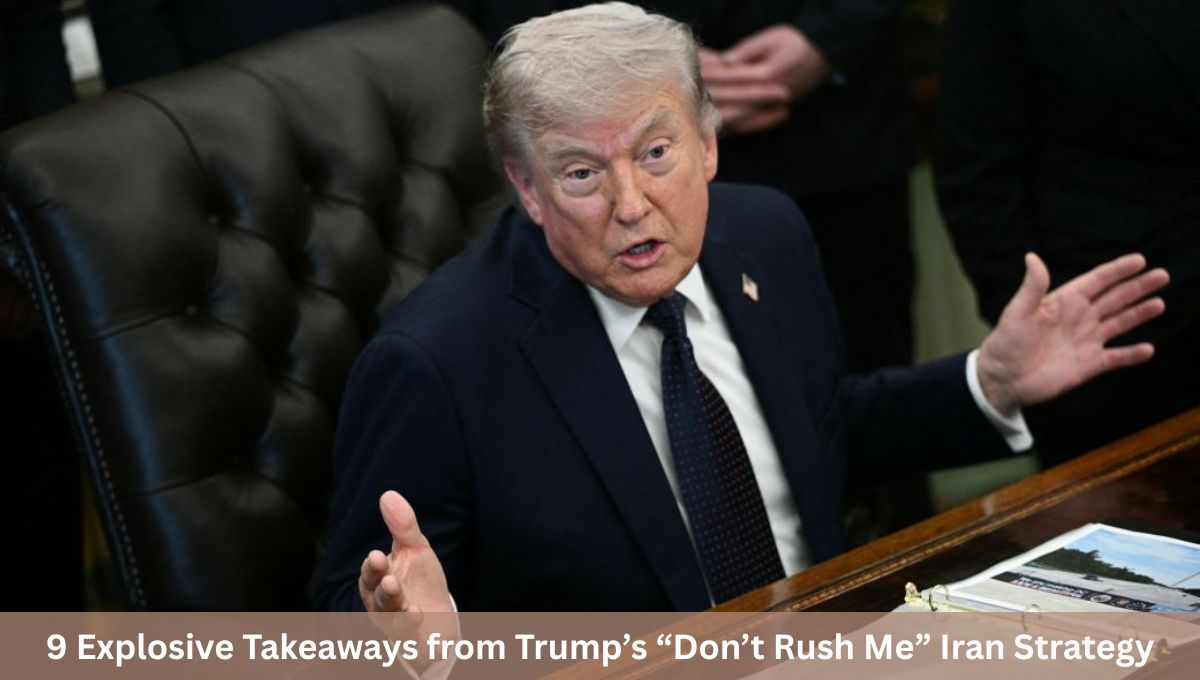
9 Explosive Takeaways from Trump’s “Don’t Rush Me” Iran Strategy that rules out nuclear strikes. The evolving standoff between the United States and Iran has entered a new and uncertain phase.
Thank you for reading this post, don't forget to subscribe!US President Donald Trump has made it clear:
he is in no hurry to finalize a deal with Tehran.
At the same time, he has ruled out the use of nuclear weapons while maintaining intense military and economic pressure.
This dual-track approach—strategic patience combined with aggressive leverage—has significant implications not just for the Middle East, but for global markets, security frameworks, and diplomatic norms.
Here’s a comprehensive breakdown of what Trump’s latest remarks reveal and what they mean for the world.
9 Explosive Takeaways from Trump’s “Don’t Rush Me” Iran Strategy
Trump’s Core Message: “Don’t Rush Me”
At the heart of Trump’s latest statement is a clear negotiating posture—time is a tool, not a constraint. Speaking at the White House, Trump dismissed any suggestion that he is under pressure to secure a quick agreement with Iran.
Key points:
- No fixed deadline for Iran to respond
- Preference for a long-term, “everlasting” deal
- Willingness to extend negotiations indefinitely
Trump framed urgency as a disadvantage, suggesting that Iran—not the United States—is under time pressure.
“I want to make the best deal. I could make a deal right now… but I don’t want to rush.”
This signals a classic pressure tactic:
delay resolution while tightening constraints on the opposing side.
Military Claims: “75% of Targets Hit”
Trump asserted that US military operations have already achieved most of their objectives.
According to his claims:
- 75–78% of intended targets have been struck
- Iran’s naval, air, and defense systems are largely neutralized
- Military pressure has forced Tehran toward negotiations
He described the campaign as highly effective and suggested that the remaining targets could be eliminated quickly if diplomacy fails.
“If they don’t want to make a deal, then I’ll finish it up militarily.”
Strategic implication:
The US is positioning itself as having escalation dominance—capable of ending the conflict on its terms.
Nuclear Weapons: Firm Rejection
One of the most significant elements of Trump’s remarks was his outright rejection of nuclear weapons.
His stance:
- No intention to use nuclear weapons
- Belief that conventional force is sufficient
- Assertion that nuclear weapons “should never be used”
“Why would I use a nuclear weapon… when we’ve totally decimated them without it?”
Why this matters globally:
- Reduces immediate fears of nuclear escalation
- Reinforces the role of conventional warfare
- Signals restraint despite aggressive rhetoric
However, the strong language also reflects confidence in US military superiority.
Economic Pressure: The Strait of Hormuz Lever
Trump highlighted the Strait of Hormuz as a key economic pressure point.
Key facts:
- A major portion of global oil flows through the strait
- Iran’s economy depends heavily on oil revenue
- Control over the strait directly impacts global energy markets
Trump stated that the US is deliberately keeping the strait restricted.
“If we open it, they make $500 million a day. I don’t want that until they settle this.”
Implications:
- Economic strangulation as a negotiation tactic
- Increased volatility in global oil prices
- Strategic use of maritime chokepoints
“Clock Is Ticking”—But Not for the US
Despite saying he is not in a hurry, Trump repeatedly emphasized that time is running out—for Iran.
Contradiction or strategy?
Not necessarily.
This is a negotiation framework where:
- The US projects patience
- Iran is portrayed as weakened and pressured
“I have all the time in the world… but Iran doesn’t.”
Effect:
- Shifts psychological pressure onto Tehran
- Reinforces US leverage in negotiations
Rising Military Presence in the Region
The US has significantly increased its military footprint in the Middle East.
Developments include:
- Deployment of a third aircraft carrier
- Expanded naval operations in key waterways
- Orders to aggressively counter Iranian maritime actions
Trump has even authorized direct action against threats in the Strait of Hormuz. Orders include targeting boats suspected of laying mines.
Strategic message:
- Deterrence through overwhelming presence
- Readiness for rapid escalation if needed
Iran’s Internal Situation: “Leadership in Turmoil”
Trump repeatedly claimed that Iran’s leadership is fragmented and struggling internally.
His assertions:
- Power struggles within Iranian leadership
- Lack of unified decision-making
- Pressure from military and economic losses
“They’re fighting like cats and dogs over control.”
Analytical view:
Even if exaggerated, internal instability:
- Weakens negotiation coherence
- Delays decision-making
- Increases unpredictability
Diplomacy in Limbo
Despite ongoing tensions, diplomacy has not collapsed—but it remains stalled.
Current situation:
- Talks delayed or canceled
- No clear timeline for resumption
- Both sides maintaining hardened positions
Trump’s approach suggests:
- Negotiations will continue—but on US terms
- Military and economic pressure will shape outcomes
Global Impact: Why This Matters Beyond the US and Iran
1. Energy Markets
- Strait of Hormuz disruptions affect global oil supply
- Price volatility impacts economies worldwide
2. Geopolitical Stability
- Increased risk of regional escalation
- Spillover effects into neighboring regions
3. International Diplomacy
- Shift toward pressure-based negotiation models
- Reduced reliance on multilateral frameworks
4. Security Dynamics
- Reinforcement of conventional military dominance
- Continued tension without full-scale war
The Strategic Equation: Pressure Without Escalation
Trump’s current doctrine can be summarized as:
Maximum pressure + Strategic patience + Controlled escalation
Components:
- Military dominance without nuclear use
- Economic pressure through energy chokepoints
- Deliberate delay in negotiations
This approach aims to force Iran into concessions without triggering a broader war.
What Happens Next?
Several scenarios are possible:
Scenario 1: Negotiated Deal
- Iran agrees under pressure
- Gradual de-escalation
Scenario 2: Prolonged Standoff
- Continued blockade and military presence
- No immediate resolution
Scenario 3: Renewed Conflict
- Breakdown of talks
- Completion of remaining military objectives
At present, Scenario 2 appears most likely.
Conclusion: A High-Stakes Waiting Game
Trump’s “Don’t rush me” stance reflects a calculated strategy rather than indecision.
By:
- Rejecting nuclear escalation
- Maintaining military pressure
- Leveraging economic choke points
the United States is shaping a negotiation environment where time itself becomes a weapon.
For global observers, the key takeaway is clear:
This is no longer just a conflict—it is a controlled geopolitical contest where patience, pressure, and perception will determine the outcome.
Also Read: 10 Explosive Insights into Trump’s NATO “Naughty List” Amid Iran War
Also Read: What does Trump mean when he warns, ‘Don’t rush me’ in Iran?
Related Posts:
- 9 Explosive Claims as Trump Says US Winning Iran War
- 11 Explosive Warnings as Trump Vows to ‘Knock the…

- Trump's 3 Blunt Warnings to China and Russia Over…
- 3 Explosive Conditions Iran Sets to End War with US…
- Trump’s 20-Point Gaza Peace Plan Gains Urgent Global…

- 11 Explosive Revelations From Ted Cruz’s Leaked…