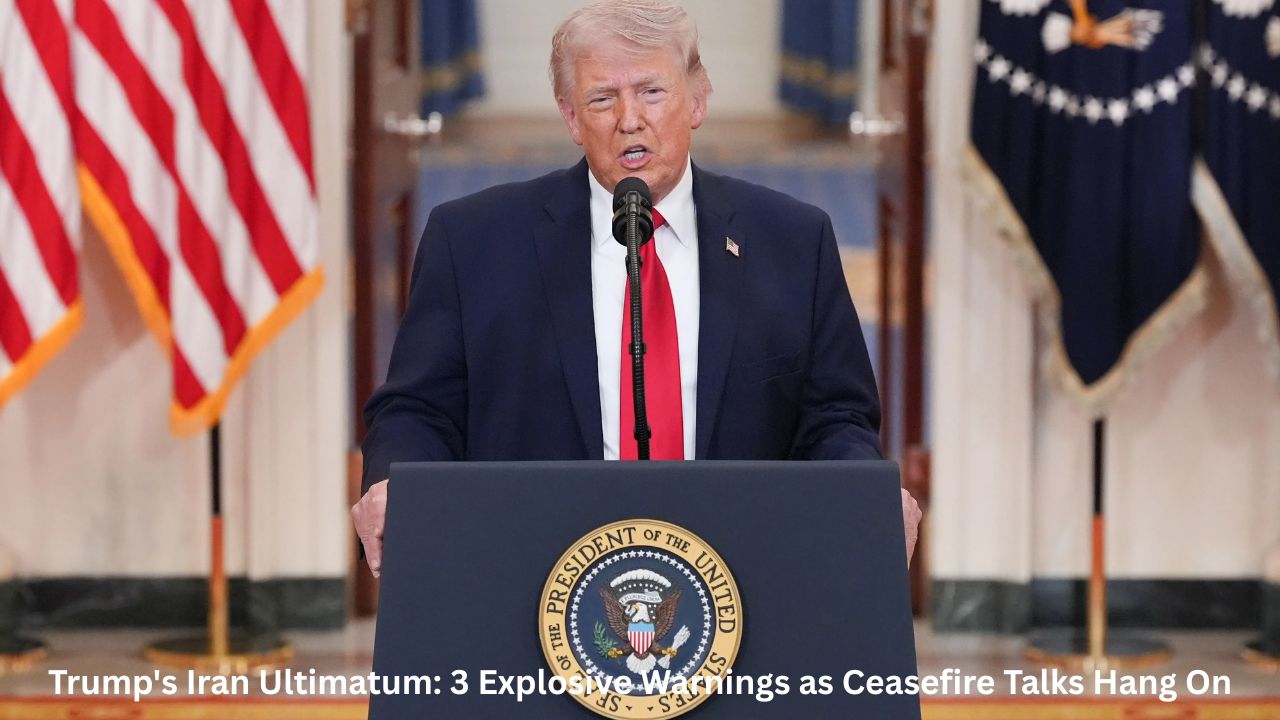
Trump’s Iran Ultimatum: 3 Explosive Warnings as Ceasefire Talks Hang On while mediators report major progress. A fragile calm has settled over the Middle East after weeks of intensifying US-Iran fighting — but President Donald Trump made clear on Monday that the pause is conditional, not permanent.
In a pointed new interview, Trump warned he is fully prepared to order a return to what he called “very strong military action” against Iran if ongoing negotiations collapse, even as regional mediators report genuine, significant progress toward ending the standoff. The warning lands at a delicate moment.
Trump halted a two-week US bombing campaign over the weekend, oil markets have rallied on hopes of de-escalation, and the president is set to sit down Tuesday with Israeli Prime Minister Benjamin Netanyahu for their first face-to-face meeting since the war with Iran began.
Here’s a full breakdown of where things stand, what Trump is actually threatening, and why this moment matters for the rest of the world.
Trump’s Iran Ultimatum: 3 Explosive Warnings as Ceasefire Talks Hang On
Trump Says the Pause Is Temporary, Not a Ceasefire
Speaking to reporters and in a separate interview, Trump confirmed he made the call to pause strikes on Iran specifically to give diplomacy one more shot — but he was blunt about what happens if that diplomacy fizzles out.
“We are in very deep talks with Iran. If they don’t work out, we will go back to very strong military action,” he said, framing the pause as a calculated risk rather than a genuine olive branch.
Asked directly how much patience he was prepared to show, Trump gave a characteristically terse answer:
negotiations would either move quickly or not happen at all.
It’s a signal that Washington views this window as narrow, and that the current quiet along the Strait of Hormuz could evaporate fast if talks stall.
Why Trump Paused the Bombing Campaign in the First Place
Perhaps the most revealing detail to emerge from Trump’s comments is exactly why he agreed to hold fire.
According to Trump, it wasn’t a change of heart about Iran, but a direct request from the countries mediating the crisis.
“All of the people that deal with Iran asked me:
‘Don’t fire,'” he said, adding that he believes Tehran genuinely wants to reach a deal.
Trump also pointed to tangible economic upside from the pause, noting that oil prices fell and stock markets rose once the bombing stopped — a “nothing gained, nothing lost” rationale, in his words, for giving negotiators more room to work.
That economic reasoning lines up with what markets actually did:
benchmark crude, which had briefly spiked above $100 a barrel for the first time since May, tumbled by more than 8 percent to trade just under $89 a barrel as the ceasefire held.
Two Weeks of Escalation That Led to This Moment
To understand why this pause matters, it helps to look at what preceded it. The US carried out 13 consecutive nights of intensifying bombing against Iranian targets, a campaign that provoked Tehran into firing on American bases in the region in response.
According to reporting on the internal deliberations, Trump’s own military leadership eventually told him the bombing campaign had run its course — reportedly amid concerns that the US was also running low on missile interceptors needed to defend against further Iranian retaliation.
Iran, for its part, has said it will hold off on its own attacks for as long as the American pause continues, and Tehran’s Foreign Ministry has stopped short of confirming any direct negotiations are underway, describing communications instead as messages passed through intermediaries.
The Mediators Racing to Save the Deal
Behind the scenes, a wide coalition of regional players is working overtime to keep the fragile de-escalation from unraveling.
The negotiations are primarily being run through channels between Iran and Oman, but Qatar, Pakistan, and Egypt are all actively involved, alongside Trump’s own envoys, Steve Witkoff and Jared Kushner.
Two regional officials briefed on the closed-door discussions described the progress achieved so far as “significant,” noting that mediators are specifically trying to hammer out a mechanism for managing commercial vessel traffic through the Strait of Hormuz — the narrow waterway that has been ground zero for the recent strikes and counterstrikes, and a critical corridor for global oil supply.
One senior US official reportedly described the indirect talks as having reached a “serious stage,” with both sides exchanging proposals even though no final agreement has been reached.
The ultimate goal, according to people familiar with the effort, is restoring an interim ceasefire framework that had earlier collapsed, and eventually relaunching broader talks on a comprehensive nuclear agreement with Iran.
Fragile Peace, Real Cracks Already Showing
Despite the diplomatic momentum, the so-called pause is already looking shaky in practice.
Even as the US and Iran refrained from direct strikes on each other for several days, other flashpoints kept flaring across the region.
Jordan reported shooting down two drones, and Iraqi security sources said a base used by Iranian Kurdish opposition fighters in northern Iraq was struck by drones as well — though no casualties were reported in either incident.
Adding another layer of complexity, Ukraine’s recent strike on an Iranian tanker in the Caspian Sea has further inflamed tensions, with Iran’s foreign minister alleging the attack was carried out at Israel’s urging and vowing retaliation.
It’s a reminder that even a US-Iran pause doesn’t necessarily calm every front connected to this wider standoff.
Trump’s Netanyahu Meeting: A High-Stakes First Encounter
Trump’s Iran comments arrive just one day before his first in-person meeting with Netanyahu since the war between Israel, the US, and Iran began.
The two leaders have not always been in lockstep on strategy, and Trump himself acknowledged some daylight between Washington and Israel over how firmly to handle Tehran, telling reporters the allies have “a little difference, but pretty close” alignment overall.
Ahead of the sit-down, Trump signaled he intends to make his own resolve clear to the Israeli leader, saying he plans to remind Netanyahu that were it not for his presidency, Iran likely would already possess nuclear weapons.
Netanyahu, for his part, said in a video statement before departing Israel that Iran will “top the agenda,” alongside Israel’s broader security posture and efforts to expand its circle of regional peace agreements.
Notably, both leaders are also expected to attend Tuesday’s funeral for Senator Lindsey Graham, a longtime, staunch ally of Israel and a vocal supporter of tough action against Iran, whose death has added a layer of political gravity to an already consequential week in Washington.
A Curious Wildcard: Trump’s Russia Comment
In one of the more unusual moments from his remarks, Trump said he intends to personally ask Russian President Vladimir Putin about reports that Moscow has been supplying satellite imagery to assist Iran. “I’ll ask Putin about it,” Trump said. “We’ll find out.”
The comment underscores just how tangled this crisis has become, with Russia’s war in Ukraine, Iran’s standoff with the US and Israel, and Washington’s broader diplomatic calendar all intersecting in the same news cycle.
What This Means for Global Markets and Audiences
For readers well beyond the region, the stakes here are considerable.
The Strait of Hormuz remains one of the world’s most important chokepoints for oil shipments, and any return to hostilities could send energy prices sharply higher again, just as markets had begun to relax.
A durable ceasefire, by contrast, would likely keep crude prices anchored near current levels and reduce the risk of a wider regional conflagration involving Israel, Gulf states, and potentially even shipping routes far beyond the immediate combat zone.
At the same time, Trump’s insistence on a tight timeline — “either it goes fast or not at all” — suggests global markets and diplomats alike should brace for more volatility in the days ahead rather than a quiet resolution.
Analysts note this isn’t the first time Trump has set a short deadline for Iran talks only to let negotiations drag on regardless, so how strictly he holds to his own ultimatum will be worth watching closely.
Why the Strait of Hormuz Keeps Coming Back Into Focus
It’s worth pausing on why so much of this negotiation centers on one narrow strip of water.
The Strait of Hormuz sits between Iran and the Arabian Peninsula and serves as the passage for a huge share of the world’s seaborne oil and gas exports.
Any disruption there doesn’t just affect the countries directly involved — it ripples through fuel prices, shipping insurance costs, and supply chains on nearly every continent.
That’s precisely why mediators are reportedly focused on building a workable system for safely managing vessel transit through the strait as a first, concrete step, even before tackling the far thornier question of a comprehensive nuclear agreement.
Getting commercial traffic moving again would be both a practical win and a powerful confidence-building measure for both sides.
Conclusion
The next few days will likely determine whether this fragile lull between the US and Iran becomes a genuine turning point or just another pause before renewed conflict.
With mediators from Oman, Qatar, Pakistan, and Egypt working urgently behind the scenes, oil markets cautiously optimistic, and Trump due to meet both Netanyahu and, separately, Ukrainian President Volodymyr Zelensky at the White House this week, Washington finds itself at the center of overlapping global crises.
Trump’s message is unambiguous:
diplomacy has a real chance, but if it fails, he says the US is ready to return to “very strong military action” without hesitation.
Whether that threat holds the ceasefire together — or accelerates its collapse — will become clear soon.
Also Read: 8 Explosive Developments as Trump Issues 48-Hour Ultimatum Over Hormuz Crisis
Also Read: Trump sets new ultimatum for Saudi nuclear deal: join Abraham Accords