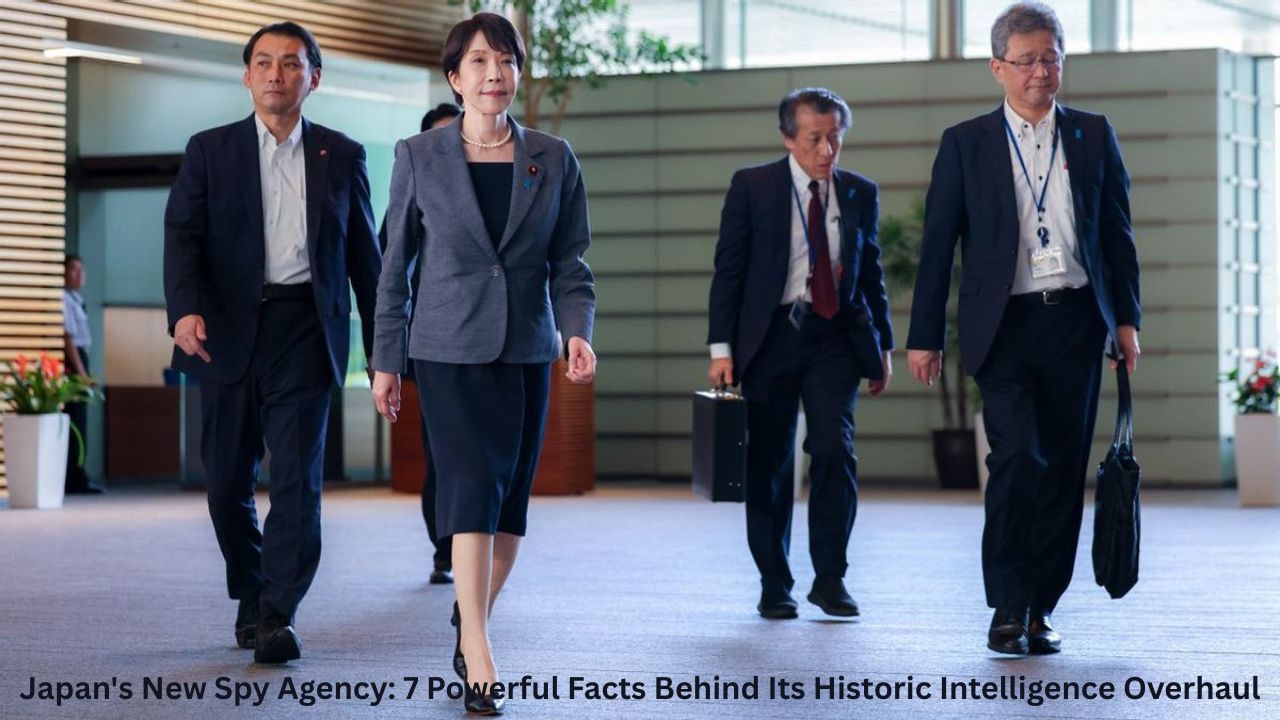
Japan’s New Spy Agency: 7 Powerful Facts Behind Its Historic Intelligence Overhaul since World War II. For the first time since the end of World War II, Japan has a single, centralized body dedicated to national intelligence. On July 31, 2026, the government of Prime Minister Sanae Takaichi formally launched the National Intelligence Bureau, alongside the first-ever meeting of a new National Intelligence Council chaired by Takaichi herself.
Thank you for reading this post, don't forget to subscribe!It’s a move decades in the making — and one that is already stirring debate from Tokyo to Beijing to Washington.
For a country that has long relied on a fragmented, checks-and-balances approach to intelligence gathering, this is a genuinely historic shift.
Below, we break down the seven most important facts about Japan’s new intelligence architecture, why it’s happening now, and why the reaction has been anything but quiet.
Japan’s New Spy Agency: 7 Powerful Facts Behind Its Historic Intelligence Overhaul
What Is Japan’s New National Intelligence Bureau?
The National Intelligence Bureau is an upgraded version of the Cabinet Intelligence and Research Office, Japan’s long-standing but comparatively low-powered intelligence coordination unit.
Rather than simply relabeling an old office, the government has given the new bureau statutory authority to pull together intelligence from across the Japanese government — including the National Police Agency, the Foreign Ministry, the Defense Ministry, and the Public Security Intelligence Agency — and to require those agencies to share what they know.
The bureau now serves as the secretariat for the National Intelligence Council, a ten-member body headed by the prime minister that will set the country’s overall intelligence priorities and begin drafting Japan’s first-ever National Intelligence Strategy.
7 Key Facts About Japan’s Historic Intelligence Overhaul
1. It’s Japan’s First Centralized Intelligence System Since WWII
Since 1945, Japan has deliberately kept its intelligence functions spread across multiple agencies, with no single body allowed to dominate.
That design wasn’t accidental — it was meant to prevent the kind of unchecked security apparatus that existed in prewar and wartime Japan.
The new bureau represents the most significant rewrite of that postwar arrangement in more than 80 years.
2. A Two-Tier Structure: Council and Bureau
Japan’s new system runs on two levels. The National Intelligence Council, chaired by Takaichi and including her top cabinet ministers, makes the big strategic calls.
The National Intelligence Bureau — staffed by roughly 730 personnel and led by veteran police official Kazuya Hara, 58 — does the coordinating and analytical work underneath it.
Hara’s background includes postings at Japanese embassies in Russia and the United States, along with time at the Defense Intelligence Headquarters, giving the bureau’s leadership a genuinely international résumé.
3. Built on Legislation Passed Just Months Earlier
The bureau didn’t appear overnight.
It follows the National Intelligence Council Establishment Act, which cleared Japan’s House of Representatives in April 2026 and the House of Councillors in May 2026, backed by the ruling Liberal Democratic Party and its coalition partner, the Japan Innovation Party.
The speed of that legislative process — from bill to fully operational agency in a matter of months — reflects just how much political capital Takaichi has put behind intelligence reform.
4. Part of a Much Bigger Security Reset
The new intelligence bureau isn’t an isolated policy tweak — it’s one piece of a broader security transformation under Takaichi.
Since taking office, her government has pushed Japan’s defense budget toward roughly 1.9% of GDP (about $58 billion for fiscal year 2026), on track to hit the long-discussed 2% threshold ahead of schedule.
In April 2026, Takaichi’s cabinet also lifted Japan’s decades-old ban on exporting lethal weapons, opening the door to arms sales to 17 partner nations with which Japan already has defense technology agreements.
Constitutional revision is reportedly next on the agenda, with a proposal targeted for 2027. Taken together, this is arguably the fastest overhaul of Japan’s postwar security posture in a generation.
5. Domestic Worries Over Privacy and Oversight
Not everyone in Japan is applauding.
Lawmakers, legal scholars, and members of the public have raised pointed questions about how much parliamentary or independent oversight the new bureau will actually face, how “national security information” will be legally defined, and what safeguards exist to protect ordinary citizens’ privacy and free expression.
Protests were held near Japan’s parliament, the Diet, while the legislation was being debated.
Some foreign academics — including Alexis Dudden, a historian at the University of Connecticut — have noted that the bureau’s ability to help shape legislation through the prime minister’s office marks a notable administrative shift, and that its mandate for handling domestic matters remains vaguely defined.
6. China’s Sharp Rebuke — and Japan’s Defense
Beijing didn’t stay quiet. Chinese Foreign Ministry spokesperson Mao Ning said Japan’s move represented a “negative” shift in the country’s security policy, arguing that Japan’s historical intelligence agencies had enabled “countless crimes” during its era of wartime expansion, and urged Tokyo to learn from history.
Chinese state commentary has gone further still, framing the bureau as evidence of a resurgent Japanese militarism.
Tokyo, for its part, has framed the reform very differently — as a practical, defensive response to a genuinely more dangerous regional environment, citing North Korean missile threats, rising cyberattacks, and pressure from China itself as the driving concerns.
Chief Cabinet Secretary Minoru Kihara called the council’s launch “the first step in intelligence reform,” positioning it as modernization rather than militarization.
7. This Is Only Phase One
Analysts are quick to note the new bureau’s current limits. Unlike America’s CIA, it does not run its own overseas human-intelligence network — making it structurally closer to the U.S. Office of the Director of National Intelligence, which coordinates existing agencies rather than running spies abroad. That may not be the end state, though.
The ruling coalition has floated creating a separate, dedicated foreign intelligence service by the end of fiscal year 2027, alongside new anti-espionage legislation and a possible registration system for foreign lobbyists and agents — both expected to be debated in next year’s ordinary Diet session.
Why Japan Is Making This Move Now
Japan’s calculation is straightforward, at least from Tokyo’s point of view:
the regional security picture has changed, and its intelligence machinery hadn’t kept pace.
North Korea continues to test and deploy missiles capable of reaching Japanese territory.
Beijing’s economic pressure tactics and growing military assertiveness around Taiwan and the East and South China Seas have alarmed Japanese officials.
Cyberattacks against government and corporate targets have become routine rather than rare.
Against that backdrop, having intelligence scattered across half a dozen agencies with limited coordination looked increasingly like a liability.
There’s also a regional dimension worth noting for a global audience:
the new bureau is expected to strengthen intelligence-sharing arrangements Japan already has with the United States and South Korea, including real-time missile-warning data sharing that has been in place since December 2023.
A more centralized Japanese intelligence system could make that three-way cooperation faster and more efficient.
A Lesson From History: Why Japan Waited So Long
This isn’t the first time a Japanese leader has tried something like this.
Back in 1983, then-Prime Minister Yasuhiro Nakasone warned that Japan had become a “paradise for spies” and pushed for anti-espionage legislation — including, controversially, the death penalty for offenders.
That proposal collapsed under public backlash, partly because memories of Imperial Japan’s wartime abuses were still raw enough that many citizens feared any expanded security apparatus could slide back toward surveillance and repression.
More than four decades later, according to analysts cited by CNN, the political and generational landscape has shifted enough that a centralized intelligence body is no longer the third rail it once was — even if unease about where the new system’s boundaries lie hasn’t fully disappeared.
Global Reactions and What Comes Next
International reaction so far breaks down fairly predictably.
Western outlets and defense analysts have largely described the bureau as an overdue modernization of an intelligence system that was, by most accounts, unusually decentralized for a major economy.
Chinese state media and officials have been the most vocal critics, casting the move as part of a broader pattern of Japanese remilitarization.
South Korean commentary has focused mainly on what the bureau means for trilateral security coordination with Washington and Tokyo.
What happens next will likely determine which narrative holds up better.
Japan’s promised National Intelligence Strategy, expected anti-espionage legislation, and the debate over a standalone foreign intelligence service will all test how the new bureau actually operates in practice — and how much independent oversight it’s genuinely subject to.
Conclusion
Japan’s National Intelligence Bureau marks the country’s most significant intelligence reform since the end of World War II, and it arrives as part of a much broader recalibration of Japanese defense policy — higher military spending, eased arms export rules, and a more assertive regional posture under Prime Minister Sanae Takaichi.
Supporters call it a necessary catch-up for a G7 economy facing real 21st-century threats. Critics, particularly in Beijing, see something more troubling in the making.
Either way, the debate over how Japan balances national security with democratic oversight and civil liberties is only just getting started — and it’s one the rest of the world will be watching closely in the months ahead.
Also Read: 7 Powerful Reasons Behind Japan’s Shocking Weapons Export Shift
Also Read: What is Japan’s new intelligence agency, and why is Tokyo building it?
Related Posts:
- Sanae Takaichi Becomes Japan’s First Female Prime…

- Japan 2025: Conservative Powerhouse Sanae Takaichi…

- 12 Explosive Shifts as Japan’s Iron Lady Takaichi…

- Anna Chapman — Putin’s Glamorous 43-Year-Old Spy Returns

- 5 Powerful Highlights as Trump Lands Second Nobel…

- 7 Alarming Signals in the China–Japan Clash Over PM…