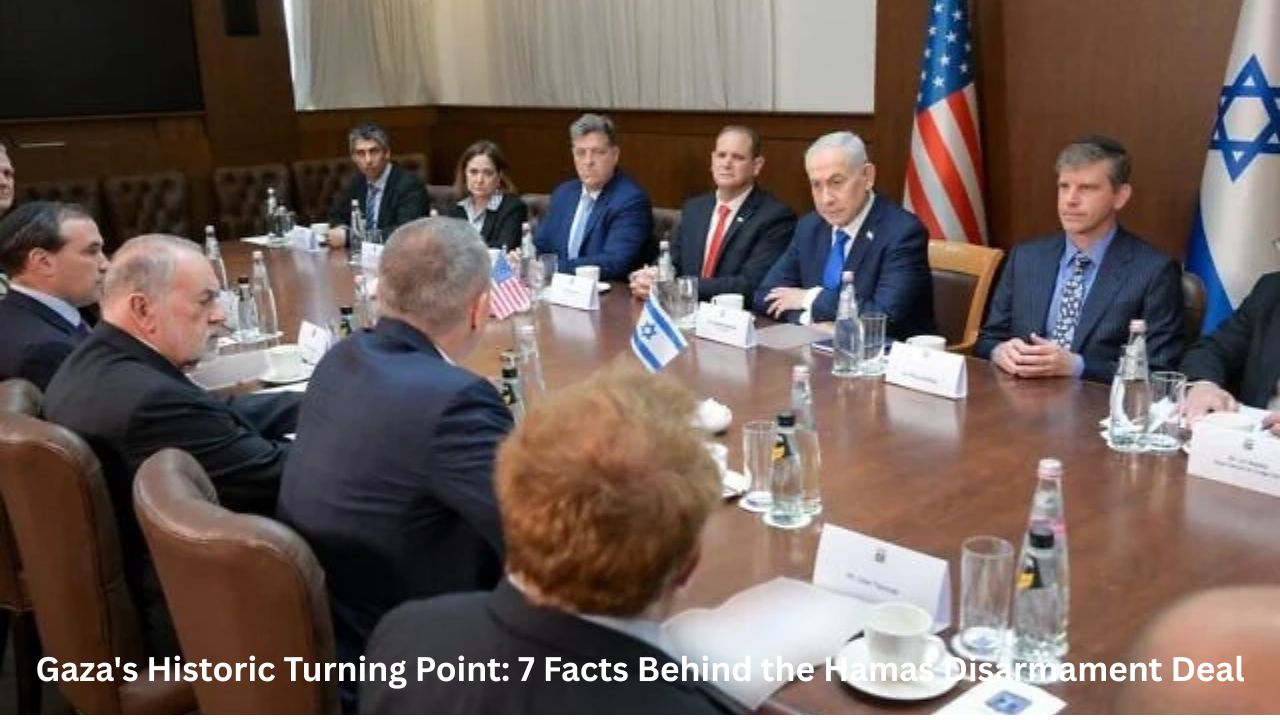
Gaza’s Historic Turning Point: 7 Facts Behind the Hamas Disarmament Deal under a new Trump-brokered framework. For the first time since the war began, Hamas has publicly agreed to give up its weapons in Gaza. It’s a moment that US President Donald Trump has hailed as historic — but on the ground, in Jerusalem, and across the wider Middle East, reactions range from cautious relief to outright rejection.
Nearly three years after Hamas’s October 7, 2023, attack triggered one of the deadliest conflicts in the region’s modern history, the announcement of a new disarmament framework has reopened questions that have hung over this war from the very start:
Will Hamas actually lay down its arms? Will Israel actually leave Gaza? And can anyone trust either side to follow through?
Here’s a complete breakdown of what’s actually in the new Gaza disarmament agreement, how each side is responding, and why this breakthrough could still collapse before it’s implemented.
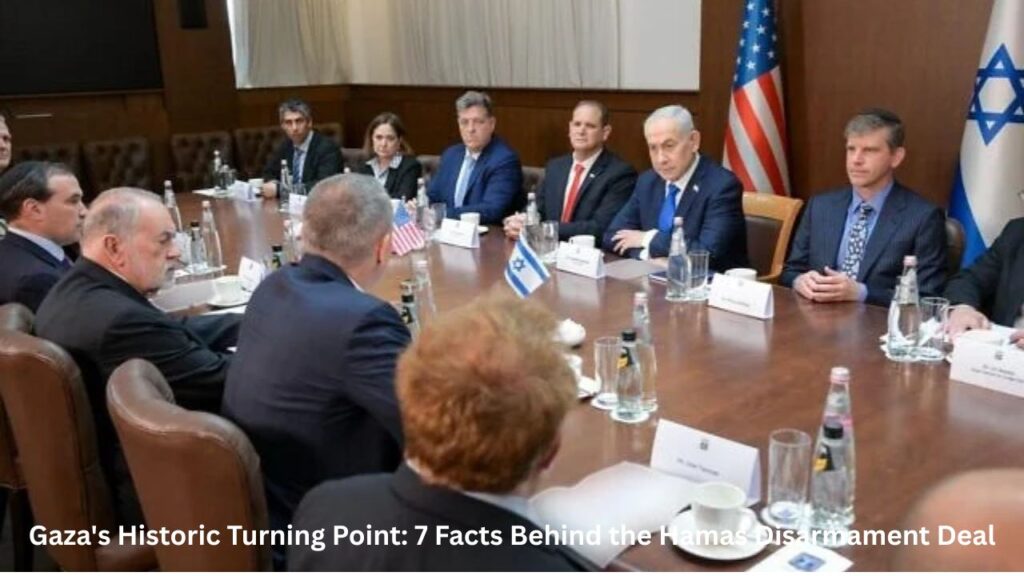
Gaza’s Historic Turning Point: 7 Facts Behind the Hamas Disarmament Deal
1. What the New Agreement Actually Says
The framework was unveiled through Trump’s “Board of Peace” initiative, the mechanism established earlier this year to oversee implementation of his broader 20-point Gaza peace plan.
According to details shared with reporters, the roadmap calls for Hamas to place its weapons into storage facilities that would be run by a newly vetted Palestinian police force, with security clearance handled by Israel’s Shin Bet and oversight provided by an international multinational force.
Gaza residents would still be permitted to apply for a personal handgun license under Palestinian law.
In exchange, Israel would carry out a phased troop withdrawal from the territory, gradually handing administrative control to a Palestinian technocratic government rather than to Hamas.
Trump described the vision as a Gaza where a new Palestinian police force takes responsibility for public safety, ultimately serving ordinary residents rather than an armed faction.
A two-week ceasefire window is currently in place to hammer out the finer details of how the handover would actually work.
If Hamas doesn’t begin the disarmament process within that window, officials say the ceasefire itself would be considered violated.
2. Hamas Says Yes — But With Conditions
Hamas has publicly confirmed it accepts the broad terms of the deal. However, the group has been clear that its cooperation is conditional.
Hamas has stated it will not disarm unless Israel fully withdraws its forces and dismantles what it describes as armed groups and militias operating under occupation.
The group has also demanded guarantees toward an eventual independent Palestinian state in Gaza — a demand Israel has long resisted.
This isn’t a simple handshake agreement. It’s a sequencing standoff: Israel wants to see disarmament before it withdraws, while Hamas wants withdrawal guarantees before it disarms. That gap is exactly where the deal’s biggest risk of collapse now sits.
3. Israel’s Response: Cautious, Conditional, and Politically Explosive
Israel has not formally endorsed the agreement, and its military posture reflects deep skepticism.
A senior Israeli defense source confirmed that troops will not pull back from the current front line — known as the Yellow Line — until Israel is satisfied that Hamas has undergone genuine, complete disarmament, not simply symbolic gestures.
Domestically, the reaction from Israeli politicians has ranged from wary to hostile.
Far-right National Security Minister Itamar Ben Gvir dismissed the framework outright, arguing that any pause in operations against Hamas commanders amounts to inviting future attacks.
Even centrist critics of Prime Minister Benjamin Netanyahu, including former military chief and election rival Gadi Eisenkot, argue the deal falls short of the “total victory” Israel has spent years pursuing, noting that Hamas has managed to rebuild much of its fighting force despite years of Israeli operations.
4. Netanyahu’s Impossible Balancing Act
Perhaps no one faces more political pressure from this deal than Netanyahu himself.
Israel heads into elections in late October, and analysts say the prime minister is now squeezed between two audiences he cannot afford to alienate:
Trump, who has publicly claimed Israel is “very happy” with the agreement despite clear signs to the contrary, and his own right-wing coalition partners, many of whom view any territorial withdrawal from Gaza as a betrayal of the war’s original goals.
A US official has already warned that Trump would be extremely disappointed if Israel is seen as obstructing the agreement.
Political analysts tracking Israeli public opinion say Netanyahu is unlikely to withdraw meaningfully from Gaza regardless of what he says publicly, and may instead rely on symbolic troop repositioning to keep Washington satisfied without alienating his base ahead of the vote.
5. A Deal That “Proves Everyone Right” — And Everyone Wrong
Israeli commentators have noted an unusual dynamic in how this agreement is being read: nearly every side of the debate over the war can point to it as vindication.
Israel’s long-standing argument — that Hamas’s continued armed presence in Gaza was the core problem — now appears to be echoed not just by Washington, but by regional mediators including Egypt, Turkey, and Qatar, all of whom backed a deal premised on the group giving up its weapons.
At the same time, the agreement’s vision of transferring Gaza to Palestinian civilian governance represents one of the most significant steps toward Palestinian self-administration proposed in two decades, a point not lost on Israel’s international critics who have accused it of seeking permanent control over the territory.
And within Israel itself, the deal simultaneously supports Netanyahu’s argument that military pressure forced Hamas’s hand, while also handing ammunition to critics who say he never achieved the decisive victory he long promised voters.
6. Voices From Gaza: Hope Mixed With Deep Distrust
For Palestinians living amid the war’s devastation, the announcement has landed with a complicated mix of emotions.
Mohammed Hamdouna, a displaced teacher from northern Gaza, said he hoped the region’s longest ordeal might finally be ending, but admitted he was afraid to fully believe it until aid, shelter, and open crossings actually materialize.
Others voiced deeper skepticism. A Gaza taxi driver living in a makeshift tent said he doubted the fighting would truly stop, arguing that past agreements have repeatedly broken down.
Meanwhile, residents have described moments of genuine, if fragile, relief — including families waking to news of the truce after years of displacement and loss.
Israeli strikes have reportedly continued in parts of Gaza even after the announcement, a reminder of how far the situation remains from a fully settled peace.
7. Global Reaction: Support, But With Heavy Caveats
International reaction to the disarmament announcement has been broadly positive, though hedged with caution.
Saudi Arabia’s Foreign Ministry welcomed what it called a historic step but stressed that a complete Israeli withdrawal, deployment of an international stabilization force, and uninterrupted humanitarian aid remain essential to the plan’s success.
The European Union’s foreign policy chief, Kaja Kallas, called the agreement a potentially constructive step, while cautioning that verifying Hamas’s compliance would be a major challenge and that Israel would eventually need to follow through on withdrawal.
United Nations Secretary-General António Guterres urged all parties to implement the roadmap without hesitation or attempts to undermine it.
The UK and Germany also welcomed the deal, with both governments emphasizing that real, verifiable progress — not just an announcement — is what will determine whether the plan actually holds.
What Could Derail the Deal
Several fault lines could still unravel this fragile framework. Hamas’s demand for statehood guarantees runs directly counter to Netanyahu’s public opposition to Palestinian sovereignty, a position with limited support among the Israeli public following the trauma of October 7.
Israel’s insistence on verifying “genuine” disarmament before any troop withdrawal gives it broad latitude to delay indefinitely if it chooses.
And with Israeli elections just months away, domestic politics could easily override diplomatic momentum, especially if coalition partners threaten to collapse the government over any perceived concession.
Continued Israeli military activity in Gaza, even amid the ceasefire, also raises questions about how “paused” the conflict really is on the ground — a concern echoed by Palestinians who say they’ve heard promises of peace before.
There’s also the question of enforcement. The plan relies on a multinational stabilization force to help oversee the disarmament process, but as regional analysts have pointed out, few countries have shown willingness to commit troops to a mission that could put them in direct contact with an armed and organized Hamas.
Without a credible force on the ground to verify that weapons have genuinely been surrendered rather than simply hidden or redistributed, both Israeli and international skeptics warn that “disarmament” could end up being more symbolic than real — leaving the door open for the conflict to reignite down the line.
Conclusion
This disarmament agreement represents the most significant diplomatic movement in the Gaza conflict in months, but “historic” doesn’t mean “guaranteed.”
Both sides have reasons to want this deal to succeed, and both sides have deep, unresolved reasons to distrust it.
Hamas wants Israeli withdrawal and a political future in Gaza; Israel wants proof of disarmament before it gives up any ground; and ordinary Gazans, after years of devastation, are left hoping for an outcome that has eluded them before.
With a two-week window now underway to finalize implementation details, the coming days will show whether this framework becomes the foundation for lasting peace — or another chapter in a conflict that has repeatedly defied resolution.
For a global audience watching the Middle East’s next chapter unfold, the message from this moment is clear:
cautious optimism, not celebration, is the appropriate response until weapons are actually surrendered and troops actually withdraw.
Also Read: Trump’s Gaza Warning: ‘Kill Hamas’ Threat After Ceasefire Deal
Also Read: All About Trump’s ‘Board Of Peace’ That Brokered Hamas Disarmament Deal
Related Posts:
- Trump’s 20-Point Gaza Peace Plan Gains Urgent Global…

- 12 Explosive Claims as Donald Trump Says Iran War…

- 10 Explosive Signals Trump Says Iran War Could End…
- 9 Explosive Signals as Trump Targets Cuba’s Oil…

- 7 Explosive Moments in the Trump–Macron Davos Showdown

- 7 Critical Signals Behind Trump’s Claim of a Ukraine…