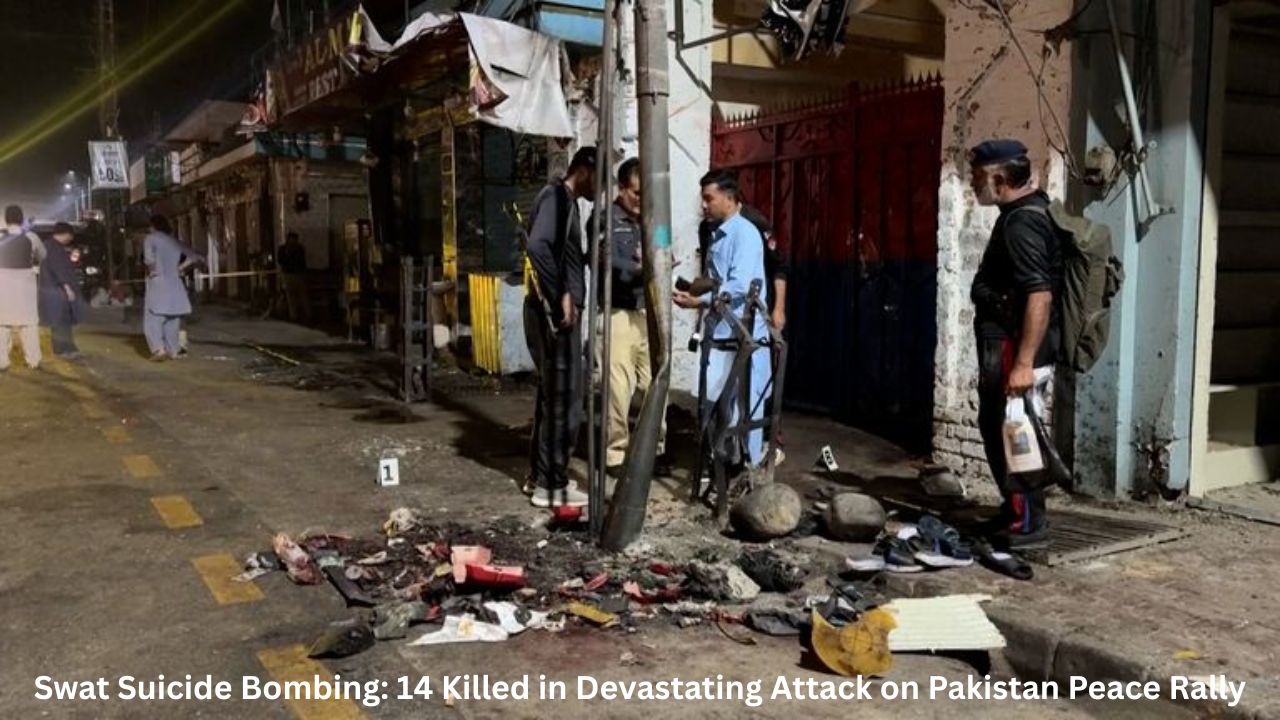
Swat Suicide Bombing: 14 Killed in Devastating Attack on Pakistan Peace Rally as violence surges across the Northwest. A suicide bomber tore through a crowd of demonstrators outside a police station in northwestern Pakistan on Sunday evening, killing at least 14 people and wounding dozens more in one of the deadliest attacks to hit the country in recent months.
The blast struck a rally that had gathered for the opposite reason it ended in — residents demanding an end to the very violence that ultimately took their lives.
The attack has reignited fear across Pakistan’s Khyber Pakhtunkhwa province, a region already reeling from a sharp resurgence of militant activity, and has once again turned global attention to the fragile security situation along the Afghanistan border.
Swat Suicide Bombing: 14 Killed in Devastating Attack on Pakistan Peace Rally
What We Know About the Attack
The Target: A Rally Against Militant Violence
The bombing occurred in Kabal, a town in the Swat Valley, where hundreds of local residents had gathered near a police station entrance to protest a recent surge in violence in the region.
According to witnesses, the demonstrators were chanting anti-militancy slogans and calling on the government to take decisive action against armed groups operating in the surrounding mountains.
Speakers had reportedly just finished telling the crowd that ensuring security was the state’s responsibility when the explosion tore through the gathering.
Swat’s District Police Officer, Umar Khan, said the bomber detonated his explosives after officers attempted to stop and search him at the entrance to the police station, suggesting security personnel may have inadvertently prevented an even larger tragedy by intercepting him before he reached the heart of the crowd.
Whether the rally itself was the intended target, or whether the attacker was aiming for the police station, remains unclear.
Casualties: A Rising and Uncertain Toll
Officials confirmed that at least 14 people were killed, a toll that Pakistani police said included five police officers and eight civilians, with the 14th victim believed to be the bomber himself.
The number of wounded has varied across reports as the situation developed through the night, with local officials citing figures ranging from around 18 to more than two dozen, some in critical condition.
Several of the injured were rushed to a hospital in the nearby city of Saidu Sharif.
The uncertainty in the casualty figures is typical in the chaotic hours following a mass-casualty attack, and authorities cautioned that the toll could still rise as rescue and identification efforts continued.
Where It Happened — and Why Swat Matters
For anyone unfamiliar with the region, Swat Valley’s name may not immediately register, but its history explains why this attack carries such heavy symbolic weight.
Once known for its natural beauty and tourism, Swat became a stronghold of the Pakistani Taliban in the late 2000s, when the group imposed a harsh version of Islamic rule over the valley, banning schooling for girls and carrying out public executions.
It took a major Pakistani military offensive in 2009 to drive the militants out and restore government control.
For over a decade, Swat came to symbolize a hard-won victory against extremism in Pakistan.
That is precisely why recent months have alarmed residents so deeply:
militants have begun resurfacing in the valley, circulating videos of their activities on social media and operating with growing visibility in the surrounding hills.
Sunday’s rally was one of a series of demonstrations local communities have organized specifically to push back against that resurgence — making the attack on the protest itself feel, to many residents, like a direct act of retaliation.
A Region Under Siege: Violence Is Surging Across the Northwest
Sunday’s bombing did not happen in isolation. It is the latest in a rapid string of attacks that have battered Khyber Pakhtunkhwa province in recent weeks.
Just three days earlier, an ambush using explosive-laden drones killed 11 police officers at a checkpoint in the district of Hangu.
Days before that, a car bombing in the nearby district of Tank killed 27 soldiers, an attack claimed by the Tehrik-e-Taliban Pakistan (TTP).
Researchers at the Pakistan Institute for Conflict and Security Studies recorded 154 “terrorism-related” deaths across the province in July alone — more than double the toll recorded in June.
On a national scale, Pakistan’s military said it has recorded over 3,100 terrorism incidents since the start of the year, with more than 800 Pakistanis, including soldiers, police officers, and civilians, killed in that period.
Military officials also said the country has faced 28 suicide attacks since January, many of which they attributed to Afghanistan-based militants.
Who’s Behind It? The TTP Question
As of the latest reports, no group has formally claimed responsibility for the Swat bombing.
Even so, suspicion has quickly turned toward the Tehrik-e-Taliban Pakistan, commonly known as the TTP, which has waged an insurgency against the Pakistani state since 2007 in an attempt to impose its own interpretation of religious rule.
The group is ideologically aligned with, but organizationally distinct from, Afghanistan’s ruling Taliban, and many of its fighters and leaders are believed to have found safe haven across the border since the Taliban returned to power in Kabul in 2021.
This is a distinction that matters for a global audience trying to make sense of the region:
Afghanistan’s government and the TTP are separate entities, but Pakistan has long accused Kabul of tolerating, or even quietly supporting, TTP fighters operating from Afghan soil — a charge the Afghan Taliban government consistently denies.
Government Response and Political Reactions
Pakistan’s top leadership moved quickly to condemn the attack.
President Asif Ali Zardari and Prime Minister Muhammad Shehbaz Sharif both issued statements expressing grief over the loss of life, offering condolences to victims’ families, and directing authorities to ensure the wounded received the best possible medical care.
In his statement, Sharif expressed “deep grief and sorrow over the suicide blast,” while both leaders vowed that Pakistan’s fight against militancy would continue until it was fully eradicated.
Interior Minister Mohsin Naqvi also issued a condemnation, and Swat police said they had launched a search operation and cordoned off the area to hunt for anyone who may have assisted the bomber.
One rally speaker, addressing the crowd shortly before the blast, had captured the community’s exhaustion after years of unrest, saying simply, “We have witnessed years of bloodshed.”
The Bigger Picture: Pakistan-Afghanistan Tensions
This attack lands against the backdrop of a deepening diplomatic rift between Islamabad and Kabul.
Pakistan has repeatedly accused the Afghan Taliban government of sheltering militant groups that plan and launch cross-border attacks, an allegation Afghanistan firmly rejects.
That dispute has already produced real consequences on the ground:
Pakistani air strikes on Afghan territory earlier this year reportedly killed dozens of civilians, according to both the Afghan government and the United Nations, further straining relations between the two neighbours.
For the wider region and international observers, the significance goes beyond a single bombing.
A resurgence of violence in a place like Swat — long held up as proof that hard-fought counter insurgency gains could last — signals that the broader security architecture in Pakistan’s northwest may be under real strain, with implications for regional stability, cross-border relations, and the safety of civilians caught in the middle.
What Happens Next
Pakistani authorities have promised a full investigation into Sunday’s bombing, and security forces are expected to intensify operations in and around Swat in the coming days.
Given the pattern of recent months, however, residents and analysts alike are bracing for the possibility that this will not be an isolated incident.
With casualty figures still being finalized, a claim of responsibility yet to surface, and diplomatic tensions with Afghanistan showing no sign of easing, the situation in Khyber Pakhtunkhwa remains fluid and closely watched.
Conclusion
Sunday’s bombing in Kabal stands as a grim illustration of the very crisis the victims had gathered to protest.
A community that once symbolized Pakistan’s ability to reclaim territory from extremism now finds itself confronting the same threat all over again, with ordinary residents and police officers bearing the human cost.
As investigators work to identify the perpetrators and the wounded recover in hospitals across the region, the attack serves as a sobering reminder that despite years of military gains, the fight against militancy in this corner of South Asia is far from over — and its consequences continue to ripple well beyond Pakistan’s borders.
Also Read: 11 Devastating Facts About the Islamabad Mosque Suicide Blast That Shook Pakistan