7 Dead in Explosive Iran Protests as Economic Anger Boils Over under heavy security. Iran is facing its most serious wave of unrest in nearly three years as protests over a collapsing economy and soaring inflation have turned deadly across several provinces.
What began as demonstrations by shopkeepers over a sharp fall in the Iranian rial has rapidly escalated into nationwide protests involving students, merchants, and ordinary citizens, with chants increasingly targeting the country’s political leadership.
At least seven people have been killed in clashes between protesters and security forces, according to Iranian media, rights groups, and international news agencies. Deaths have been reported in cities including Lordegan, Kuhdasht, Isfahan, and Azna, underscoring how quickly the unrest has spread beyond Tehran into rural and provincial areas.
The protests mark the largest demonstrations Iran has seen since the mass unrest of 2022 and 2023, when the death of Mahsa Amini in police custody sparked nationwide outrage.
While the current wave of protests was triggered by economic hardship, it has increasingly taken on political overtones, with demonstrators openly challenging the authority of Supreme Leader Ayatollah Ali Khamenei.
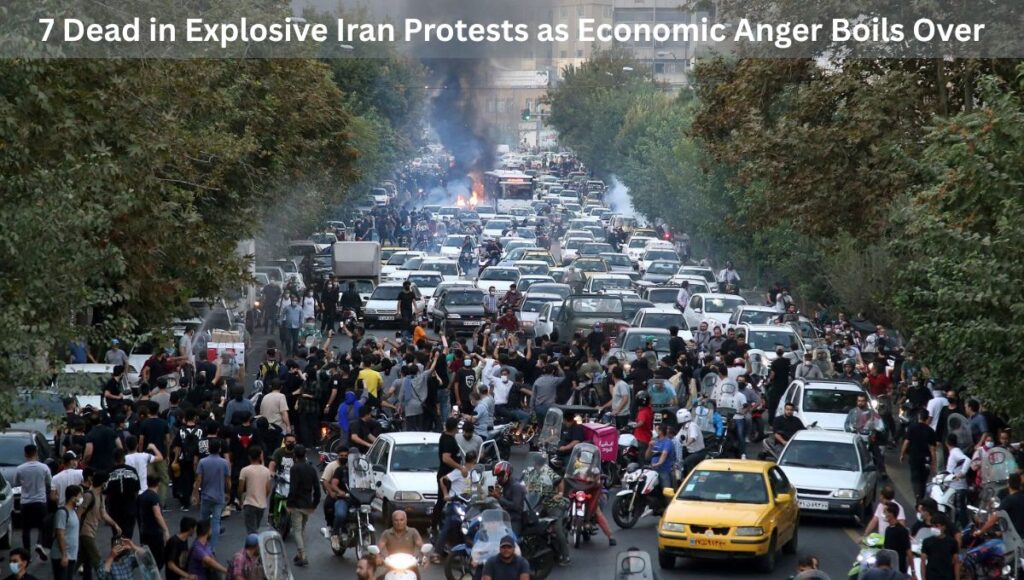
7 Dead in Explosive Iran Protests as Economic Anger Boils Over
Protests Ignite Over Soaring Prices and Currency Collapse
The latest unrest began on Sunday when shopkeepers in Tehran and other major cities closed their businesses and took to the streets to protest the government’s handling of a sharp currency slide and rapidly rising prices.
The Iranian rial has lost roughly half its value against the US dollar in 2025, while official inflation reached 42.5 percent in December, placing immense pressure on household budgets.
Merchants complained that the falling currency has made imports unaffordable, wiped out savings, and pushed the cost of basic goods beyond the reach of ordinary Iranians. Within days, the protests spread from bazaars to university campuses, with students at more than ten universities joining demonstrations.
As anger grew, protests moved beyond economic demands. Chants such as “Death to the dictator” echoed through parts of Tehran, signaling a broader challenge to Iran’s theocratic system and its leadership.
Violence Erupts as Protests Spread Nationwide
What initially began as largely peaceful demonstrations soon escalated into violent confrontations with security forces. Semi-official Iranian news agency Fars and rights groups reported fatalities and injuries as clashes broke out in several provinces.
In Lordegan, a city in Chaharmahal and Bakhtiari province, Fars reported that two people were killed during clashes between protesters and security forces. The agency claimed that some demonstrators were armed, while rights group Hengaw said several people were killed or wounded by security forces.
Further violence was reported in Kuhdasht, a western city in Lorestan province, where Iranian authorities confirmed the death of a member of the Basij, a volunteer paramilitary force affiliated with the Islamic Revolutionary Guard Corps (IRGC).
The Revolutionary Guards said the Basij member was killed while defending public order and accused demonstrators of exploiting the protests.
Hengaw, however, identified the man as Amirhossam Khodayari Fard and said he had been protesting and was killed by security forces, highlighting the conflicting narratives surrounding the deaths.
In Isfahan province, Hengaw reported that a protester was shot dead on Wednesday. Reuters said it could not independently verify these claims.
Azna and Lorestan: Clashes Turn Deadly
Additional fatalities were reported in the city of Azna in Lorestan province, where Fars said at least three people were killed and 17 others injured during protests that included an attack on a police station.
According to the agency, protesters set fire to police vehicles and clashed with officers, prompting the use of tear gas.
Videos circulating online appeared to show gunfire, burning debris in the streets, and crowds shouting slogans such as “Shameless! Shameless!” as tensions boiled over.
Iranian state television also reported that a 21-year-old member of the Basij was killed overnight during protests in Kuhdasht, citing local officials. Authorities described protesters as “rioters” and warned against turning economic demonstrations into acts of insecurity.
Students and Merchants Drive the Unrest
A defining feature of the current protests is the coalition of groups involved. Merchants, shop owners, and students have emerged as the backbone of the demonstrations, shutting down key bazaars and disrupting daily life across multiple cities.
University campuses have become focal points for dissent, with students chanting slogans against the government and expressing solidarity with broader economic grievances. In Tehran, demonstrators were heard chanting slogans in support of Reza Pahlavi, the son of the late Shah Mohammad Reza Pahlavi, who was overthrown during the 1979 Islamic Revolution.
As chants of “Long live the Shah” rang out in parts of the capital, Reza Pahlavi, who lives in exile in the United States, posted a message on X expressing support for the protesters. “I am with you. Victory is ours because our cause is just and because we are united,” he wrote, adding that Iran’s economic situation would continue to deteriorate as long as the current regime remains in power.
Government Declares Holiday Amid Shutdowns
As protests intensified, authorities declared a nationwide holiday on Wednesday, citing cold weather and the need to save energy. Critics said the move was aimed at limiting demonstrations by shutting down businesses, banks, and government offices.
Major bazaars in several cities remained closed for days as merchants refused to reopen, amplifying the economic impact of the unrest. Activist news site HRANA and rights groups reported detentions of demonstrators in provinces including Kermanshah, Khuzestan, and Hamedan.
Despite the arrests and heavy security presence, protests continued in multiple regions, signaling deep and widespread frustration.
Iran’s Economic Crisis at the Heart of the Protests
At the core of the unrest is Iran’s prolonged economic crisis. Years of US and Western sanctions linked to Tehran’s nuclear program have crippled the economy, restricting oil exports, limiting access to foreign currency, and isolating the country from global financial systems.
Inflation has surged above 40 percent, eroding purchasing power and pushing millions closer to poverty. The rial’s dramatic depreciation has made imported goods prohibitively expensive, while wages have failed to keep pace with rising costs.
Recent regional tensions have compounded the crisis. A 12-day air war with Israel in June, as well as Israeli and US airstrikes targeting Iran’s nuclear infrastructure and military leadership, further strained state finances and investor confidence.
Political Anger Surfaces Alongside Economic Pain
Although economic hardship sparked the protests, political anger has quickly surfaced. Demonstrators have openly criticized Supreme Leader Ayatollah Ali Khamenei and the broader theocratic system, reflecting long-simmering grievances over political repression and lack of accountability.
Videos shared on social media showed scenes reminiscent of iconic protest moments elsewhere, including footage of a lone protester sitting calmly in the middle of a Tehran street facing advancing motorcycle police amid clouds of tear gas.
Some online commentators compared the image to the “Tank Man” moment from China’s 1989 Tiananmen Square protests. Such images have resonated deeply with Iranians who remember the violent suppression of earlier protest movements.
Government Response: Dialogue and Force
Iran’s civilian government, led by President Masoud Pezeshkian, has attempted to strike a balance between repression and conciliation. Pezeshkian acknowledged protesters’ “legitimate demands” and warned that failure to address economic hardship would have serious moral consequences.
“From an Islamic perspective… if we do not resolve the issue of people’s livelihoods, we will end up in hell,” he said during a televised event.
Government spokesperson Fatemeh Mohajerani announced that authorities would hold direct talks with representatives of trade unions and merchants, though no details were provided. At the same time, officials emphasized that security forces would respond decisively to any attempt to turn protests into violence.
Iran’s prosecutor general warned that while peaceful economic protests were valid, any effort to sow insecurity or damage public property would be met with a “legal, proportionate and decisive response.”
IRGC and Basij at the Center of Clashes
The Islamic Revolutionary Guard Corps and its affiliated Basij volunteer force have played a central role in responding to the unrest. The Guards accused demonstrators in Kuhdasht of taking advantage of popular protests to create instability, while Tasnim news agency reported the arrest of seven people allegedly linked to groups hostile to the Islamic Republic abroad.
Rights groups, however, accused security forces of using excessive force against protesters, including live ammunition in some cases. Conflicting accounts of deaths and injuries have made it difficult to establish an exact toll, but the reported fatalities underscore the seriousness of the situation.
Echoes of Past Uprisings
The current protests inevitably draw comparisons to Iran’s previous waves of unrest, particularly the demonstrations that followed Mahsa Amini’s death in 2022. Those protests, driven by outrage over women’s rights and police brutality, led to hundreds of deaths and widespread arrests.
While the scale of the current unrest has not yet matched that earlier movement, analysts say the economic focus of the protests could make them more difficult to contain. Rising prices and currency collapse affect nearly every segment of society, from merchants and students to public sector workers.
Uncertain Path Ahead for Iran
As protests enter a second week, Iran’s leadership faces a difficult choice. Concessions on economic policy may be limited by sanctions and fiscal constraints, while a heavy-handed security response risks fueling further anger.
The combination of economic despair, political frustration, and regional tensions has created a volatile environment with no easy solutions. For many Iranians, the protests reflect not only immediate hardship but also a deeper sense that the system has failed to deliver stability or opportunity.
With inflation remaining stubbornly high and the rial under continued pressure, the conditions that sparked the unrest show little sign of easing. Whether dialogue, force, or a combination of both will succeed in restoring calm remains an open question.
What is clear is that Iran’s latest protests have once again exposed the fragile balance between state authority and public patience — and the high human cost when that balance breaks down.
Also Read: 5 Shocking Revelations from Iran’s $1bn Hijab-Free Wedding
Also Read: Trump warns Iran after protests turn deadly across several provinces
Related Posts:
- 7 Powerful Facts About Ayatollah Ali Khamenei’s…
- 5 Major Takeaways from the US Supreme Court's…

- 3 Explosive Conditions Iran Sets to End War with US…
- 7 Heartbreaking Facts About Venezuela's Earthquake Disaster
- 11 Explosive Developments as Iran Warns US Over…
- 9 Explosive Claims as Trump Says US Winning Iran War