7 Powerful Signals from Xi’s ‘Unstoppable’ Taiwan Reunification Vow in New Year speech. Chinese President Xi Jinping has issued one of his strongest statements yet on Taiwan, declaring that China’s long-standing goal of reunification with the self-governing island is “unstoppable.”
Delivered during his annual New Year address, the remarks came immediately after the People’s Liberation Army (PLA) concluded the largest-ever military exercises conducted around Taiwan.
The combination of uncompromising political language, expansive live-fire drills, and renewed emphasis on historical claims has intensified concerns across the Asia-Pacific region.
Xi’s message underscores Beijing’s determination to press ahead with reunification, while also revealing how Taiwan has become central to China’s broader geopolitical, economic, and military strategy.
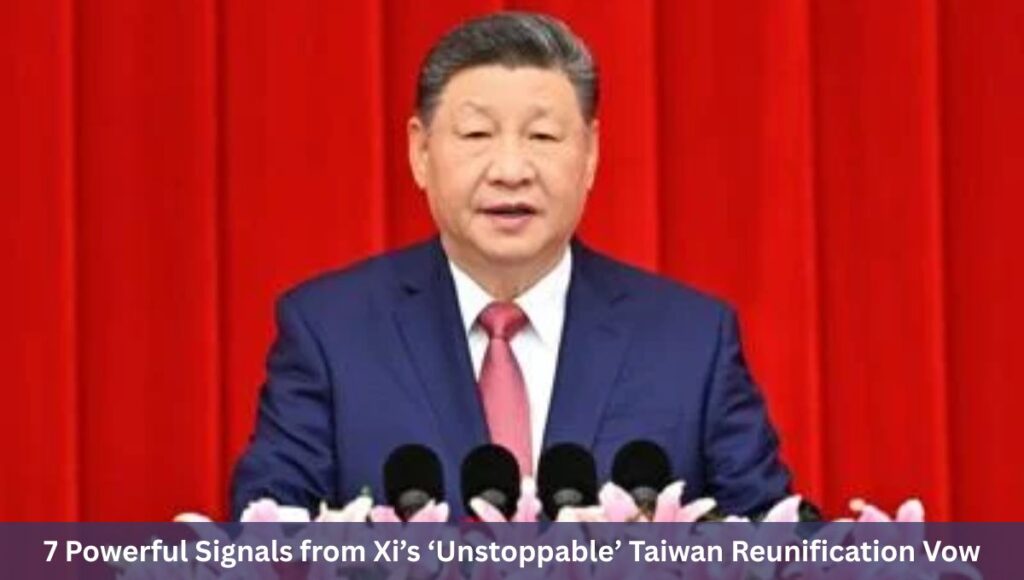
7 Powerful Signals from Xi’s ‘Unstoppable’ Taiwan Reunification Vow
Xi’s New Year Address: A Defiant Tone on Taiwan
Speaking in Beijing on Wednesday evening, Xi described reunification as a historical inevitability.
“The reunification of our motherland, a trend of the times, is unstoppable,” Xi said.
Invoking shared heritage, Xi added that people on both sides of the Taiwan Strait were bound by a “bond of blood and kinship.”
The language closely mirrored long-standing Communist Party rhetoric but carried added weight due to the timing — coming just one day after large-scale PLA drills simulating a blockade of the island.
The New Year speech was nationally televised and carefully choreographed, with interspersed footage of China’s recent military parade commemorating 80 years since the end of World War II.
Analysts note that the imagery reinforced the message that national strength, historical legacy, and military power are inseparable elements of China’s Taiwan policy.
Largest-Ever PLA Drills Around Taiwan
Justice Mission 2025
The military exercises, codenamed “Justice Mission 2025,” were described by Chinese officials as a “stern warning” against separatism and external interference.
Over two days, the PLA conducted live-fire drills across an unprecedented geographical area, involving:
- Navy, air force, rocket force and coast guard units
- Simulated blockades of major Taiwanese ports
- Warships and fighter jets operating close to the island
- Rocket launches into waters surrounding Taiwan
Taiwan’s Ministry of National Defense said the drills represented a serious escalation and forced the island’s military into a heightened state of readiness.
Dozens of domestic flights were cancelled, and Taiwanese forces scrambled aircraft and vessels to monitor Chinese movements.
Security officials in Taipei later confirmed that more than 90 Chinese naval and coast guard vessels had been deployed across the wider region, including the East China Sea and South China Sea.
Taiwan Responds: ‘Safer and More Resilient’
In a New Year’s Day address of his own, Taiwanese President William Lai Ching-te struck a resolute tone, stressing the need for self-defence and national resilience.
“In the face of China’s rising expansionary ambitions, the international community is paying attention to whether the Taiwanese people possess the resolve for self-defense,” Lai said.
He reaffirmed his administration’s commitment to:
- Defending national sovereignty
- Strengthening military readiness
- Enhancing whole-of-society resilience
- Building credible deterrence mechanisms
Taiwan, which has its own elected government, military, currency and passport, maintains that only its people can determine their future.
Opinion polls consistently show that a large majority of Taiwanese favour maintaining the status quo, with far fewer supporting immediate independence or unification.
US Arms Sales and Strategic Ambiguity
The PLA exercises followed closely on the heels of a major US announcement: Washington approved its largest-ever arms package to Taiwan, valued at $11.1 billion.
Although the United States does not officially recognise Taiwan, it is legally bound under the Taiwan Relations Act of 1979 to help the island maintain the capacity to defend itself.
However, the law stops short of guaranteeing direct US military intervention in the event of a Chinese invasion or blockade.
This deliberate ambiguity has long been a cornerstone of US policy, but rising Chinese military pressure has prompted debate over whether the strategy remains viable.
Beijing has repeatedly condemned US arms sales, viewing them as a violation of its sovereignty and a destabilising factor in cross-strait relations.
Historical Narrative: ‘Taiwan Recovery Day’
Xi also highlighted the establishment of an annual “Taiwan Recovery Day” in 2025, marking the end of Japanese colonial rule over the island in 1945.
The move reinforces Beijing’s historical framing of Taiwan as an inseparable part of China whose return to Chinese control is unfinished business from World War II.
Taiwan’s legislature has also passed legislation recognising October 25 as a national holiday, though interpretations of its significance differ sharply between Beijing and Taipei.
Critics argue that historical symbolism is being used to justify contemporary military pressure, while supporters say it reaffirms China’s sovereignty claims.
Economic Messaging Amid Global Headwinds
Beyond Taiwan, Xi’s New Year address focused heavily on economic confidence and technological advancement.
He said China was on track to achieve its 5 percent growth target for 2025, with gross domestic product expected to reach around 140 trillion yuan ($19.7 trillion).
Xi described the coming years — the start of the 15th Five-Year Plan (2026–2030) — as critical for sustaining high-quality development.
“We must remain confident, seize the momentum and steadily advance high-quality development,” Xi said.
He highlighted progress in:
- Artificial intelligence
- Semiconductor development
- Aerospace and space exploration
- Military technology
Xi argued that China has become one of the world’s fastest-growing innovation economies, despite what he described as external attempts to contain its rise.
Trade Tensions and Domestic Pressures
Despite strong trade performance — including a record $1.076 trillion trade surplus in the first 11 months of the year — China continues to face significant domestic challenges.
These include:
- Weak consumer demand
- High youth unemployment
- Fierce competition in manufacturing
- Rising trade frictions with the US and EU
In a separate article published in Qiushi, the Communist Party’s leading theoretical journal, Xi pledged to crack down on “local protectionism” and “involution-style competition,” a term commonly used in China to describe excessive but inefficient rivalry among firms.
Global Diplomacy and Power Projection
Xi also framed China as a stabilising force in a turbulent world.
“China has always stood on the right side of history,” he said, adding that Beijing was committed to promoting global peace and a “shared future for mankind.”
The address referenced China’s hosting of major diplomatic events in 2025, including the Shanghai Cooperation Organisation summit in Tianjin, attended by leaders such as Russia’s Vladimir Putin, India’s Prime Minister Narendra Modi, and Turkey’s President Recep Tayyip Erdoğan.
Observers noted that Xi’s emphasis on diplomacy was closely interwoven with displays of military strength — signalling that Beijing sees hard power and engagement as complementary, not contradictory.
Regional and International Reactions
Taiwan condemned the PLA drills as a blatant provocation and a threat to regional stability.
Western allies echoed concerns, warning that escalation across the Taiwan Strait could have severe global economic and security consequences.
China’s Taiwan Affairs Office defended the exercises as “necessary and just,” insisting they were aimed at deterring separatist forces and foreign interference.
As Chinese vessels gradually withdrew from waters near Taiwan later in the week, Taiwanese authorities said the situation had “calmed down,” though military readiness remained elevated.
Why Xi’s Words Matter Now
Xi’s declaration that reunification is “unstoppable” is not new in substance, but it is significant in context.
It comes at a time when:
- Cross-strait military activity is at historic highs
- US-China relations remain deeply strained
- Taiwan’s leadership is openly emphasising deterrence
- China is entering a crucial economic planning cycle
By pairing forceful rhetoric with visible military capability, Xi is reinforcing deterrence while signalling resolve — both to domestic audiences and international rivals.
An Uncertain Path Ahead
While Beijing insists reunification is inevitable, the path toward it remains deeply contested and fraught with risk.
Taiwan shows no sign of yielding its de facto independence. The United States continues to bolster Taipei’s defences.
Regional allies are increasingly wary of instability in the Taiwan Strait, one of the world’s most important trade corridors.
Xi’s New Year message leaves little doubt that Taiwan will remain at the centre of China’s strategic priorities.
What remains unclear is whether Beijing intends to rely primarily on pressure and deterrence — or whether it is willing to test the limits of force in pursuit of what it calls a historic mission.
For now, the world watches closely as words, war games, and geopolitics converge across the Taiwan Strait.
Also Read: 10 Explosive Facts Behind China’s Hard-Hitting Sanctions on US Defence Firms Over Taiwan