7 Explosive Revelations Behind Xi Jinping’s Military Purge and China’s Water-Filled Missiles, revealing deep corruption inside the PLA. China’s military has long been portrayed as a disciplined, rapidly modernising force preparing to challenge U.S. power and reshape the balance of global security.
But behind the parades, hypersonic missile tests, and muscular rhetoric lies a far darker story—one of corruption, mistrust, and alarming operational failures. At the heart of this unfolding drama is Xi Jinping’s sweeping purge of the People’s Liberation Army (PLA), the most severe shake-up of China’s military leadership since the Mao era.
The dramatic removal of General Zhang Youxia, once Xi’s closest ally and China’s highest-ranking uniformed officer, has intensified scrutiny of the PLA’s true state of readiness.
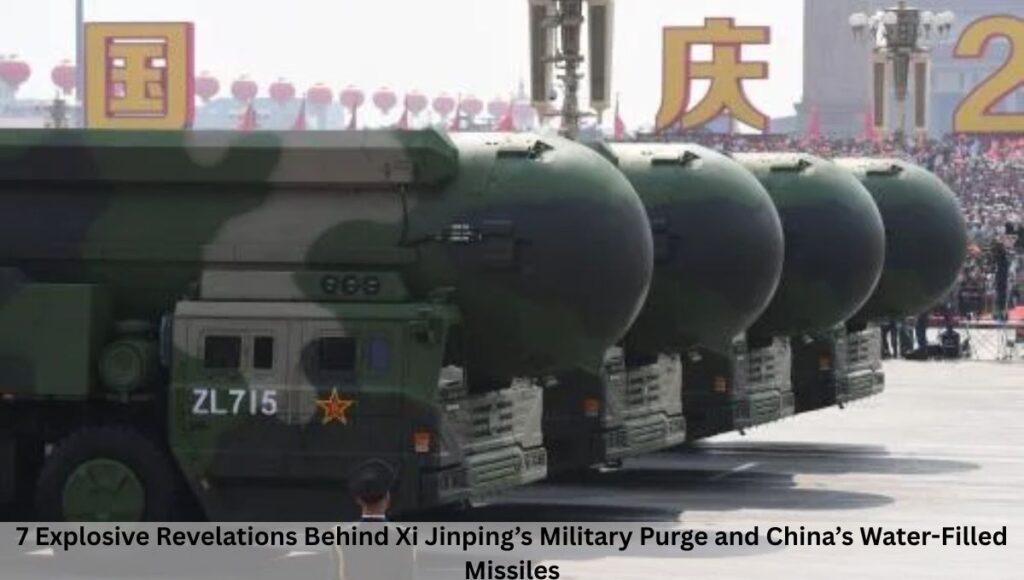
Even more shocking are claims from U.S. intelligence that some of China’s nuclear missiles were filled with water instead of fuel, while missile silos in western China were allegedly constructed with faulty lids that could not open in wartime.
If even partially true, these revelations cut to the core of China’s nuclear deterrent—and help explain why Xi Jinping has launched a ruthless campaign to “squeeze out the water diluting combat effectiveness.”
7 Explosive Revelations Behind Xi Jinping’s Military Purge and China’s Water-Filled Missiles
Xi Jinping’s Ruthless Military Reckoning
Since assuming power in 2012, Xi Jinping has made one thing clear: the Communist Party must maintain absolute control over the gun.
Unlike his predecessors, Xi does not rely on consensus or informal balances within the PLA. Instead, he has personalised command, placing himself at the centre of every major military decision through the Central Military Commission (CMC).
The latest purge marks a decisive escalation.
In January, China confirmed investigations into General Zhang Youxia, vice chairman of the CMC, and General Liu Zhenli, chief of staff of the CMC’s Joint Staff Department.
Together, they represented the apex of professional military leadership in China.
State media described them as “corrupt elements” whose removal would “remove roadblocks” and restore combat effectiveness.
But analysts across Asia, Europe, and the United States say the story goes far beyond bribery.
The Water-Filled Missile Allegations
The most explosive claims emerged in 2024, when Bloomberg, citing U.S. intelligence assessments, reported that corruption within the PLA Rocket Force had reached staggering levels.
According to those assessments:
- Entire missile silo fields in western China were built with heavy lids that could not open properly
- Some missiles assigned to strategic forces were reportedly filled with water instead of fuel
- Procurement fraud and falsified readiness reports masked deep technical failures
These revelations reportedly shook confidence inside China’s leadership and triggered the purge of the PLA Rocket Force’s entire senior command.
The Rocket Force is not just another branch of the PLA—it controls China’s nuclear deterrent, including intercontinental ballistic missiles capable of striking the United States.
Fact, Fiction, or Strategic Shock?
Not all observers agree on the interpretation.
Asia Times strongly disputed the water-filled missile narrative, arguing that:
- China’s liquid-fuel missiles are not stored filled with propellant
- Fuel storage would cause corrosion and safety risks
- Any presence of water would imply deliberate sabotage, not negligence
Others note that even false intelligence reports, if believed by Xi Jinping, could be enough to trigger drastic action.
As a former Western intelligence analyst put it:
“In China’s system, perception can matter more than proof. If Xi loses confidence, careers end—facts or not.”
Who Was Zhang Youxia—and Why His Fall Matters
Zhang Youxia was no ordinary general.
- Son of a revolutionary commander who fought alongside Xi Jinping’s father
- A trusted ally who survived multiple previous purges
- Promoted past retirement age and elevated to the top uniformed role in the PLA
His dismissal stunned China watchers.
Zhang was reportedly detained on January 19, facing allegations that include:
- Accepting bribes for promotions
- Compromising PLA combat readiness
- Violating the “CMC chairman responsibility system”
- Leaking sensitive information—possibly nuclear-related—to the United States
While Beijing has not confirmed espionage claims, PLA Daily editorials accused Zhang of causing “immense damage” to combat capability and undermining party control of the military.
A Hollowed-Out High Command
The scale of the purge is unprecedented.
At the start of Xi’s third term in 2023, the CMC had seven members.
Today:
- Only Xi Jinping remains as a civilian leader
- The sole uniformed member is General Zhang Shengmin, a political commissar and discipline inspector with no combat command background
This is the smallest CMC since Mao Zedong’s era, raising serious questions about institutional resilience.
Critics argue that:
- Operational expertise has been sidelined
- Fear now outweighs initiative
- Military decision-making has become dangerously centralised
Supporters counter that Xi is eliminating unreliable networks before a future crisis.
Corruption as a Weapon—and an Excuse
Corruption in the PLA is not new.
For decades, officers paid for promotions, skimmed procurement contracts, and built patron-client networks. Xi tolerated this—until it became politically or strategically inconvenient.
Former diplomats and analysts argue that corruption is often:
- An instrument, not a cause, of purges
- Selectively enforced once an official loses protection
- Used to dismantle rival power bases
As former diplomat Michael Kovrig observed:
“Corruption was tolerated while Zhang was useful—and actionable once he wasn’t.”
Taiwan Looms Large
Timing matters.
The purge comes amid:
- Intensifying PLA drills around Taiwan
- Rising tensions with Japan
- Pentagon assessments pointing to 2027 as a key readiness milestone
Many analysts believe Xi wants the PLA capable of seizing Taiwan, but not necessarily eager to fight.
Paradoxically, the purge may:
- Reduce the likelihood of near-term invasion, due to leadership disruption
- Increase coercive pressure, including larger drills and riskier manoeuvres
- Heighten chances of miscalculation in the Taiwan Strait
Is China’s Military Weaker—or More Dangerous?
The answer may be both.
On one hand:
- Leadership churn disrupts planning
- Commanders become risk-averse
- Institutional trust erodes
On the other:
- Political obedience is reinforced
- Independent networks are dismantled
- Xi gains tighter personal control over escalation decisions
As analysts at Australia’s ASPI noted:
“Purges signal doubt, not confidence—but they can also clear the path for obedience.”
Xi Jinping’s Deeper Fear
Ultimately, this is not just about missiles or Taiwan.
Xi Jinping’s deepest concern is regime survival.
He watched authoritarian governments collapse during the Arab Spring when security forces refused orders.
His response has been relentless:
- Break the military’s autonomy
- Eliminate alternative loyalties
- Ensure the PLA answers to him personally, not just the Party
In that sense, the purge of Zhang Youxia is not an anomaly—it is the culmination of a decade-long project.
What Comes Next
Several scenarios are now in play:
- Xi repopulates the CMC with younger, personally vetted officers
- Greater civilian oversight of the military
- Continued purges deeper into regional commands
- More assertive—but controlled—military signalling around Taiwan
One thing is clear: no one is safe, not even Xi’s oldest allies.
Conclusion: Power, Paranoia, and Preparedness
The saga of water-filled missiles and faulty silos may never be fully confirmed. But its political impact is undeniable. Xi Jinping has chosen fear over familiarity, control over cohesion, and loyalty over experience.
Whether this makes China’s military stronger—or merely more obedient—will shape not just Taiwan’s future, but global security in the years ahead.
For now, the purge sends a stark message to the PLA and the world alike:
In Xi’s China, power is proven not by trust—but by survival.
Also Read: Xi Jinping Hosts China’s Largest-Ever Military Parade: War or Peace at Crossroads
Also Read: Missiles filled with water and broken silos. Inside Xi’s corrupt military