
9 Explosive Signals as Women ‘Fidayeen’ Lead Deadliest Balochistan Attacks in Years amid rising female militancy. A coordinated wave of violence swept across Pakistan’s restive Balochistan province over a 24-hour period, marking one of the most intense insurgent offensives in recent years.
What set this operation apart was not only its scale and synchronisation — but the prominent role played by two women suicide attackers, signalling a profound shift in the dynamics of the long-running Baloch separatist insurgency.
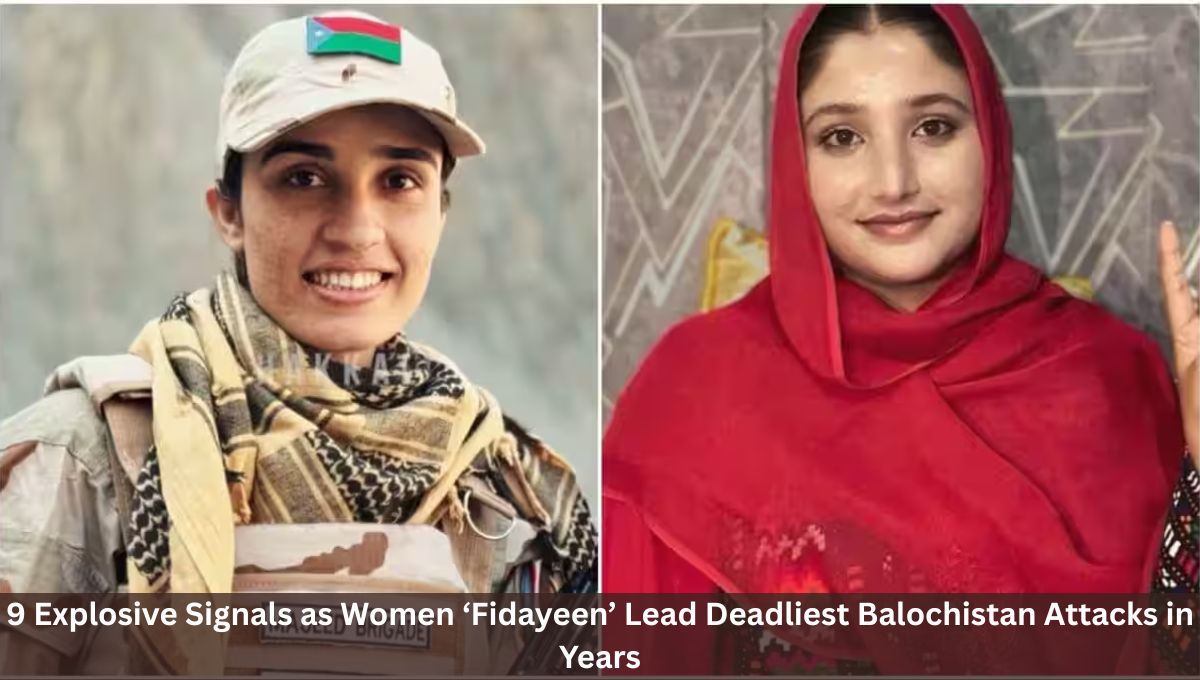
The Baloch Liberation Army (BLA) released photographs, videos and statements identifying the women as Asifa Mengal (23) and Hawa Baloch (24), both members of its elite Majeed Brigade, a unit reserved for suicide missions, or fidayeen operations.
The offensive, dubbed “Operation Herof 2.0”, targeted symbols of Pakistan’s authority across multiple districts, including government offices, banks, police stations, Frontier Corps facilities, highways and military installations.
9 Explosive Signals as Women ‘Fidayeen’ Lead Deadliest Balochistan Attacks in Years
A Province Under Siege
According to Pakistani authorities, attacks were reported across Kalat, Gwadar, Mastung, Noshki, Kharan, Turbat, Pasni and parts of Quetta, with militants striking almost simultaneously.
The violence included:
- Suicide bombings and VBIED attacks
- Grenade assaults on police stations
- Armed raids on banks and government buildings
- Temporary seizure of highways
- Gun battles in urban centres
Pakistani officials confirmed the deaths of at least 31 civilians, including women and children, and 17 security personnel.
The military said it launched massive counter-operations, claiming to have killed 145 to 177 militants over 48 hours — figures that could not be independently verified.
The BLA, meanwhile, claimed it inflicted over 200 casualties on Pakistani security forces, acknowledging the deaths of 18 of its own fighters, including 11 fidayeen.
Who Were the Two Women ‘Fidayeen’?
Asifa Mengal: From Classroom to Suicide Mission
According to the BLA, Asifa Mengal was born in 2002 in Noshki, a town in western Balochistan. She joined the Majeed Brigade on her 21st birthday in 2023, a symbolic act the group highlighted in its propaganda.
On January 31, 2026, Asifa carried out a vehicle-borne improvised explosive device (VBIED) attack targeting the Inter-Services Intelligence (ISI) headquarters in Noshki, killing herself in the blast.
The BLA portrayed her trajectory as a rejection of “conventional life” in favour of armed resistance, framing her act as retaliation against what it calls Pakistan’s military occupation of Balochistan.
Hawa Baloch: ‘War Is Fun,’ Says Video Released Before Death
The second woman, Hawa Baloch, emerged as the most visible face of the operation after the BLA released a video documenting her final hours.
An aspiring writer from Kech district, Hawa’s path into militancy was deeply personal. Her father, Nabi Baksh Baloch, a BLA fighter, was killed in Sistan, Iran, in 2021. Following his death, she joined the Majeed Brigade.
In the video, recorded at night on a phone camera, Hawa is seen firing a rifle, smiling, and addressing the camera directly.
“Pakistan cannot face us,” she says. “Today, we are facing the enemy… Today you will know how tough it is to face Baloch women.”
Moments later, the footage shows her bloodied body lying beside another fighter, marking the end of her life during clashes at the Gwadar Front.
Why the Rise of Women Militants Matters
The participation of women as suicide attackers represents a strategic and psychological escalation in the Baloch insurgency.
Historically, Baloch resistance was:
- Male-dominated
- Tribal in leadership
- Concentrated in rural areas
That profile has changed dramatically.
According to analysts, the increasing role of women reflects:
- Deepening desperation within Baloch society
- Years of enforced disappearances of men
- Breakdown of traditional social barriers
- Tactical adaptation by insurgent groups
Pakistani political scientist Ayesha Siddiqa notes that when women enter armed insurgencies, it signals a conflict that has reached an extreme level of societal rupture.
Not an Isolated Phenomenon
The involvement of women in BLA attacks is not new, but it is becoming more frequent and more visible.
Notable precedents include:
- 2022 Karachi University bombing by Shari Baloch, which killed three Chinese nationals
- 2022 Turbat attack by journalist Sumaiya Qalandrani Baloch
- 2025 Kalat attack by science graduate Banuk Mahikan Baloch
These women came from educated, urban or professional backgrounds, challenging stereotypes of insurgents as uneducated or marginalised.
Operation Herof 2.0: A Tactical Escalation
The BLA described Operation Herof 2.0 as a continuation of a similar coordinated assault launched in August 2024.
Key features of the operation included:
- Simultaneous attacks across more than 12 locations
- Use of civilians’ clothing to infiltrate public spaces
- Deployment of women suicide bombers
- Temporary hostage-taking of officials
- Release of propaganda videos in real time
Pakistani officials acknowledged that attackers entered banks, hospitals, schools and markets, raising serious concerns about civilian safety.
Conflicting Casualty Claims
As with most conflicts in Balochistan, casualty figures remain disputed.
Pakistan’s Claims
- 177 militants killed in 48 hours
- 17 security personnel killed
- 31 civilians killed
BLA’s Claims
- Over 200 Pakistani personnel killed
- 17 security officials captured (later disputed)
- 18 BLA fighters killed
Independent verification remains impossible due to restricted access, internet shutdowns and media limitations across the province.
Pakistan Blames India, India Pushes Back
Within hours of the attacks, Pakistan’s Interior Minister Mohsin Naqvi blamed India, alleging the operation was planned with Indian support — claims made without public evidence.
India categorically rejected the accusations.
“Instead of parroting frivolous claims, Pakistan should address the longstanding demands of its people,” India’s foreign ministry said.
Analysts argue that while regional geopolitics play a role, the roots of the Baloch insurgency are overwhelmingly domestic.
Why Balochistan Remains a Flashpoint
Balochistan is:
- Pakistan’s largest province by area
- Its least populated
- Its poorest, despite vast mineral wealth
The province holds significant reserves of gold, copper, coal, gas and oil, generating revenue largely controlled by the federal government.
Since its annexation in 1948, Balochistan has experienced at least five major insurgencies, driven by demands for autonomy, political inclusion and control over resources.
Human Rights and Enforced Disappearances
Human rights groups estimate that over 5,000 Baloch men have disappeared since 2000, allegedly detained by security forces.
With men jailed, killed or missing, women have increasingly stepped into leadership roles — both in peaceful protests and armed resistance.
Civil society activists like Mahrang Baloch have pursued non-violent advocacy, while others have turned to militancy, reflecting a fractured response to repression.
China, the US, and the Investment Risk
The violence carries major implications for foreign investment, particularly:
- China-Pakistan Economic Corridor (CPEC)
- Gwadar deep-sea port
- Planned US mineral investments
Balochistan is central to China’s $60 billion CPEC project, yet Chinese engineers and facilities have been frequent targets.
Analysts warn that continued instability threatens Pakistan’s efforts to attract both Chinese and Western capital, especially as foreign direct investment has sharply declined.
Pakistan’s Security Apparatus Under Strain
Pakistan’s military is simultaneously engaged on multiple fronts:
- Baloch insurgency
- Pakistani Taliban violence
- Border tensions with India
- Economic instability
Opposition leader Mehmood Achakzai called the Balochistan attacks a “pure intelligence failure”, demanding accountability.
“No one has resigned,” he said, contrasting Pakistan’s response with international standards.
Are Women Being Empowered or Exploited?
There is sharp debate over whether women militants represent empowerment or exploitation.
Supporters argue that:
- Women are exercising agency
- Patriarchal barriers are breaking
- Resistance reflects collective suffering
Critics counter that:
- Young women are groomed through propaganda
- Personal grief is weaponised
- Suicide missions strip women of real choice
Most analysts agree on one point: the trend reflects deep structural failure, not a passing tactic.
A Conflict With No Easy Exit
Despite repeated military crackdowns, the insurgency shows no sign of fading.
Experts warn that:
- Force alone cannot resolve political grievances
- Blaming external actors avoids accountability
- Militarisation deepens alienation
As long as political exclusion, economic marginalisation and human rights abuses persist, Balochistan is likely to remain volatile.
Conclusion: A Dangerous New Phase
The emergence of women fidayeen at the forefront of BLA operations marks a dangerous new phase in Pakistan’s longest-running internal conflict.
Beyond the immediate bloodshed, the attacks raise profound questions about:
- State legitimacy
- Security strategy
- Women’s roles in conflict
- The future of foreign investment
- Regional stability
For Pakistan, the message from Balochistan is stark: the crisis is not episodic — it is structural. Until those roots are addressed, no amount of force may be enough to contain it.
Also Read: Afghan Women Left to Die After Earthquake as Taliban’s Sharia Ban Blocks Male Rescuers
Related Posts:
- 5 Major Takeaways from the US Supreme Court's…

- Afghanistan–Pakistan War 2025: Inside the 48-Hour Ceasefire

- Afghan Women Left to Die After Earthquake as…

- 7 Heartbreaking Facts About Venezuela's Earthquake Disaster

- 7 Critical Reasons the Donbas Is the Most Explosive…

- In 8 Moves, EU Targets China-Linked Refineries and…
