
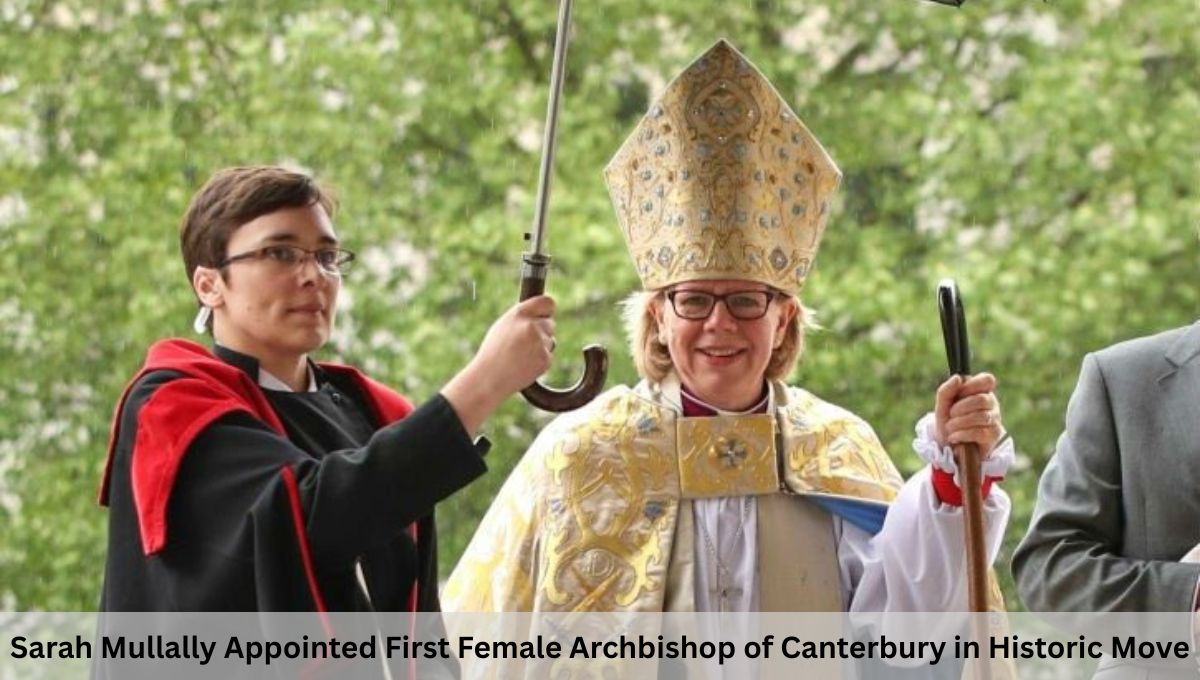
Breaking 1,400 years of tradition, Dame Sarah Mullally Appointed First Female Archbishop of Canterbury in Historic Move. Dame Sarah Mullally has been appointed as the new Archbishop of Canterbury, marking a historic first in the Church of England’s 1,400-year history. At 63, Mullally becomes not only the first woman to hold the post but also the spiritual leader of more than 85 million Anglicans worldwide.
Her appointment follows the resignation of Justin Welby, who stepped down last year after an independent report criticized his failure to act over decades of sexual abuse within the Church. Mullally’s elevation is seen as both a milestone for women in church leadership and a test of whether the institution can regain credibility in a society marked by secularization and division.
Sarah Mullally Appointed First Female Archbishop of Canterbury in Historic Move
From Nurse to Archbishop: Mullally’s Unique Journey
Sarah Mullally’s path to Canterbury is unlike any of her predecessors. Before entering ordained ministry, she enjoyed a distinguished career in the National Health Service, rising to become England’s youngest-ever Chief Nursing Officer in 1999.
She began her career as a cancer nurse and midwife, working in hospitals across London. By the age of 37, she was appointed to lead the nation’s nursing profession, overseeing thousands of staff and influencing national health policy.
Though she had been volunteering in her local church, it wasn’t until the early 2000s that Mullally made the life-changing decision to train for the priesthood. She was ordained in 2002 and served short curacies before quickly being recognized for her administrative and pastoral skills.
In 2015, she became Bishop of Crediton, and just three years later, she was appointed Bishop of London—the Church of England’s third most senior position. That appointment alone made headlines, as she became the first woman to serve in the role.
Her blend of experience—healthcare leadership, safeguarding expertise, and pastoral care—is now viewed as vital preparation for one of the most challenging religious offices in the world.
Breaking 1,400 Years of Tradition
The Archbishop of Canterbury is regarded as the most senior bishop in the Church of England and spiritual leader of the Anglican Communion. Since St. Augustine’s appointment in 597, the role has always been held by men.
That changed in 2025 with Mullally’s appointment, a move made possible by reforms introduced during Justin Welby’s tenure, when women were first allowed to be consecrated as bishops in 2014.
“This is a historic moment not only for the Church of England but for Anglicans worldwide,” said church historian Diarmaid MacCulloch. “It shows the institution is willing to break with centuries of exclusion, even as it faces deep internal conflict.”
Also Read: Vatican congratulates first female archbishop of Canterbury
How the Archbishop of Canterbury Is Chosen
The process of selecting an Archbishop of Canterbury is a mix of tradition and politics. Candidates are identified by the Crown Nominations Commission (CNC), a 17-member body chaired by former MI5 chief Jonathan Evans.
After months of consultations, the commission selects a preferred candidate. That name is then passed to the Prime Minister—currently Sir Keir Starmer—who forwards it to the monarch for formal approval.
While King Charles III is the Supreme Governor of the Church of England, the Archbishop of Canterbury remains the most visible leader of the church and the first among equals in the global Anglican Communion.
Evans had earlier stressed the importance of choosing someone who could break with the historic pattern of “white, Oxbridge-educated men from southeast England,” signaling the church’s desire for broader representation. Mullally’s appointment directly reflects that shift.
Also Read: Robert Francis Prevost Elected Pope Leo XIV: First American Pope in Catholic Church History
Her First Words: Condemning Hatred and Violence
In her first public statement after the announcement, Mullally addressed the deadly attack on a synagogue in Manchester, which had left the Jewish community reeling.
“We are witnessing hatred that rises up through fractures across our communities,” she said from Canterbury Cathedral. “We then as a Church have a responsibility to stand with the Jewish community against antisemitism in all its forms. Hatred and racism of any kind cannot be allowed to tear us apart.”
Her words were widely praised as a signal of her intention to confront not only internal church crises but also the broader fractures in British society.
Justin Welby’s Resignation and the Abuse Scandal
The backdrop to Mullally’s appointment is the damaging resignation of Justin Welby, who left office after an independent investigation found he failed to report the abuse carried out by John Smyth, a prominent figure in Christian networks during the 1970s and 1980s.
The report concluded that Welby and other senior leaders “could and should” have reported Smyth to the police by 2013. Instead, years passed before survivors’ voices were properly heard.
Welby’s departure was unprecedented. Historians note that no Archbishop of Canterbury had resigned under such circumstances in more than a millennium. The scandal shook the church’s credibility to its core.
Mullally, by contrast, has long been known as a reformer willing to confront failures. “Our history of safeguarding failures has left a legacy of deep harm and mistrust,” she acknowledged. “As Archbishop, my commitment will be to ensure we listen to survivors, care for the vulnerable, and foster a culture of safety.”
Challenges Ahead: Declining Attendance and Deep Divisions
Mullally inherits an institution in crisis. Church attendance in the UK has been declining for decades, with fewer than one million regular worshippers across 20 million baptized members. London has bucked the trend somewhat, but nationally the decline is steep.
Beyond attendance, the Church faces intense divisions over issues including:
- The role of women in leadership – while celebrated in the UK, her appointment has been criticized by conservative Anglican groups in Africa and Asia, who argue that episcopal leadership should remain male-only.
- Same-sex blessings – Mullally supported the decision in 2023 to allow blessings for same-sex couples, calling it “a moment of hope.” But global Anglican churches remain bitterly divided, with many in the global south rejecting the move.
- Assisted dying – Mullally has been a vocal opponent of assisted dying legislation, calling it “unsafe and unworkable,” aligning her with her predecessor on the issue.
The Global Fellowship of Confessing Anglicans (GAFCON), representing conservative voices in Africa and Asia, denounced her appointment as a sign that Canterbury had “relinquished its authority to lead.”
National and International Reactions
Political Leaders
Prime Minister Keir Starmer welcomed the appointment, saying:
“The Church of England is of profound importance to this country. The Archbishop of Canterbury will play a key role in our national life. I wish Dame Sarah every success and look forward to working together.”
King Charles III offered his congratulations through Buckingham Palace, calling her new role “of such importance in the UK and across the global Anglican Communion.”
Religious Voices
Former Archbishop Rowan Williams described her task as requiring “a newspaper in one hand and a Bible in the other,” noting that the public expectation for archbishops to comment on every issue is “quite heavy.”
Meanwhile, the Vatican offered cautious congratulations. Cardinal Kurt Koch, responsible for promoting Christian unity, praised growing Anglican-Catholic understanding but noted that the ordination of women remains a “deep obstacle” to full unity.
Leadership Style: Collaboration and Compassion
Mullally is widely regarded as a collaborative leader, shaped by her nursing background. In interviews, she has often highlighted the similarities between nursing and ministry: both involve walking with people through life’s most difficult moments.
As Bishop of London, she worked to modernize the diocese, applying her NHS management experience to streamline processes and encourage innovation. During the COVID-19 pandemic, she played a prominent role in guiding the church’s response, supporting communities and clergy under strain.
Asked what she would bring to the new role, she said:
“I have had experiences as a nurse leading complex organisations, as the government’s chief nursing officer, and as bishop of a diverse diocese in London. But I recognise I can’t do it alone. I need to do it with other colleagues.”
Symbolism and Inspiration for Women
Mullally herself has acknowledged the historic nature of her appointment. “Being the first woman is historic,” she said. “I often go to schools, and the young women sit up and listen.
They don’t necessarily want to be the Bishop of London or Archbishop of Canterbury, but it allows them to imagine possibilities for their own dreams.”
Her appointment comes three decades after women were first ordained as priests in the Church of England in 1994, and just 11 years after the first female bishops were consecrated. Today, more than 40 of England’s 108 bishops are women.
Looking Ahead: What Awaits the 106th Archbishop
When she is formally enthroned at Canterbury Cathedral in March 2026, Sarah Mullally will become the 106th Archbishop of Canterbury, a role dating back to St. Augustine of Canterbury in 597 AD.
Her immediate priorities are expected to include:
- Safeguarding reform – ensuring survivors of abuse receive justice and the church fosters a culture of safety.
- Rebuilding trust – restoring credibility after years of scandal and mismanagement.
- Bridging divides – holding together an Anglican Communion increasingly split between liberal and conservative wings.
- National leadership – providing moral guidance on issues such as healthcare, social justice, and cost-of-living challenges.
- Engaging younger generations – reversing the decline in attendance by making the church relevant to modern Britain.
As one commentator noted, “She faces an in-tray that is daunting even for someone with her experience. But her resilience, compassion, and ability to listen may prove to be the qualities the church needs most right now.”
Conclusion: A Turning Point for the Church
Sarah Mullally’s appointment as the first female Archbishop of Canterbury is a landmark not only for the Church of England but for Christianity itself. It represents a decisive break with centuries of male-only leadership, while also highlighting the challenges of leading a global communion riven by cultural and theological divisions.
For many, she embodies the possibility of a more compassionate, accountable, and inclusive church. For others, her appointment deepens concerns about the direction of Anglicanism. What is certain is that the world will be watching as she takes on one of the most demanding spiritual roles in modern life.
As Rowan Williams once put it, the job of Archbishop requires balancing faith and public life: “a Bible in one hand and a newspaper in the other.” Sarah Mullally now steps into that role, determined to lead with integrity, healing, and hope.


