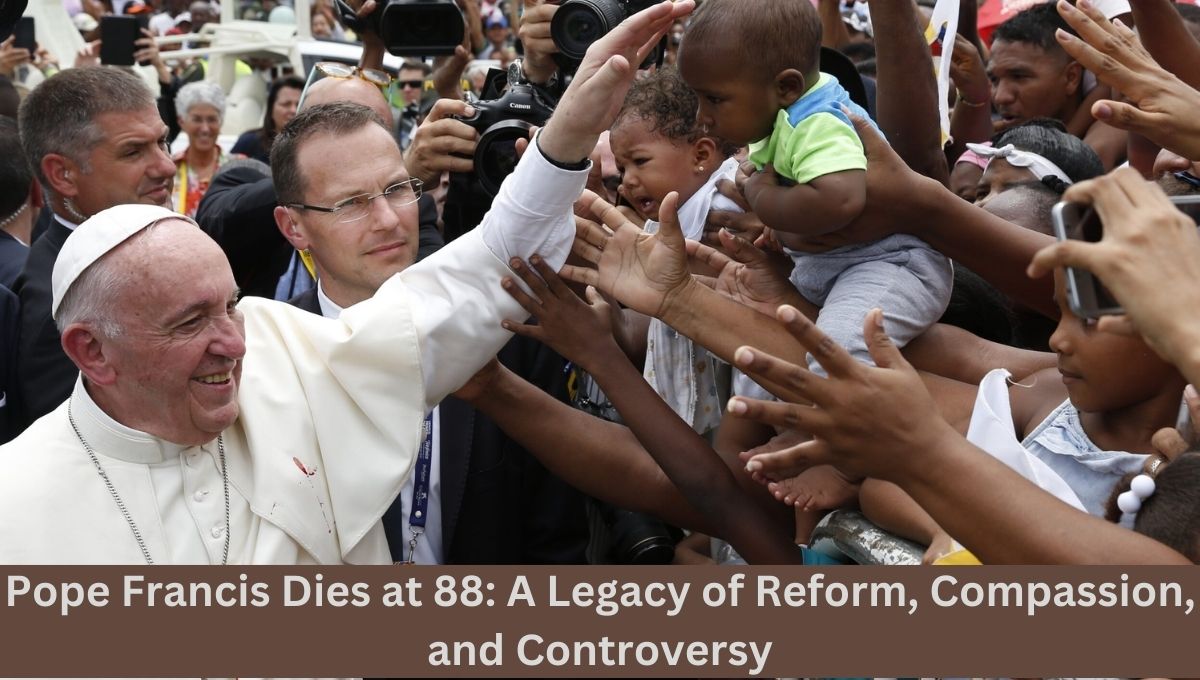
The transformative leader of the Roman Catholic Church, Pope Francis, who redefined the papacy with his focus on inclusivity, social justice, and humility, has died at the age of 88. To the global stage of the Vatican, from his humble beginnings in Buenos Aires, his decade-long tenure was marked by bold reforms, cultural clashes, and an unwavering focus on the marginalized.
Pope Francis Dies at 88: A Legacy of Reform, Compassion, and Controversy
From Nightclub Bouncer to Bishop of Rome
Born Jorge Mario Bergoglio to Italian immigrants on December 17, 1936, in Buenos Aires, Argentina, Francis had an unlikely path to the papacy. Before entering the seminary and being ordained in 1969, he worked as a nightclub bouncer. In Argentina he became the head of the Jesuits and was appointed cardinal by Pope John Paul II in 2001. Following Pope Benedict XVI’s historic resignation in 2013, Francis became the first pope from the Americas and the first Jesuit to assume the role.
A Pope of Firsts and Fierce Convictions
Francis set himself apart quickly. He refused the lavish papal apartments to choosing the name of St. Francis of Assisi, a symbol of humility and service he embodied a break from Vatican tradition. His preference to live in a simple residence and pay his own hotel bill made headlines and signaled a leadership style grounded in modesty.
Being a spiritual head of over 1.4 billion Catholics, he tackled long-standing issues head-on. Francis restructured Vatican bureaucracy, championed environmental action, and prioritized mercy over dogma. Advocating for healing before judgment, he called the Church a “field hospital after battle.”
Reaching Out to the Marginalised
His outreach to society’s most vulnerable, was perhaps the most defining aspect of his papacy. He became a fierce advocate for the poor, immigrants, and the LGBTQ+ community. His now-famous 2013 quote, “If a person is gay and seeks God and has goodwill, who am I to judge?” This quote sent shockwaves through the Church and the world.
Francis approved blessings for same-sex couples in 2023, which was a groundbreaking shift in Vatican policy, though he stopped short of endorsing same-sex marriage, frustrating liberal Catholics.
His compassion also extended globally. On the island of Lampedusa, he celebrated Mass for drowned migrants, and he denounced anti-immigration policies, including President Trump’s U.S.–Mexico border wall. Francis said, “The globalization of indifference is a very ugly disease.”
A Reformer Under Fire
While beloved by many, but within the Church, Francis faced sharp resistance from conservative factions. He was opposed by the critics for his softening on communion for divorced Catholics, his restrictions on the traditional Latin Mass, and his vaccine advocacy during the COVID-19 pandemic.
In a rare move, in 2023, following internal investigations, Francis dismissed conservative Bishop Joseph Strickland of Texas. His efforts to modernize the Church and weed out abusers met stiff resistance, especially in the U.S., where conservative clerics viewed his approach as heretical.
Addressing the Church’s “Shame”
Francis also addressed the devastating sexual abuse crisis of the Catholic Church. The most comprehensive legal revisions in 40 years were introduced by him and he acknowledged the past failings, calling the abuse scandals “our shame.” Yet, critics argued he didn’t go far enough.
After initially defending a Chilean bishop accused of covering up abuse in 2018, Francis issued a rare public apology. He admitted in a letter to Chilean bishops, “I made serious mistakes in the assessment and perception of the situation.”
A Global Pastor
Francis believed in pastoring the whole world. In 2021 he became the first pope to visit Iraq, making history, while encouraging Christians to stay and rebuild. He visited nearly every continent. He brokered a diplomatic thaw between the U.S. and Cuba and became the first pope to address the U.S. Congress, where he urged action on climate change.
Also, his papacy included harsh rebukes of economic inequality and unbridled capitalism. He criticized systems that left millions in poverty, and frequently decried the “idolatry of money.”
Controversy and Compassion on the World Stage
Francis was unafraid to wade into political waters. He met multiple times with Ukrainian President Volodymyr Zelenskyy, while he condemned Russia’s invasion of Ukraine. But, in 2024, he drew backlash for suggesting Ukraine should consider a “white flag” and negotiate peace. This suggestion prompted sharp responses from Ukrainian officials.
Domestically, his mixed messages often left both progressives and conservatives wanting more. A theology professor in the U.K., Lewis Ayres stated, “There’s a big difference between the way he appears in the media and how he is perceived internally in the Church.”
Final Years and Fading Health
Francis, in recent years, battled numerous health issues, including diverticulitis, hernia surgeries, and pneumonia. He suffered several falls and used a wheelchair. Rumors swirled about potential resignation, especially after he visited the tomb of Pope Celestine V, who resigned centuries earlier in 2022.
He continued shaping the Church’s future, despite his declining health. He appointed 21 new cardinals in December, most of them under 80 and eligible to vote in the next conclave.
A Complex, Enduring Legacy
Pope Francis leaves behind a complex but deeply human legacy. He didn’t unite the Church, while among millions disillusioned with it, he reinvigorated hope. He preached inclusivity, mercy, and environmental stewardship. In a rapidly changing world, he embodied the message of Christ.
As Kathleen Cummings of the University of Notre Dame summarized, “Has he managed to unite the Church? No. But he’s managed to give many people who had little hope in their Church renewed hope.”
Also Read: Cardinal Kevin Farrell Becomes Acting Head of Vatican Following Pope Francis’ Death
Also Read: Pope Francis’s remarkable peacemaking life