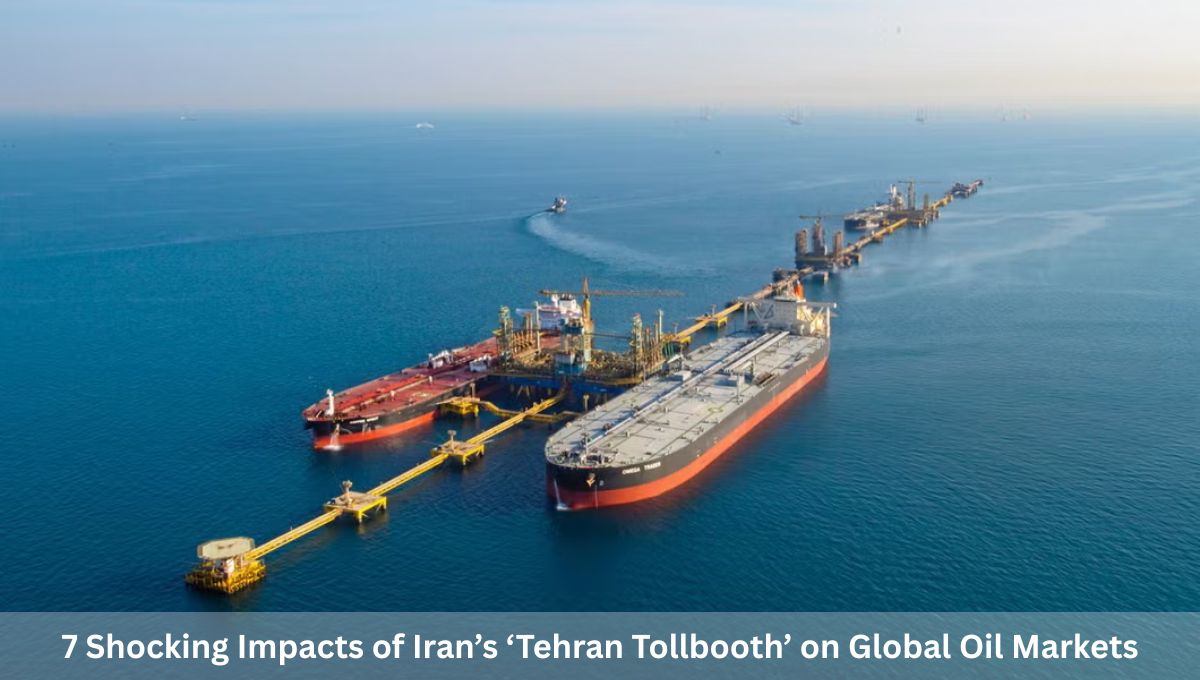
7 Shocking Impacts of Iran’s ‘Tehran Tollbooth’ on Global Oil Markets and international law. The idea of a permanent “Tehran tollbooth” on one of the world’s most critical energy routes is no longer theoretical—it is rapidly becoming a geopolitical flashpoint with far-reaching implications.
Iran’s proposal to charge up to $2 million per tanker passing through the Strait of Hormuz has triggered alarm across governments, energy markets, and shipping industries.
While the direct cost of such tolls might seem modest relative to the scale of global oil trade, the broader consequences could reshape energy economics, global trade norms, and geopolitical power balances for years.
This article breaks down what Iran’s strategy means—and why the world is paying close attention.
7 Shocking Impacts of Iran’s ‘Tehran Tollbooth’ on Global Oil Markets
What Is the ‘Tehran Tollbooth’?
Iran’s proposal is part of a broader geopolitical and economic strategy tied to its ongoing standoff with the United States and its allies.
Key Elements of the Plan
- A fee of up to $2 million per tanker
- Mandatory disclosure of:
- Cargo details
- Destination
- Ownership
- Payments potentially accepted in yuan or alternative currencies
- Escort of ships by Iranian forces through designated routes
The justification from Tehran is that these funds would help finance post-war reconstruction and stabilize its economy.
However, critics argue that this is less about reconstruction and more about leveraging control over a global chokepoint.
Why the Strait of Hormuz Matters
The Strait of Hormuz is not just another shipping lane—it is arguably the most important oil transit route in the world.
Critical Facts
- Handles ~20% of global oil and gas supply
- Previously saw 20 million barrels per day transit
- Connects major Gulf producers to global markets
Any disruption—or monetization—of this route has immediate global consequences.
Is Iran’s Toll System Legal?
From a legal standpoint, the toll system is highly controversial.
Conflict with International Law
The United Nations Convention on the Law of the Sea (UNCLOS) guarantees:
- Free and unimpeded transit passage
- No arbitrary tolls for passage through international straits
Key Issues
- Iran has not fully ratified UNCLOS
- The United States also has not ratified it
- However, UNCLOS is widely treated as customary international law
This creates a gray zone:
- Legally disputed
- Politically explosive
- Difficult to enforce
Impact #1: Rising Oil Prices
Even a small additional cost per barrel can ripple across global markets.
Direct Cost Impact
- ~$1 per barrel toll
- Estimated $7 billion annually
Market Reaction
- Oil prices have already surged:
- From ~$70 per barrel
- To peaks of ~$119–$150
Long-Term Outlook
- Analysts expect $100+ oil prices to persist
- Elevated prices may continue into 2027
The real issue isn’t just the toll—it’s the uncertainty and supply disruption.
Impact #2: Higher Shipping and Insurance Costs
The toll is only part of the cost burden.
Additional Cost Layers
- Increased war-risk insurance premiums
- Higher freight rates
- Hazard pay for crew in conflict zones
Operational Risks
- Threat of ship seizures
- Military escorts
- Navigation restrictions
These factors can multiply costs far beyond the toll itself.
Impact #3: Disruption to Global Supply Chains
Shipping companies are highly sensitive to risk.
Likely Industry Responses
- Avoiding the Strait altogether
- Delaying shipments
- Rerouting via longer, costlier paths
Result
- Slower global trade
- Increased delivery costs
- Supply chain bottlenecks
This extends beyond oil to manufacturing, food, and industrial goods.
Impact #4: Economic Pressure on Oil-Producing Nations
Interestingly, the biggest financial burden may not fall on consumers.
Who Pays Most?
Estimates suggest:
- Gulf producers may absorb 80–95% of costs
- Up to $14 billion annually
Implications
- Reduced profit margins for exporters
- Potential production adjustments
- Increased geopolitical tension within the region
Impact #5: Limited Immediate Global Economic Shock
Despite the headlines, some economists believe the short-term macroeconomic impact may be limited.
Why?
- Global oil market size: ~$3 trillion
- Toll cost is relatively small proportionally
Estimated Price Effect
- Increase of only:
- $0.05 to $0.40 per barrel
However, this assumes:
- Stable flows
- No escalation
Both are uncertain.
Impact #6: A Dangerous Global Precedent
This may be the most significant long-term consequence.
What’s at Stake?
If Iran succeeds:
- Other nations could impose tolls on:
- Strategic straits
- Maritime chokepoints
Potential Domino Effect
- Red Sea
- Malacca Strait
- Panama Canal-like routes
This would fundamentally alter:
- Global shipping norms
- Trade economics
- Maritime law enforcement
Impact #7: Increased Risk of Global Recession
The broader economic risk lies in escalation.
Key Concerns
- Prolonged disruption of energy flows
- Sustained high oil prices
- Reduced industrial output
Worst-Case Scenario
- Global recession triggered by:
- Energy shock
- Trade disruption
- Financial instability
Some institutions already warn that:
- Major economies could face disproportionate impact
- Energy-dependent nations are most vulnerable
What Does This Mean for Iran?
For Iran, the toll system is both an economic and strategic tool.
Potential Benefits
- New revenue stream
- Economic relief amid sanctions
- Funding for reconstruction
Strategic Gains
- Greater control over regional trade
- Increased geopolitical leverage
- Ability to pressure global powers
However, risks include:
- Escalation with major military powers
- Further sanctions
- Isolation from global markets
Shipping Crisis: A Snapshot
Recent developments highlight the severity of the situation:
Traffic Collapse
- From ~120 ships/day
- To fewer than 5 ships/day
Security Incidents
- Multiple vessel seizures
- Attacks and interceptions
- Increased military presence
Operational Impact
- Ships redirected
- Delays across global trade routes
- Rising uncertainty
The Energy Market Outlook
The oil market remains highly volatile.
Short-Term Trends
- Supply constraints
- Price spikes
- Reduced trading volumes
Medium-Term Trends
- Diversification of supply routes
- Increased investment in pipelines
- Strategic reserves usage
Long-Term Trends
- Accelerated transition to alternative energy
- Reduced dependence on chokepoints
- Structural shifts in global energy trade
Can the Situation Be Resolved?
Resolution depends on multiple factors:
Diplomatic Path
- Negotiations between Iran and global powers
- Potential lifting of sanctions
- Security guarantees
Military Path
- Naval enforcement of free passage
- Risk of escalation
Economic Path
- Market adaptation
- Alternative supply chains
At present, no clear resolution is in sight.
Conclusion: More Than Just a Toll
Iran’s “Tehran tollbooth” is not merely a financial mechanism—it is a strategic move that challenges the foundations of global trade and maritime law.
While the direct economic impact may appear manageable, the broader implications are profound:
- A shift in control over global energy routes
- Increased geopolitical tension
- Long-term changes to shipping economics
- A test of international legal norms
If sustained, this development could mark the beginning of a new era in global trade—one defined not just by markets, but by control over critical pathways.
Also Read: 9 Explosive Updates as Trump Warns Iran Over Hormuz Oil Tolls
Also Read: What would a permanent ‘Tehran’s tollbooth’ on oil mean for the world?
Related Posts:
- 7 Critical Ways Iran’s Yuan Oil Plan Could Shake the…
- In 8 Moves, EU Targets China-Linked Refineries and…

- 7 Powerful Facts About Ayatollah Ali Khamenei’s…

- 7 Powerful Reasons the U.S. Is Letting Countries Buy…
- 10 Powerful Revelations from the Trump–Putin Call on…

- 9 Explosive Claims as Trump Says US Winning Iran War