
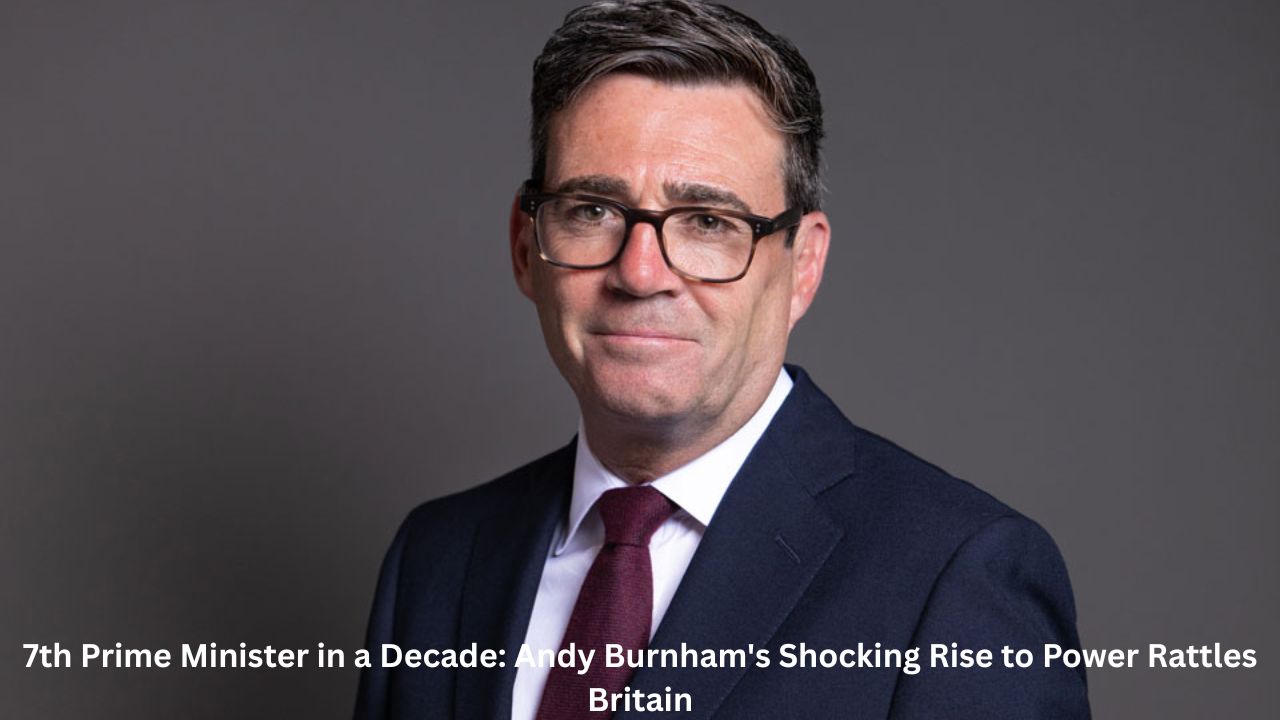
7th Prime Minister in a Decade: Andy Burnham’s Shocking Rise to Power Rattles Britain amid huge challenges. Britain has a new leader — and the world is already watching closely. On Monday, July 20, 2026, Andy Burnham walked through the black door of 10 Downing Street as the United Kingdom’s new Prime Minister, becoming the country’s seventh PM in just ten years.
His arrival closes the door on Keir Starmer’s turbulent, two-year tenure and opens a new — and uncertain — chapter for a nation gripped by economic strain, political fatigue, and rising populism.
Nicknamed the “King of the North” for his decade-long run as Mayor of Greater Manchester, Burnham’s journey to power has been anything but conventional. And within hours of taking office, he was already being tested — by markets, by protesters, and by a blunt public jab from U.S. President Donald Trump.
Here’s everything you need to know about the man now running Britain, what he said on day one, and the mountain of challenges waiting for him behind the door of Number 10.
7th Prime Minister in a Decade: Andy Burnham’s Shocking Rise to Power Rattles Britain
Who Is Andy Burnham, Britain’s New Prime Minister?
Before becoming Prime Minister, Burnham spent nearly a decade as Mayor of Greater Manchester, a region of roughly 3 million people.
Long before that, he served as a Labour MP and held Cabinet posts under former Prime Ministers Tony Blair and Gordon Brown.
Burnham had tried for the Labour leadership twice before — in 2010 and 2015 — without success.
His path back to national politics only reopened after he won a by-election in Makerfield, a northern England constituency, just weeks before becoming party leader.
Because only sitting MPs are eligible to lead the Labour Party, that by-election victory was the final piece he needed.
He faced no opposition in the race to lead Labour, and was confirmed as party leader on July 17, 2026, just three days before officially becoming Prime Minister.
A Historic and Turbulent Handover at Buckingham Palace
Burnham’s appointment was formalized in a 35-minute audience with King Charles III at Buckingham Palace on Monday morning, immediately after Keir Starmer tendered his resignation.
Starmer, who led Labour to a landslide election win in 2024 only to be ousted by his own party roughly two years later, was gracious on his way out — calling the premiership “the privilege of my life” and offering Burnham his “full support.”
Burnham didn’t mention Starmer by name in his own remarks. Instead, he used his first speech outside Downing Street to focus entirely on what comes next.
“A Circuit-Breaker for Britain”
Speaking to supporters and reporters gathered outside his new residence, Burnham didn’t hold back on ambition.
“We will make this moment a circuit-breaker for Britain, bringing forward the biggest changes in the last 40 years — a new political model and a new economic model,” he declared.
He acknowledged the public’s exhaustion with Westminster’s revolving door of leadership. “I know people at home are fed up with politics.
I hear you,” Burnham told the crowd, promising “some breathing space” for households struggling with the cost of living.
First Instruction: Ending Rough Sleeping
Rather than opening with tax policy or constitutional reform, Burnham chose a strikingly personal starting point for his premiership.
Before his Downing Street speech, he visited a homelessness charity early Monday morning — a visit he called “the best place to start.”
“I will soon go through that door behind me and issue my first instruction: to end rough sleeping in our country,” he told supporters.
A broader 10-year national plan to rebuild Britain’s economy and manufacturing base is expected to follow later in 2026.
The Trump Factor: “Poverty Stricken Disaster”
Burnham’s first day in office came with an unexpected — and blunt — welcome message from across the Atlantic.
Over the weekend, U.S. President Donald Trump took to Truth Social to comment on Burnham’s approach to fast-tracking North Sea oil and gas exploration in already-licensed fields, calling the resource “invaluable.”
Trump wrote that opening up North Sea oil would take Britain “from a Poverty Stricken Disaster to one of the Richest Countries anywhere in the World.”
The comment landed just as Burnham was settling into office — a reminder of how closely Washington is watching London’s next moves, and how transactional the U.S.–U.K. relationship has become under Trump.
Despite the blunt framing, the two leaders spoke by phone shortly after Burnham took office. According to reports, Burnham used the call to underline his commitment to defense and security cooperation between the two nations.
Notably, Labour’s deputy leader Lucy Powell has already clarified that Burnham will not reverse the party’s manifesto pledge to end new oil exploration licenses — suggesting any “opening up” of the North Sea will be limited to existing, already-licensed fields rather than a wholesale reversal of climate commitments.
Markets React: Sterling Wobbles, Then Steadies
Financial markets, always sensitive to political transitions, kept a close eye on Monday’s handover.
Sterling dipped slightly against the dollar as investors weighed early comments from Burnham that hinted at a potentially looser fiscal approach than his predecessor.
The pound was last trading around $1.34, having earlier touched highs near $1.348.
Much of the market anxiety has centered on Burnham’s choice of Chancellor. Investors had feared he might lean toward a more left-leaning figure for the role, which could signal higher spending.
Reports in the run-up to his appointment suggested centrist MP Shabana Mahmood was the frontrunner for the position, a prospect that had already helped calm bond markets in the preceding week.
Burnham ultimately named former defence secretary John Healey as his finance minister, a move that saw the pound recover some of its earlier losses.
Burnham told reporters he intends to stick to the previous government’s existing fiscal rules, though he would use “any flexibility” available within them.
“None of this is about taking risks with the economy,” he said, adding that he’s also examining raising tax-free income thresholds, which have been frozen for years.
British government bond yields, already the highest among G7 economies, remain a pressure point — 10-year borrowing costs hit an 18-year high back in May amid rising energy costs tied to the ongoing Iran conflict.
Foreign Policy: Ukraine, Gaza and a Diplomatic Balancing Act
On the world stage, Burnham moved quickly to reassure allies of continuity. He named Ukrainian President Volodymyr Zelenskyy as one of the first foreign leaders he intends to speak with, pledging that British support for Ukraine will remain “resolute.”
“I will be with him 100 percent, as Keir Starmer has been,” Burnham said, praising his predecessor’s handling of the Ukraine relationship even while avoiding direct mention of Starmer elsewhere in his speech.
Gaza, however, presents a far thornier challenge. Thousands of pro-Palestinian demonstrators gathered in central London over the weekend, urging the incoming Prime Minister to suspend arms exports to Israel and push harder for a ceasefire.
As Mayor of Greater Manchester, Burnham had previously called for a ceasefire and criticized aspects of Britain’s Gaza policy — positions that will now be tested against the realities of leading a government that must balance its relationship with Israel, the United States, and a domestic electorate deeply divided on the issue.
Notably, Burnham did not mention immigration during his first speech as Prime Minister — a striking omission given that migration, particularly small-boat Channel crossings, has become one of the most potent issues fueling the rise of Nigel Farage’s Reform UK party.
The Populist Threat: Why Burnham’s Win Matters
Burnham’s rise wasn’t just an internal Labour reshuffle — it’s widely seen as the party’s attempt to blunt the momentum of Reform UK, Nigel Farage’s anti-immigration, populist party.
Despite Labour winning a landslide election victory only around two years ago, Reform now leads national polling, with the next general election due in 2029.
Known as the “King of the North” for his popularity with working-class, northern English voters, Burnham was viewed by many within Labour as the party’s best chance of reconnecting with communities that have drifted toward Farage’s movement.
What Happens Next?
Burnham’s Cabinet appointments are still being finalized, with the Chancellor role — now confirmed to go to John Healey — being the most closely watched decision.
Beyond personnel, attention will quickly shift to concrete policy: the promised cost-of-living measures expected “this week,” the rough sleeping initiative, and the broader 10-year economic plan due later in 2026.
He also faces immediate pressure on the international front, from managing the Trump relationship and North Sea oil policy to navigating Gaza and maintaining support for Ukraine — all while leading a government for roughly 70 million people after nearly a decade spent running a single English region.
Conclusion
Andy Burnham’s arrival at 10 Downing Street marks one of the most closely watched transitions in recent British political history. He inherits a nation exhausted by leadership churn, squeezed by high living costs, and increasingly drawn to populist alternatives — the very forces his own party hopes he can neutralize.
His first day offered a mix of symbolism (a homelessness charity visit, a pledge on rough sleeping) and hard political reality (market jitters, a blunt message from Trump, and unresolved tension over Gaza).
Whether Burnham can turn his “circuit-breaker” promise into lasting change — or becomes just the latest name in Britain’s revolving door of premiers — will likely become clearer in the weeks ahead, as his Cabinet takes shape and his economic plan starts to take form.
For now, all eyes remain on Downing Street.
Also Read: 7 Major Facts as Hamas Dissolves Gaza Government After 19 Years
Also Read: A very quick guide to new prime minister Andy Burnham
Related Posts:
- 12 Explosive Days That Left Keir Starmer Fighting to…
- 5 Major Takeaways from the US Supreme Court's…

- 7 Heartbreaking Facts About Venezuela's Earthquake Disaster

- 7 Powerful Facts About Ayatollah Ali Khamenei’s…

- 7 Powerful Insights into Zohran Mamdani’s Historic…

- In 8 Moves, EU Targets China-Linked Refineries and…
