
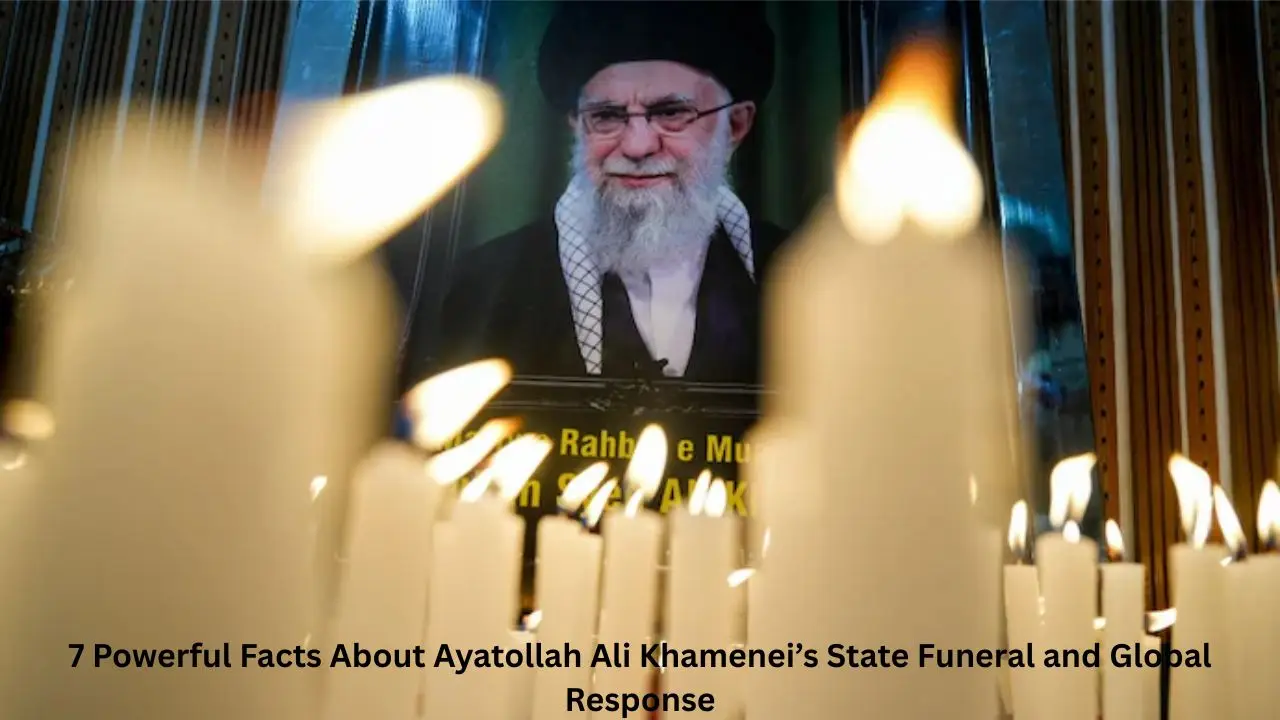
7 Powerful Facts About Ayatollah Ali Khamenei’s State Funeral and Global Response amid heightened regional tensions. Iran has entered a historic and emotionally charged chapter as it conducts the state funeral ceremonies for Supreme Leader Ayatollah Ali Khamenei, one of the country’s most influential political and religious figures.
The funeral comes after weeks of regional instability and military confrontation involving Iran, Israel, and the United States, making the ceremonies far more than a national event.
The funeral has attracted political leaders, diplomats, religious figures, and official delegations from across the world. At the same time, Iranian authorities have issued stern warnings against any military action during the mourning period, while security has been tightened across several cities and religious sites.
Beyond paying tribute to Khamenei’s legacy, the ceremonies have become a major diplomatic event that reflects Iran’s regional influence, its international partnerships, and the continuing geopolitical tensions shaping the Middle East.
7 Powerful Facts About Ayatollah Ali Khamenei’s State Funeral and Global Response
1. Iran Launches Multi-City Funeral Ceremonies
Unlike a traditional one-day state funeral, Iran has organized a series of public ceremonies across multiple cities before the final burial.
The funeral procession is designed to allow millions of Iranians from different regions to participate in paying their respects.
Tehran remains the focal point of the ceremonies, but several important religious locations have also been included because of their historical and spiritual significance.
Officials say the route symbolizes Khamenei’s role as both the country’s Supreme Leader and one of the most influential Shia religious authorities in modern history.
Authorities have deployed extensive security measures, including additional police units, Revolutionary Guard personnel, and emergency services, to manage the large crowds expected throughout the mourning period.
2. Iran Issues Strong Warning to the US and Israel
As funeral ceremonies began, Iranian officials warned the United States and Israel against carrying out any military action during the mourning period.
The warning follows weeks of heightened tensions in the region that saw military exchanges, diplomatic confrontations, and fears of a broader regional conflict.
Iranian officials stated that any attack during the funeral ceremonies would receive a decisive response.
While Washington and Jerusalem have not indicated any intention to conduct military operations during the ceremonies, the warning underscores the fragile security environment in the Middle East.
International observers believe all parties are seeking to avoid additional escalation while the funeral proceeds.
3. India Sends Political Representatives to Tehran
India’s participation has attracted considerable attention because of its traditionally balanced relations across the Middle East.
Political leaders from different parties confirmed that they had accepted invitations to attend the funeral ceremonies.
Among the prominent Indian political figures expected in Tehran are:
- Senior Congress leader Salman Khurshid
- PDP chief Mehbooba Mufti
- BJP leader M.A. Naqvi (invited)
The attendance reflects India’s longstanding diplomatic engagement with Iran while maintaining strategic relations with countries across the region.
Reports indicate that India’s official representation has been carefully calibrated to respect diplomatic protocol while avoiding any perception of taking sides in regional disputes.
4. Global Leaders Gather Amid Regional Uncertainty
The funeral has drawn delegations from numerous countries across Asia, Africa, Europe, and the Middle East.
Several governments are sending ministers, ambassadors, parliamentary representatives, or senior political figures to Tehran.
Pakistan is among the countries expected to be represented by senior leadership, while many neighboring states have also announced official participation.
For many governments, attendance represents both respect for a long-serving head of state and an opportunity for diplomatic engagement with Iranian officials during a critical transition period.
Diplomats say the gathering could lead to several bilateral meetings on the sidelines of the ceremonies, particularly involving regional security and economic cooperation.
5. Why the Funeral Route Includes Multiple Holy Cities
Iran deliberately chose several cities and religious shrines for the funeral procession rather than limiting ceremonies to Tehran. Each location represents a significant aspect of Iran’s religious and political identity.
The selected cities have historically served as centers of Shia scholarship, religious leadership, and revolutionary activity.
Officials say the multi-city route allows citizens across the country to participate while highlighting Khamenei’s decades-long influence over Iran’s political and religious institutions.
The ceremonies are also expected to reinforce national unity during a period of regional uncertainty.
6. Security Is at Its Highest Level in Years
Iranian authorities have implemented one of the country’s largest security operations in recent years.
Security measures reportedly include:
- Increased checkpoints around major cities
- Heavy deployment of security personnel
- Airspace monitoring
- Crowd-control systems
- Protection of diplomatic missions
- Enhanced surveillance near religious sites
Officials say the precautions are intended to ensure the ceremonies proceed peacefully while protecting both domestic and foreign delegations.
Security analysts note that large state funerals often require extraordinary planning because of the presence of senior international figures.
7. The Funeral Carries Major Diplomatic Significance
Beyond mourning a national leader, the funeral has become an important diplomatic event.
Delegations attending the ceremonies are expected to hold informal discussions covering issues such as:
- Regional security
- Economic cooperation
- Energy markets
- Humanitarian concerns
- Bilateral relations
The gathering comes at a time when Iran is also engaged in indirect diplomatic contacts with the United States over broader regional issues.
Many analysts believe the funeral provides an opportunity for quiet diplomacy even as official negotiations continue through other channels.
Global Reactions Reflect Iran’s Strategic Importance
The funeral has generated widespread international attention, with governments across the Middle East, Asia, Europe, Africa, and Latin America issuing condolences and reaffirming diplomatic ties with Tehran.
While the level of representation varies from country to country, the presence of foreign delegations highlights Iran’s continued geopolitical importance despite years of sanctions and regional tensions.
Several neighboring countries have sent ministers or senior officials, while others are represented by ambassadors and special envoys. International organizations have also acknowledged Khamenei’s passing, recognizing his decades-long influence on regional politics.
For many governments, attending the funeral is not only a gesture of respect but also an opportunity to maintain diplomatic engagement during a significant political transition in Iran.
India’s Diplomatic Balancing Act
India’s participation has drawn particular attention because New Delhi maintains strong relationships with multiple countries across the Middle East, including Iran, Israel, Saudi Arabia, and the United Arab Emirates.
The participation of Indian political leaders reflects the importance of India-Iran relations, which span energy cooperation, trade, regional connectivity, and strategic projects such as the Chabahar Port.
At the same time, Indian officials have sought to ensure that participation in the funeral is viewed as a diplomatic courtesy rather than a shift in foreign policy.
Analysts note that India has consistently pursued a balanced approach in West Asia, maintaining dialogue with competing regional powers while safeguarding its national interests.
The attendance of leaders from different political parties also underscores that India’s engagement with Iran extends beyond domestic political lines.
What the Funeral Means for Iran’s Political Future
While the funeral is primarily a period of national mourning, it also marks the beginning of a new chapter for Iran.
The country now faces important questions about political continuity, governance, and future policymaking. Iran’s constitutional institutions are expected to oversee the transition in accordance with established procedures, while the government has emphasized stability and continuity.
Political observers believe the coming weeks will be closely watched by regional and global powers for signals about Iran’s domestic priorities, foreign policy direction, and approach to ongoing diplomatic negotiations.
Despite speculation abroad, Iranian officials have repeatedly stressed that the country’s institutions remain fully functional and that governance will continue without disruption.
Regional Security Remains a Major Concern
The funeral takes place against the backdrop of heightened tensions across the Middle East. Recent military confrontations, disputes involving proxy groups, and concerns over maritime security have kept the region on edge.
Although indirect diplomatic contacts between Iran and the United States have shown signs of progress, fundamental disagreements remain over sanctions, regional security, and Iran’s nuclear programme.
Security experts believe all parties have a strong incentive to avoid escalation during the mourning period. Any major incident could undermine ongoing diplomatic efforts and further destabilize an already volatile region.
For now, the emphasis from most international actors has been on restraint, dialogue, and preventing misunderstandings that could trigger renewed conflict.
Economic and Energy Implications
Iran remains one of the world’s most significant energy producers, and developments inside the country are closely monitored by global markets.
Although oil prices have not experienced dramatic swings solely because of the funeral, traders continue to watch the broader geopolitical environment carefully. Any deterioration in regional security—particularly around the Strait of Hormuz—could affect global energy supplies and shipping routes.
Businesses, investors, and governments are also assessing whether Iran’s political transition will influence future sanctions, trade opportunities, and international economic cooperation. For energy-importing countries, stability in the Gulf remains a critical priority.
Public Mourning Across Iran
Millions of Iranians have participated in mourning ceremonies, with large crowds gathering in cities along the funeral route.
State institutions, religious organizations, and local communities have organized prayers, memorial events, and public tributes. National flags have been flown at half-mast, while government offices and public institutions have observed official mourning.
The scale of public participation reflects the significance of Khamenei’s role in Iran’s political and religious life over several decades. Authorities have encouraged peaceful participation and have praised citizens for maintaining order during the ceremonies.
What Happens After the Funeral?
Once the state funeral concludes, attention is expected to shift toward several key developments:
Political Transition
Iran’s constitutional institutions will continue the process of ensuring continuity in governance and leadership.
Regional Diplomacy
Diplomatic engagement with neighboring countries and global powers is expected to remain active, particularly on issues involving regional security.
US-Iran Negotiations
Indirect talks between Washington and Tehran may resume, with mediators hoping to build on recent discussions aimed at reducing tensions.
Economic Policy
Iran is likely to continue pursuing measures to address sanctions, strengthen trade partnerships, and stabilize its economy.
Regional Stability
International observers will closely monitor whether the period following the funeral leads to renewed diplomacy or increased confrontation.
Why This Event Matters Globally
Although the funeral is a domestic event for Iran, its implications extend far beyond the country’s borders.
Iran occupies a central position in Middle Eastern geopolitics, global energy markets, and regional security. Decisions made during this period could influence relations with the United States, Israel, Gulf states, Europe, Russia, China, and India.
For the international community, the funeral represents both the end of an era and the beginning of a new phase in Iran’s political journey. Governments will be watching closely for signs of continuity, reform, or shifts in foreign policy that could reshape the strategic landscape of the region.
Conclusion
The state funeral of Ayatollah Ali Khamenei is more than a ceremonial farewell to one of Iran’s longest-serving and most influential leaders. It is a defining geopolitical event unfolding at a time of heightened regional tensions, ongoing diplomatic negotiations, and significant political transition.
The participation of international delegations—including representatives from India and other countries—underscores Iran’s continued importance on the global stage. At the same time, Tehran’s security warnings and extensive protective measures reflect the fragile environment in which the ceremonies are taking place.
As millions of mourners pay their respects and world leaders closely monitor developments, the coming weeks will be crucial in determining how Iran navigates its next chapter.
Whether through renewed diplomacy, political continuity, or evolving regional dynamics, the aftermath of Khamenei’s funeral is likely to have lasting consequences not only for Iran but also for the broader Middle East and the international community.
Also Read: 21 Shocking Secrets: How AI, Cameras & Phone Networks Led to Khamenei’s Death
Also Read: Why These Cities And Shrines Were Chosen For Ali Khamenei’s Funeral Journey
Related Posts:
- 5 Major Takeaways from the US Supreme Court's…

- 7 Heartbreaking Facts About Venezuela's Earthquake Disaster
- 3 Explosive Conditions Iran Sets to End War with US…
- 9 Explosive Claims as Trump Says US Winning Iran War

- In 8 Moves, EU Targets China-Linked Refineries and…

- Trump’s 20-Point Gaza Peace Plan Gains Urgent Global…
