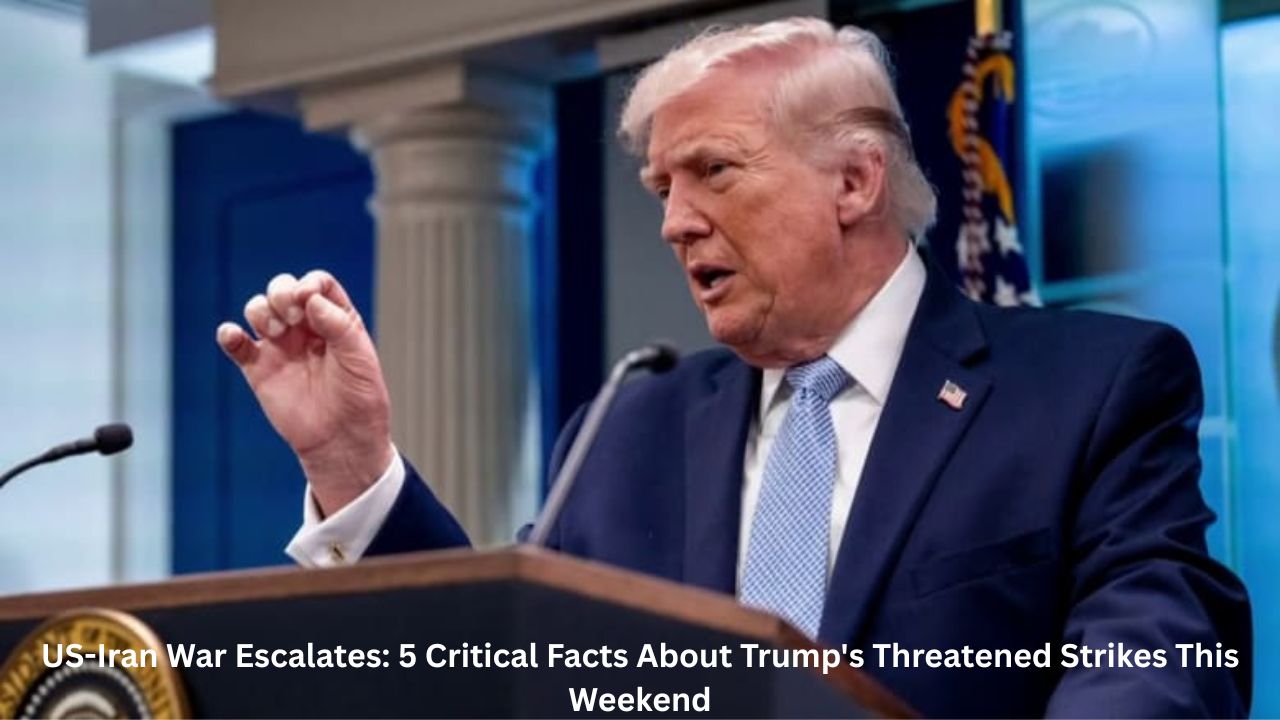
US-Iran War Escalates: 5 Critical Facts About Trump’s Threatened Strikes This Weekend with Israel possibly joining for the first time in months. Five months after the United States and Israel first launched strikes on Iran, the conflict is showing no sign of winding down — and by Friday, July 31, 2026, President Donald Trump was openly signaling that a fresh, potentially devastating round of attacks could begin within days.
Speaking at a Cabinet meeting held at Camp David, Trump warned Iran’s leadership directly: “We’ll be hitting them very hard.”
Behind that blunt public message, multiple U.S. outlets reported that the administration was actively weighing strikes on Iran’s energy infrastructure — refineries, power plants, and the broader grid — in coordination with Israel, which would mark Israel’s first direct involvement in the bombing campaign since the war’s earliest days.
Here’s what’s actually going on, why it’s happening now, and what it could mean for the region and the world.
US-Iran War Escalates: 5 Critical Facts About Trump’s Threatened Strikes This Weekend
What’s Happening Between the US and Iran Right Now?
The war between the U.S., Israel, and Iran began on February 28, 2026, when American and Israeli forces launched an initial wave of strikes on Iranian territory.
In the months since, the conflict has moved through several phases — including a 12-day Israeli military campaign in June that targeted Iran’s nuclear facilities at Isfahan, Fordow, and Natanz, followed by a fragile Memorandum of Understanding that opened a 60-day window for broader negotiations.
That diplomatic opening appears to have collapsed. By late July, ceasefire talks had stalled, and both sides resumed direct attacks.
Iran launched a drone strike against American military assets at a base in Kuwait and said it hit two tankers under U.S. escort in the Strait of Hormuz, claiming the vital shipping route was now closed due to what it called “American aggression.”
U.S. Central Command disputed that the strait was actually closed, though shipping-tracking data showed traffic had slowed dramatically — from roughly 130 crossings a day before the war to just a handful per day by the end of July.
5 Key Facts About the Looming US Strikes on Iran
1. This Is Already a Five-Month War, Not a New Crisis
It’s easy to read Friday’s headlines as the start of something new, but this is the latest chapter in a conflict that has run since February.
The war has already included direct U.S. and Israeli strikes on Iran’s nuclear program, the death of Iran’s longtime Supreme Leader Ayatollah Ali Khamenei in a strike on the first day of the fighting, and the rise of his son, Mojtaba Khamenei, as Iran’s new Supreme Leader.
What’s changed now is the scale of what’s reportedly being planned next.
2. Iran Struck First This Week — In Kuwait and the Strait of Hormuz
The immediate trigger for the current escalation appears to be Iran’s own attacks earlier in the week:
a drone strike on a Kuwaiti air base hosting American assets (Kuwait’s Ministry of Defense said the strike caused only material damage, with no casualties) and claimed strikes on two U.S.-escorted tankers in the Strait of Hormuz.
Iran said the strikes were retaliation for earlier American action, which the U.S. had itself framed as a response to an attack on its forces in Jordan — underscoring how the conflict has settled into a cycle of tit-for-tat escalation.
3. Trump Is Weighing Attacks on Iran’s Energy Grid
According to U.S. officials cited by Axios and CBS News, the White House is seriously considering a bombing campaign targeting Iranian energy infrastructure — including power plants and oil refineries — that could begin as soon as this weekend.
Trump has floated this option publicly for weeks, previously vowing to destroy a bridge or power plant every time ships are attacked in the Strait of Hormuz.
As of Friday, however, Trump had not given the final go-ahead, and CBS reported that some White House aides raised strong objections to the plan during the Cabinet meeting.
4. Israel Could Join the Campaign for the First Time in Months
If the strikes go forward as reportedly planned, they would mark the first time Israel has directly joined attacks on Iran since the war’s initial phase.
The reported coordination follows a recent Washington visit by Israeli Prime Minister Benjamin Netanyahu, who met with both Trump and U.S. Defense Secretary Pete Hegseth.
One Israeli official pushed back on the reporting, telling CBS News:
“Israel is unaware of a decision to restart full military operations.”
White House Press Secretary Karoline Leavitt, meanwhile, said the administration remains confident of winning the conflict and that Iran will not acquire a nuclear weapon under Trump’s watch.
5. Iran Says It Has a “Comprehensive Plan” to Hit Back
Tehran isn’t staying quiet about the threat.
A senior Iranian security official told the semi-official Tasnim News Agency that Iran has prepared a response plan for any new American strikes, reportedly including options to target energy infrastructure in Israel and U.S.-linked energy assets across the region.
Iran’s new Supreme Leader, Mojtaba Khamenei, has separately said the country will not submit to what he called the “excessive demands” of the United States in any future negotiations — signaling that Tehran sees the current standoff as leverage, not defeat.
Why Diplomacy Has Stalled
Trump has described himself as “losing faith” in Iran’s willingness to negotiate in good faith, pointing to what he characterizes as a pattern of broken commitments dating back to the June Memorandum of Understanding.
“All they do is make me angry,” he told reporters Friday, adding that he expects further exchanges of strikes in the near term but predicted Iran would eventually “peter out” under sustained pressure.
Iranian officials, for their part, have accused Washington of using the appearance of diplomacy to buy time for further military planning — a mutual distrust that has made a durable ceasefire difficult to reach even when both sides have technically been at the negotiating table.
The June Memorandum of Understanding had opened a 60-day window intended to settle the war’s core disputes:
Iran’s nuclear program, the pace of sanctions relief, and freedom of navigation through the Strait of Hormuz.
At the time, it was seen as the most promising diplomatic opening since the fighting began, with Iran signaling openness to diluting its stockpile of near-bomb-grade uranium under international supervision.
That the framework has unraveled so completely in the weeks since — culminating in drone strikes, tanker attacks, and now the prospect of a renewed bombing campaign — illustrates just how fragile the underlying trust between Washington and Tehran remains, even when both governments say they’d prefer a negotiated outcome.
What’s at Stake for the Global Economy
Beyond the human and political toll, an expanded campaign against Iran’s energy infrastructure carries serious economic risk.
The Strait of Hormuz is one of the world’s most critical oil shipping corridors, handling a significant share of the world’s seaborne crude exports, and even the partial disruption seen over the past week has already pushed gas prices higher and rattled energy markets.
Analysts have warned that a full campaign against Iranian power plants and refineries could trigger a broader humanitarian crisis inside Iran while also risking retaliatory strikes on energy infrastructure elsewhere in the Gulf — a scenario that could send oil prices sharply higher worldwide and add pressure to economies still recovering from earlier shocks this year.
For ordinary consumers far from the Middle East, the practical impact of this story is likely to show up first at the gas pump and in broader inflation figures, rather than in any single dramatic headline.
Energy traders have already been pricing in the risk of further disruption, and a confirmed strike on Iranian refineries or power infrastructure would almost certainly accelerate that trend, regardless of where in the world the reader happens to be filling up their tank.
Global Reactions
Reaction to the potential new strikes has been sharply divided along familiar lines.
Iranian state and semi-official media have framed any new American attack as unprovoked aggression and pointed to Iran’s own retaliatory capacity as a deterrent.
Israeli officials have offered mixed signals — with reports of active coordination with Washington sitting alongside public denials that any final decision has been made to resume full military operations.
Within the Trump administration itself, the debate appears unresolved, with reported internal objections to the plan even as the president publicly signals he’s prepared to act.
Regional and international observers, meanwhile, are watching the Strait of Hormuz closely, given how central it is to global energy security.
Conclusion
Five months into a war that has already reshaped Iran’s leadership and drawn Israel and the United States into direct, repeated military confrontation, the coming days could mark a significant new phase.
Whether President Trump ultimately gives the order to strike Iran’s energy infrastructure — and whether Israel joins that campaign for the first time since the war’s opening days — will likely determine whether this conflict edges toward a wider regional escalation or toward the kind of exhaustion-driven negotiations Trump himself has predicted.
For now, with tit-for-tat strikes continuing and diplomacy stalled, the world is left watching a volatile situation that could shift dramatically within days.
Also Read: Trump’s Iran Ultimatum: 3 Explosive Warnings as Ceasefire Talks Hang On
Also Read: Trump threatens more strikes on Iran, and other developments in the Middle East
Related Posts:
- 11 Explosive Warnings as Trump Vows to ‘Knock the…

- Trump’s 2025 Gaza Peace Plan Signing and Historic…

- 5 Powerful Highlights as Trump Lands Second Nobel…

- 9 Explosive Revelations as Trump Declares His Health…

- Trump’s Breakthrough Gaza Ceasefire Deal 2025: Key Insights

- Trump's 3 Blunt Warnings to China and Russia Over…