

11 Explosive Warnings as Trump Vows to ‘Knock the Hell Out’ of Iran if Tehran rebuilds nuclear or ballistic missile programs. United States President Donald Trump has issued one of his most explicit and aggressive warnings yet against Iran, vowing that the US would strike again if Tehran attempts to rebuild its nuclear or ballistic missile programmes.
Speaking alongside Israeli Prime Minister Benjamin Netanyahu at his Mar-a-Lago estate in Florida, Trump said Washington was closely monitoring Iran’s activities and would act “immediately” if red lines were crossed.
The remarks came amid renewed tensions across the Middle East, fragile ceasefires in Gaza and Lebanon, stalled nuclear diplomacy with Tehran, and growing Israeli concerns that Iran is rearming following the brief but intense 12-day war earlier this year involving Israel, Iran, and the United States.
At the same time, Trump warned Hamas that it would be given only a “very short period of time” to disarm under the Gaza ceasefire deal, threatening severe consequences if the Palestinian militant group fails to comply.
Taken together, Trump’s comments signalled a hardline stance that reinforces US alignment with Israel, raises the risk of renewed military escalation with Iran, and places intense pressure on Hamas as negotiations over the next phase of the Gaza truce remain stalled.
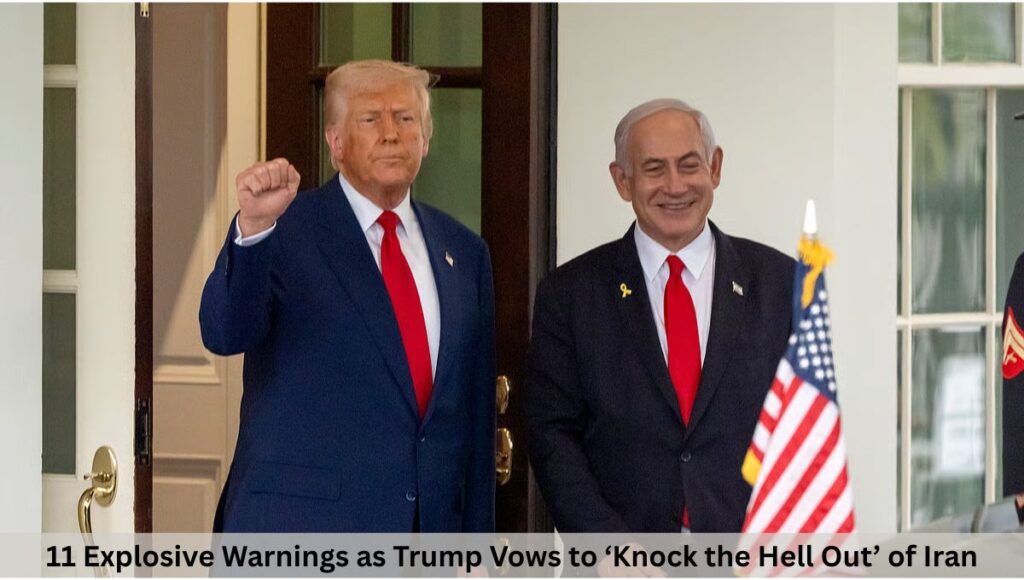
11 Explosive Warnings as Trump Vows to ‘Knock the Hell Out’ of Iran
‘We’ll Knock the Hell Out of Them’: Trump’s Stark Warning to Iran
Standing beside Netanyahu, Trump said he believed Iran was attempting to rebuild its military and nuclear capabilities following US and Israeli strikes earlier this year that targeted key Iranian facilities.
“Now I hear that Iran is trying to build up again, and if they are, we’re going to have to knock them down,” Trump told reporters. “We’ll knock them down. We’ll knock the hell out of them.”
The language marked one of Trump’s most forceful public threats toward Tehran since returning to office and underscored his willingness to use military force if diplomacy fails.
Trump added that Washington had detailed intelligence on Iran’s activities.
“We know precisely where they are headed and what they are doing,” he said. “I hope they are not moving in that direction, because we do not want to burn fuel on a B-2.”
Referring to the long-range bomber used in the earlier strike on Iran, Trump added with characteristic bluntness: “It is a 37-hour round trip, and I have no intention of wasting that fuel.”
US Prepared to Act ‘Immediately’ on Nuclear or Missile Advances
When asked whether the United States would support or participate in an Israeli strike on Iran, Trump drew a clear distinction between Iran’s missile programme and its nuclear ambitions — while making clear that both could trigger military action.
“If they will continue with the missiles, yes,” Trump said. “The nuclear? Fast. OK? One will be: Yes, absolutely. The other is: We’ll do it immediately.”
Trump declined to offer public evidence that Iran is rebuilding its programmes but insisted that US intelligence leaves little doubt about Tehran’s intentions.
“If Iran was trying to build up its nuclear programme again, we’re going to have no choice but very quickly to eradicate that buildup,” he said, adding that any future strike could be “more powerful than the last time.”
Background: US Bombing of Iranian Nuclear Sites
Earlier this year, the United States carried out air strikes against three nuclear facilities in Iran, an operation Trump has repeatedly described as a major success that “obliterated” Iran’s nuclear infrastructure.
The strikes came during the escalation commonly referred to as the 12-day war, triggered by Israeli attacks that killed senior Iranian military commanders, nuclear scientists, and civilians. Iran responded by firing hundreds of missiles toward Israel, prompting US intervention.
While no nuclear radiation leaks were reported, the strikes further strained Iran’s economy, already weakened by years of sanctions and regional conflicts.
Iran has consistently denied seeking nuclear weapons, insisting its nuclear programme is for civilian energy and scientific purposes. However, Western powers argue that Iran’s enrichment activities and missile development pose a serious global security threat.
Netanyahu Pushes Trump on Iran’s Missile Expansion
Israeli Prime Minister Benjamin Netanyahu has repeatedly warned that Iran is once again expanding its ballistic missile programme, which Israel considers an existential threat.
Israeli officials fear that Iran is producing long-range missiles in large numbers that could overwhelm Israel’s air defence systems, including the Iron Dome.
US Senator Lindsey Graham, a close Trump ally, echoed these concerns during a recent visit to Israel.
“We cannot allow Iran to produce ballistic missiles because they could overwhelm the Iron Dome,” Graham told The Jerusalem Post. “It’s a major threat.”
Netanyahu is expected to continue pressing Trump for tougher action, arguing that renewed Iranian weapons development could destabilise the entire region.
Iran Warns of ‘Immediate and Harsh’ Response
Iran responded sharply to Trump’s threats.
Ali Shamkhani, a senior political adviser to Iran’s supreme leader, warned that any aggression against Iran would trigger a severe retaliation.
“Iran’s missile capability and defence are neither containable nor subject to permission,” Shamkhani wrote on X. “Any aggression will meet an immediate harsh response beyond the imagination of its planners.”
Iranian officials have repeatedly accused the United States and its allies of using sanctions, pressure, and military force to weaken Iran and undermine its sovereignty.
Iran Says It Is in ‘Total War’
The heightened rhetoric follows recent remarks by Iranian President Masoud Pezeshkian, who said Iran is engaged in “total war” with the US, Israel, and Europe.
“In my opinion, we are at total war with the United States, Israel and Europe,” Pezeshkian said in an interview published on the website of Supreme Leader Ayatollah Ali Khamenei.
“This war is worse than the one launched against us by Iraq,” he added, referring to the devastating Iran-Iraq war of the 1980s. “It is far more complex and difficult.”
Iran faces renewed UN sanctions pushed by France, Britain, and Germany, citing concerns over Tehran’s nuclear activities.
Trump Says He Prefers a Deal — But Keeps Military Option Open
Despite his aggressive language, Trump insisted that Washington would still prefer a diplomatic solution.
“Iran should make a deal, but sometimes that doesn’t happen,” Trump said. “If they want to make a deal, that’s much smarter.”
Trump argued that Iran missed earlier opportunities to reach an agreement before the US strikes.
“They could have made a deal the last time,” he said. “They wish they made that deal.”
However, Tehran has rejected US demands as unfair and unlawful and has ruled out negotiations over its missile programme, which it considers central to its national defence.
UN Clash Over Stalled Nuclear Talks
Earlier this week, tensions spilled into the United Nations Security Council, where the US and Iran clashed over the future of nuclear negotiations.
Washington said it remains open to direct talks, while Tehran accused the US of bad faith and coercion.
No breakthrough has been achieved, leaving diplomacy stalled and increasing the risk of miscalculation.
Trump Warns Hamas: ‘There Will Be Hell to Pay’
Alongside his warnings to Iran, Trump issued a blunt ultimatum to Hamas, saying the group must disarm quickly or face devastating consequences.
“Hamas will be given a very short period of time to disarm,” Trump said. “If they don’t, there will be hell to pay.”
Trump said the issue dominated his talks with Netanyahu and was essential for moving to the second phase of the Gaza ceasefire.
“We talked about Hamas and we talked about disarmament,” he said. “They agreed to it.”
There was no immediate comment from Hamas.
Gaza Ceasefire: A Fragile First Phase
The current ceasefire in Gaza went into effect in October, following two years of devastating fighting triggered by Hamas’s October 7, 2023 attack on Israel.
The first phase of the deal calls for:
- Exchange of Israeli captives for Palestinian detainees
- Increased humanitarian aid into Gaza
- Partial Israeli troop withdrawal
However, the truce has been repeatedly strained. Israeli strikes have killed more than 400 Palestinians, according to Gaza health officials, while Hamas has yet to return the body of the last Israeli captive believed to be held in Gaza.
Israel has also restricted aid entry and delayed reopening the Rafah crossing with Egypt.
Trump Blames Hamas for Delays
Trump placed responsibility for the stalled transition to phase two squarely on Hamas.
“If they don’t disarm, as they agreed to do, then there’ll be hell to pay,” he said.
Hamas has said it will not give up its weapons as long as Israeli occupation of Palestinian territory continues, though it has previously offered a long-term truce of seven to ten years.
Israel, meanwhile, has warned it will resume military action if Hamas is not disarmed peacefully.
Netanyahu and Trump: Alignment With Limits
Trump described his relationship with Netanyahu as close and productive.
“I think we came to a lot of conclusions,” Trump said. “There’s very little difference in what we’re looking at.”
Netanyahu echoed that sentiment, saying: “Sometimes we have different ideas, but we work it out, and most of the time we see eye to eye.”
However, Trump acknowledged disagreements over the occupied West Bank.
“We don’t agree on the West Bank 100 percent,” Trump said, without elaborating.
Reconstruction of Gaza and Phase Two Talks
Trump said reconstruction in Gaza would begin soon despite the fragile ceasefire.
“Reconstruction of Gaza will begin soon,” he said. “Hope to get to phase two very quickly.”
Phase two envisions:
- A full Israeli withdrawal
- Hamas giving up governance and weapons
- Deployment of an international security force
- Installation of a Palestinian technocratic administration
A UN Security Council resolution adopted in November mandates the international security force, but key details remain unresolved.
Broader Regional Issues: Lebanon, Syria, Turkey
Trump and Netanyahu also discussed:
- Hezbollah in Lebanon
- Syria’s new leadership after Bashar al-Assad’s ouster
- The possibility of Turkish peacekeepers in Gaza
Trump said he hoped Israel could maintain a peaceful border with Syria, though Israel has expressed deep mistrust of Syria’s new president, a former Islamist rebel commander.
Israel has carried out air strikes in Damascus in recent months, citing security concerns.
Risk of Wider War
Despite Trump’s claim to have brokered ceasefires involving Israel and Hamas, Israel and Iran, and Israel and Lebanon, analysts warn that renewed strikes on Iran could spiral into a broader regional conflict.
In June, Iran responded to US strikes by launching missiles at a US airbase in Qatar. While no US casualties were reported, the incident underscored the risk of escalation.
Trita Parsi of the Quincy Institute warned that Iran’s response to another attack could be far harsher.
“Unless they strike back hard, Iran will become a country that Israel will bomb every six months,” Parsi said.
A Region on a Knife’s Edge
Trump’s remarks underscore the precarious balance in the Middle East.
On one hand, he portrays himself as a dealmaker pushing ceasefires and reconstruction. On the other, his threats signal readiness to unleash overwhelming force against Iran and Hamas.
Whether diplomacy can survive this moment — or whether the region slides back into large-scale conflict — may depend on whether red lines are crossed in Tehran or Gaza in the coming weeks.
For now, Trump’s message is clear:
disarm, deal, or face devastating consequences.
Also Read: US Warns Iran After Ceasefire: “Don’t Even Think About Nuclear Weapons Again” – VP JD Vance
Also Read: Trump Says Israel and US Will ‘Knock The Hell’ Out of Iran After Leader Vows ‘Total War’
Related Posts:
- Trump’s 2025 Gaza Peace Plan Signing and Historic…

- 9 Explosive Revelations as Trump Declares His Health…

- 12 Explosive Claims as Donald Trump Says Iran War…
- 10 Explosive Warnings as Donald Trump Calls Iran…
- Trump to Host 2026 G20 Summit at His Florida Golf…

- 5 Powerful Highlights as Trump Lands Second Nobel…
