7 Powerful Moments from King Charles’ Historic US Visit Amid Tensions, a security scare, and diplomatic challenges. The arrival of King Charles III and Queen Camilla at the White House marked far more than a ceremonial moment. It unfolded against a backdrop of political friction, global uncertainty, and a nation still shaken by a recent security scare.
Welcomed by Donald Trump and Melania Trump, the royal visit symbolizes both continuity and strain in one of the world’s most enduring alliances—the relationship between the United States and the United Kingdom.
This four-day state visit, timed to coincide with the 250th anniversary of American independence, carries enormous symbolic weight.
Yet beneath the pageantry lies a complex diplomatic mission:
to steady a relationship showing visible cracks.
7 Powerful Moments from King Charles’ Historic US Visit Amid Tensions
A Royal Welcome at a Tense Moment
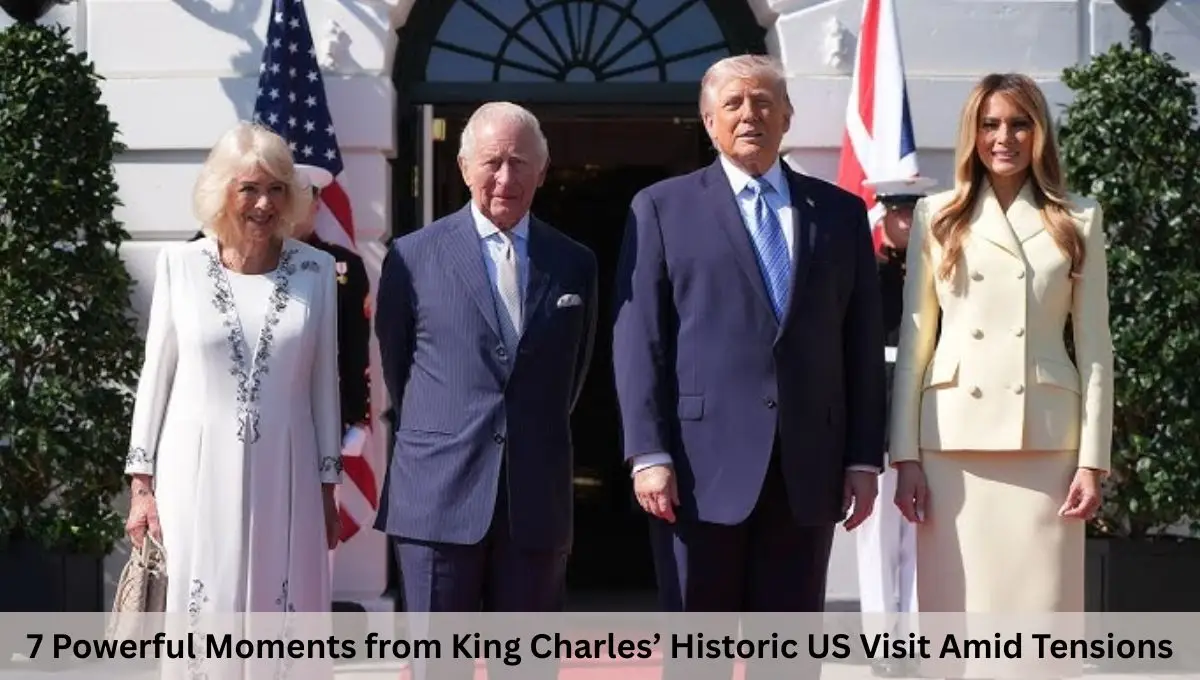
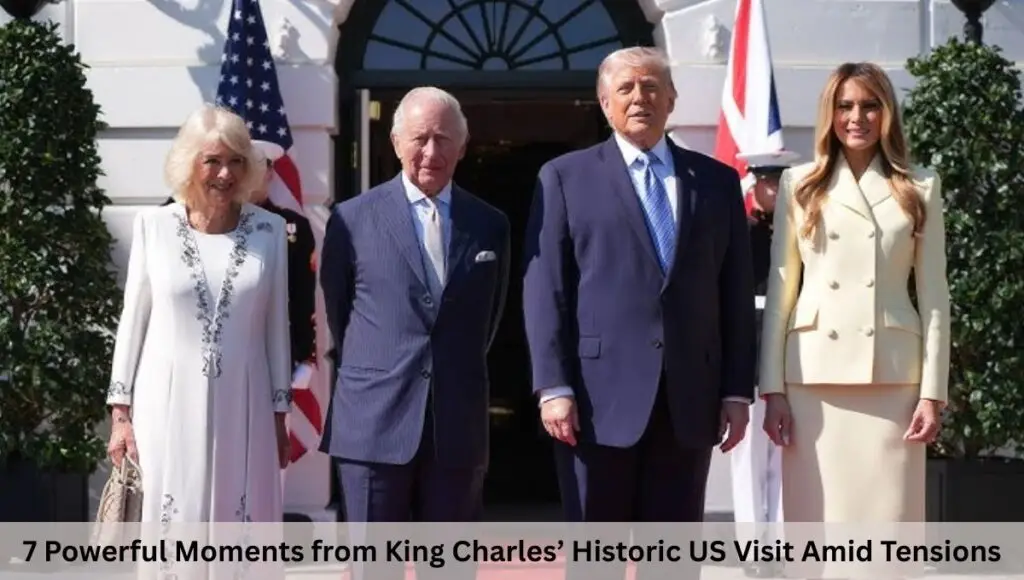
The scene at the White House was classic diplomacy—flags lining the streets, formal greetings, and carefully choreographed smiles.
King Charles and Queen Camilla were greeted warmly by President Trump and the First Lady.
The two couples exchanged pleasantries, posed for photographs, and retreated inside for a private tea—an understated but meaningful gesture.
Soon after, they toured the newly expanded White House beehive, a symbolic nod to sustainability—an issue close to the King’s heart.
But the calm setting masked a deeper reality:
Washington was still reeling from a shocking shooting incident just days earlier, and political tensions between London and Washington were far from resolved.
A Visit Shadowed by Security Concerns
The royal visit comes just days after a dramatic shooting at the Washington Hilton during a high-profile dinner attended by President Trump.
The incident triggered a massive security response, forcing authorities to reassess protocols ahead of the royal arrival. Security across Washington was significantly tightened.
Officials implemented additional measures to ensure the safety of not just the British monarch but also top US leadership.
For King Charles, the message was clear:
proceed—but cautiously.
Buckingham Palace confirmed that the visit would go ahead after consultations with US authorities, emphasizing gratitude toward law enforcement for their swift actions.
The “Special Relationship” Under Strain
For decades, the US-UK alliance—often referred to as the “special relationship”—has been a cornerstone of global stability.
But recent developments have tested that bond. At the center of the tension is the ongoing conflict involving Iran.
The UK government, led by Keir Starmer, declined to support US military action—drawing sharp criticism from President Trump.
Trump’s remarks have been unusually blunt, reportedly describing the British Prime Minister as “no Winston Churchill.” The disagreement has extended beyond rhetoric.
Reports suggest internal US discussions about reassessing support for British sovereignty over the Falkland Islands—a move that would have been unthinkable in previous decades.
Yet despite these tensions, Trump has consistently separated his criticism of the UK government from his admiration for King Charles, describing him as a “great man” and “friend.”
Diplomacy Through Symbolism
Unlike elected leaders, King Charles operates in a unique space—one defined not by policy decisions but by symbolism and soft power.
This visit is a textbook example of what analysts call “ceremonial diplomacy.”
The King cannot negotiate treaties or military alliances. But he can shape tone, perception, and public sentiment.
By appearing alongside President Trump, addressing Congress, and engaging with American communities, Charles sends a powerful message:
the alliance endures, even in disagreement.
Garden Party Diplomacy
Following the White House meeting, the royal couple attended a garden party at the British embassy in Washington.
The event brought together a wide array of influential figures—from policymakers to cultural leaders. Among attendees were senior US officials, political figures, and diplomats.
The atmosphere was relaxed, even festive, with guests enjoying traditional British fare such as smoked salmon sandwiches and roast beef.
Despite the political tensions looming in the background, the event projected unity and continuity.
This contrast—public warmth amid private disagreement—is a hallmark of modern diplomacy.
The King’s Historic Address to Congress
One of the most significant moments of the visit is King Charles’ address to the US Congress.
This will be only the second time a British monarch has spoken before a joint session, the first being Queen Elizabeth II in 1991.
The speech is expected to last around 20 minutes and will focus on:
- Shared democratic values
- Historical ties
- The importance of cooperation
- Global challenges such as security and climate change
Importantly, the King is expected to acknowledge differences between the two nations while emphasizing their ability to overcome them.
This message is particularly relevant at a time when geopolitical alliances are being tested worldwide.
A Subtle Response to Global Tensions
While the King is expected to avoid direct political statements, his speech may include subtle references to current global issues.
These could include:
- The Iran conflict
- NATO cooperation
- The Ukraine war
- Economic tensions
By addressing these themes indirectly, Charles maintains neutrality while still contributing to the broader conversation.
This delicate balance is central to the monarchy’s role in modern diplomacy.
A Carefully Managed Meeting with Trump
Behind closed doors, King Charles and President Trump are expected to hold a private bilateral meeting.
Unlike many of Trump’s past meetings with foreign leaders, this one will reportedly be off-camera—a deliberate choice aimed at avoiding potential diplomatic missteps.
Given the unpredictable nature of modern politics, both sides appear keen to ensure the meeting remains controlled and respectful.
This reflects the high stakes of the visit—not just politically, but symbolically.
The Role of Melania Trump and Queen Camilla
While much attention focuses on the King and President, the roles of Melania Trump and Queen Camilla are equally important.
The First Lady is playing a key role in hosting duties, including:
- Designing the state dinner
- Coordinating cultural events
- Engaging with guests
Queen Camilla, known for her advocacy on social issues, is expected to participate in educational and community-focused initiatives.
Their interactions help humanize the visit and broaden its impact beyond politics.
The State Dinner: Power and Pageantry
A highlight of the visit is the state dinner at the White House.
This event represents the pinnacle of diplomatic hospitality, featuring:
- Formal attire (white tie)
- Carefully curated guest list
- Symbolic menu choices
- Cultural performances
President Trump has reportedly taken a personal interest in planning the event, underscoring its importance.
State dinners are more than social gatherings—they are strategic displays of alliance and respect.
Beyond Washington: A Broader American Journey
The royal visit extends beyond Washington, reflecting an effort to connect with the American public.
New York Visit
King Charles and Queen Camilla will visit the September 11 Memorial, paying tribute to victims of the 2001 attacks.
This moment highlights shared experiences of loss and resilience between the two nations.
Virginia Engagements
In Virginia, the King will meet conservation groups—a cause he has championed for decades. This aligns with his long-standing commitment to environmental issues and sustainability.
The Shadow of Controversy
No major diplomatic visit is without complications.
This trip is overshadowed by ongoing controversies, including:
- The Jeffrey Epstein scandal involving Prince Andrew
- Political tensions between the US and UK
- Domestic criticism in both countries
Calls for the King to meet Epstein survivors have been firmly declined, with officials citing legal concerns.
The decision reflects the careful balancing act required to navigate sensitive issues without derailing the visit.
Soft Power in Action
King Charles’ visit demonstrates the enduring relevance of monarchy in global affairs.
While the UK no longer wields imperial power, it retains influence through:
- Cultural diplomacy
- Historical ties
- Symbolic leadership
This “soft power” can be particularly effective during periods of political tension.
By emphasizing shared history and values, the King helps create space for dialogue—even when governments disagree.
A Relationship Tested, Not Broken
Despite current tensions, history suggests the US-UK alliance is resilient.
From the Suez Crisis to disagreements over Iraq and trade, the two nations have weathered numerous disputes. Each time, they have ultimately found common ground.
King Charles’ message to Congress is expected to echo this theme:
Differences are inevitable—but the partnership endures.
What to Watch Next
As the visit unfolds, several key moments will shape its impact:
- The tone of King Charles’ Congress speech
- The outcome of his meeting with Trump
- Public reaction in the US
- Media coverage and global perception
These factors will determine whether the visit succeeds in easing tensions—or simply highlights them.
Conclusion: A Delicate Diplomatic Balancing Act
King Charles’ US visit is more than a ceremonial tour—it is a high-stakes diplomatic mission.
Set against a backdrop of political disagreements, security concerns, and global uncertainty, the visit aims to reinforce one of the world’s most important alliances.
Through careful words, symbolic gestures, and strategic appearances, the King seeks to remind both nations—and the world—that their partnership runs deeper than any single disagreement.
In an era of shifting alliances and rising tensions, that message may be more important than ever.
Also Read: Why King Charles’ U.S. State Visit Is the ‘Most High-Stakes’ Overseas Trip of His Reign