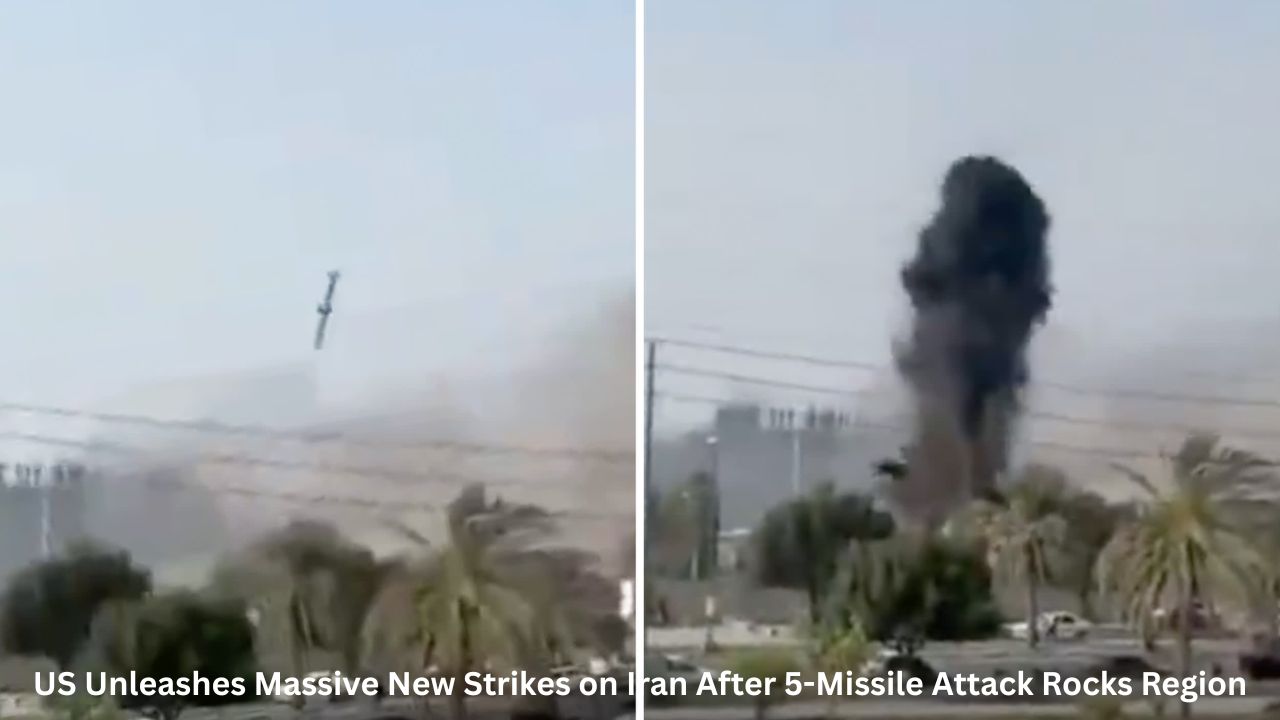
US Unleashes Massive New Strikes on Iran After 5-Missile Attack Rocks Region with the war spreading into Iraq, Saudi Arabia, Egypt and even the Caspian Sea. A fragile pause in one of the most dangerous conflicts of the decade has collapsed.
Just five days after President Donald Trump halted an intense US bombing campaign against Iran to give diplomacy one more shot, American forces are back in action — and the wider Middle East is being pulled in with them.
Late Wednesday, US Central Command (CENTCOM) confirmed it had carried out a two-hour wave of strikes on dozens of Iranian military sites, in direct retaliation for an Iranian ballistic missile attack on a US base in Jordan a day earlier.
The exchange marks a sharp and worrying turn in a war that has now stretched on for five months, with fresh fighting erupting almost simultaneously in Iraq, Saudi Arabia, Egypt and even the Caspian Sea.
For a global audience watching oil markets, shipping lanes and diplomatic channels for signs of where this goes next, here is a clear breakdown of what just happened, why it happened, and what could come next.
US Unleashes Massive New Strikes on Iran After 5-Missile Attack Rocks Region
What Triggered the Latest Round of Strikes
Iran’s Missile Attack on a US Base in Jordan
The current flare-up traces back to Tuesday night, when Iran’s Islamic Revolutionary Guard Corps (IRGC) fired multiple ballistic missiles toward American forces stationed in Jordan.
Jordanian and US military officials say all five missiles were intercepted before they could cause damage or casualties.
It was the first attack of its kind since Trump had suspended the bombing campaign the previous Friday, following 13 consecutive nights of US strikes on Iranian military targets.
That pause had been billed as a window for renewed negotiations. Instead, it lasted less than a week.
Trump’s Vow to Hit Back
Speaking from the Oval Office on Wednesday, Trump made clear the pause was over. He told reporters the US would respond forcefully, framing the coming strikes as payback rather than a fresh escalation.
Speaking to Fox News, he said simply, “they’re going to get a beating,” while also claiming Iranian officials had privately admitted the missile launch was a mistake and asked Washington to hold off retaliating. The White House pressed ahead regardless.
Inside the US Strikes on IRGC Targets
A Two-Hour Operation Against Dozens of Sites
At 10pm Eastern Time on Wednesday, CENTCOM said it had completed what it called a “heavy wave of strikes” against Iran, running from roughly midnight to 2am GMT on Thursday.
According to the military’s own statement, the operation struck dozens of Islamic Revolutionary Guard Corps targets nationwide, including military command centres, missile and drone manufacturing facilities, coastal surveillance posts, and sites tied to Iran’s maritime operations in the Gulf.
US officials framed the goal as reducing the ability of Iran and its regional allies to threaten American troops, commercial shipping routes, and neighbouring Gulf states — rather than an open-ended new offensive.
Casualties and Iran’s Defiant Response
Iranian state media reported that three people were killed in the strikes on Qeshm Island, a strategic location near the Strait of Hormuz.
In response, the IRGC vowed to “punish the aggressor” and warned that any nation assisting US operations would also face retaliation.
Iranian commanders separately reasserted that they retain full operational control over the Strait of Hormuz, a warning aimed squarely at any outside power considering intervention in the vital waterway.
The War Spreads Well Beyond Iran’s Borders
What sets this latest escalation apart from earlier rounds is how quickly the fighting has bled into neighbouring countries — turning a bilateral US-Iran confrontation into a genuinely regional crisis.
US-Saudi Joint Strikes Hit Militias in Iraq
Hours before the strikes on Iran itself, the United States and Saudi Arabia carried out coordinated air raids on Iran-aligned militia sites across eastern Iraq.
The targets belonged to Iraq’s Popular Mobilisation Forces (PMF), an umbrella of Shia armed groups that Riyadh blames for recent drone attacks on Saudi oil infrastructure, including the Abqaiq processing facility.
The PMF says at least 20 of its fighters were killed and around 32 wounded. It was notably the first time Saudi Arabia has publicly joined Washington in a strike inside Iraq, a significant shift for a kingdom that had previously kept its involvement quieter.
Iraq’s presidency condemned the operation as a violation of national sovereignty, while separately rejecting any claim that it had approved the use of Iraqi territory to stage attacks on neighbouring states.
Houthi Attacks Widen the Front to the Red Sea
Compounding the pressure, Yemen’s Iran-backed Houthi movement has escalated its own campaign this week, launching attacks against Saudi Arabian oil facilities and vessels navigating the Bab al-Mandeb Strait — one of the world’s most critical shipping corridors.
The combination of Houthi strikes and the new Iraq front raises fresh questions about the security of regional energy exports.
A Mysterious Drone Strike in Egypt
Adding another unpredictable element, a drone struck a US-owned gas storage tanker at the Egyptian port of Damietta on the Mediterranean coast, according to an initial assessment from British maritime security firm Ambrey.
Egypt’s Petroleum Ministry confirmed a fire broke out at the port but did not mention any drone strike, and responsibility for the attack has not been established.
The Strait of Hormuz Standoff
Even before this week’s strikes, tension was building over the Strait of Hormuz, the narrow waterway through which roughly a fifth of the world’s oil passes daily.
Iranian officials this week formally rejected an Omani-brokered proposal for a 50-50 joint management arrangement over the strait, insisting that any workable route must remain largely under Iranian control.
Iranian deputy foreign minister Kazem Gharibabadi said Tehran would not accept a US-backed southern route or any alternative not under Iran’s watch, warning that the strait would stay effectively closed otherwise.
He went further, cautioning that Iran would treat any foreign vessel involved in a Western-led de-mining initiative — reportedly backed by roughly 34 countries — as a legitimate military target.
For global shipping and energy markets, that stance alone is enough to keep insurance premiums and oil prices on edge.
A New and Unexpected Front: The Caspian Sea
In a sign of how far this conflict’s ripple effects now extend, Iran is also grappling with its first war-related incident in the Caspian Sea.
Ukraine’s military struck a vessel it described as a military cargo ship travelling from Russia, killing one crew member and wounding several others.
Iran insists the vessel was a commercial ship carrying iron ore, and local reports identified the sailor killed as a 23-year-old on his first voyage.
Iran’s foreign minister said Ukraine’s top diplomat had assured him the strike was unintentional, but Tehran is still pressing Kyiv to accept responsibility.
Analysts note Iranian officials are wary of a scenario where this incident draws European powers more directly into the broader war, something Tehran would prefer to avoid even as it hardens its position elsewhere.
Why Diplomacy Keeps Falling Apart
Regional mediators, including Oman, have continued pushing for a negotiated end to the conflict, which began on February 28 when the US and Israel first struck Iran. But each attempt at a pause has proven short-lived.
Iranian officials argue Washington has failed to honour earlier commitments from a June memorandum of understanding — including opening a southern shipping route, releasing frozen Iranian funds, and reining in Israeli operations in Lebanon.
That perceived breach of trust, combined with a growing belief within Iran’s political and military establishment that a larger US bombing campaign is inevitable, has hardened Tehran’s negotiating posture rather than softened it.
Analysts tracking the region say Iranian leadership now appears less willing to make concessions on sensitive issues like the Strait of Hormuz or its nuclear programme, precisely because officials expect the conflict to intensify regardless of what they offer at the table.
Conclusion: A Conflict Still Far From Over
What began as a US-Israel military campaign against Iran in February has now evolved into a sprawling regional crisis touching Jordan, Iraq, Saudi Arabia, Yemen, Egypt, Lebanon and, most surprisingly, the Caspian Sea.
The latest US strikes on IRGC targets may have been framed as a direct response to a single missile attack, but the surrounding chain of events — Saudi Arabia’s first public military role alongside Washington, renewed Houthi attacks on oil infrastructure, and Iran’s hardening stance on Hormuz — suggests a conflict that is broadening rather than winding down.
For governments, energy markets, and shipping companies watching from outside the region, the core risk is no longer confined to Iran and the US alone.
With multiple fronts now active at once and diplomatic trust badly damaged on both sides, the coming days are likely to determine whether this becomes a brief, contained flare-up or the next major phase of a war already stretching into its sixth month.
Also Read: 9 Explosive Facts About US ‘Bunker Buster’ Strikes on Iran Near Hormuz
Also Read: US carries out massive new wave of attacks on Iran, CENTCOM says
Related Posts:
- 10 Explosive Warnings as Donald Trump Calls Iran…
- 3 Explosive Conditions Iran Sets to End War with US…

- 11 Explosive Warnings as Trump Vows to ‘Knock the…

- 7 Powerful Facts About Ayatollah Ali Khamenei’s…

- 10 Explosive Strikes: Israel Bombs Tehran Oil Depots…

- 7 Powerful Ways the US–Saudi $1 Trillion Partnership…