
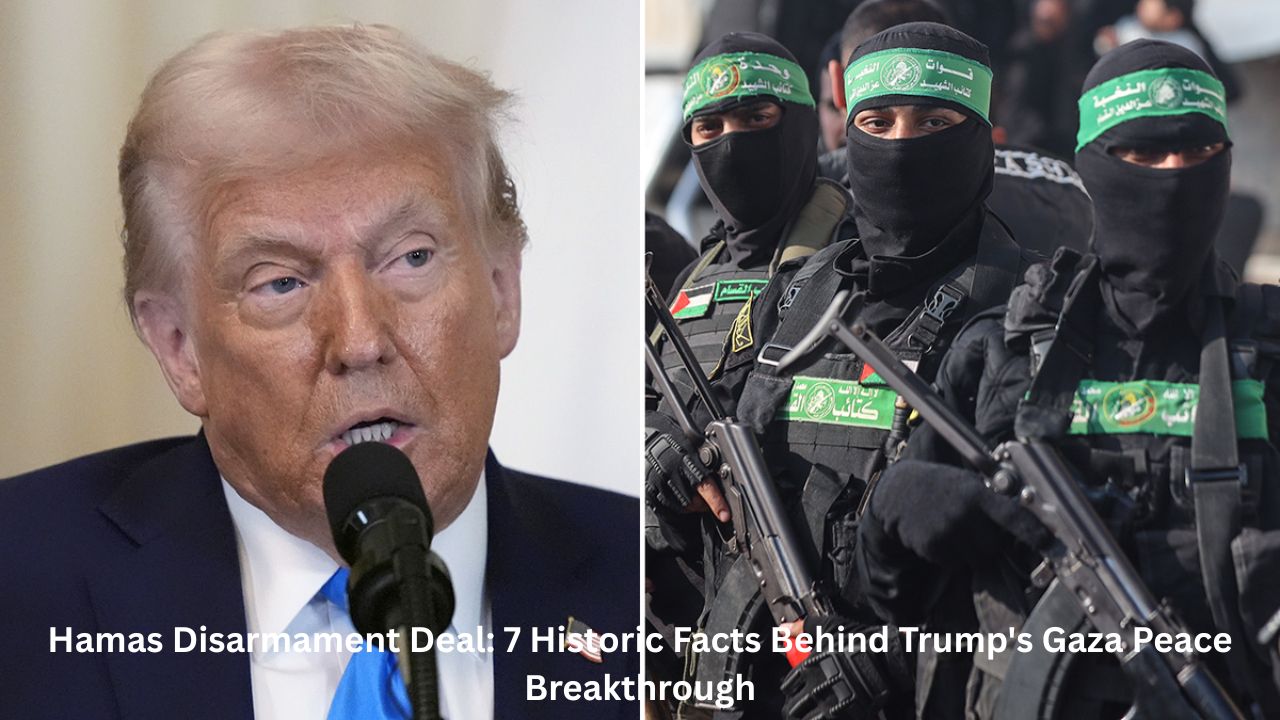
Hamas Disarmament Deal: 7 Historic Facts Behind Trump’s Gaza Peace Breakthrough, brokered by his peace team. Nearly two years after the war in Gaza upended the Middle East, the region may finally be inching toward a genuine turning point.
On July 30, 2026, Hamas and other Palestinian armed factions agreed in principle to a document laying out how they will give up their weapons — a step US President Donald Trump has described as a “monumental step toward lasting peace and security.”
The announcement came through Trump’s Board of Peace, the body Washington set up to oversee Gaza’s post-war transition, and it arrives after months of tense, on-again-off-again negotiations in Egypt. For a region that has seen ceasefires collapse before, the world is watching cautiously.
Here’s a complete, easy-to-follow breakdown of what’s actually in the Hamas disarmament deal, how it’s expected to unfold, and why so many people — including Israeli officials themselves — remain doubtful it will hold.
Hamas Disarmament Deal: 7 Historic Facts Behind Trump’s Gaza Peace Breakthrough
1. What the Agreement Actually Says
According to a copy of the document, the deal commits Hamas and other Palestinian factions to a precise disarmament roadmap that must be finalized within 14 days, with extensions possible only if an international verification body and all parties agree.
It doesn’t hand weapons over to Israel or any outside power.
Instead, a newly formed Palestinian body — the National Committee for the Administration of Gaza (NCAG) — will take custody of all weapons, working alongside an International Stabilization Force (ISF) that is expected to begin deploying inside the territory.
A senior negotiator involved in the talks summed up the guiding principle bluntly:
“One authority, one law, one weapon.”
In other words, no faction, militia, or armed group would be allowed to operate outside the new government’s control.
2. How the Disarmament Roadmap Will Work
Under the framework being finalized, disarmament won’t happen overnight.
Reports indicate the process could stretch across six to eight months, with all heavy and light weaponry gradually decommissioned.
Hamas is expected to hand over maps detailing its tunnel network, weapons-production sites, and arms depots so they can be dismantled systematically rather than piecemeal.
Sector-by-Sector Roll out
The new Palestinian technocratic government would take administrative control of each part of Gaza only after that specific area has been independently verified as demilitarized.
This staged approach is designed to build trust gradually rather than asking either side to make a single leap of faith.
A New Police Force and Amnesty Terms
A newly trained Palestinian police force — vetted through Israel’s internal security apparatus — would be deployed to maintain order in areas under NCAG authority.
Fighters who voluntarily hand in personal weapons would be eligible for payments under a buyback scheme, and rank-and-file Hamas members would reportedly receive amnesty and be allowed to remain in Gaza, provided they lay down arms and step back from any governing or military role.
3. Trump and the Board of Peace Call It “Historic”
Trump wasted no time framing the agreement as a diplomatic win.
Posting on Truth Social, he wrote that the deal represented a monumental step toward lasting peace and security, adding that Gaza would ultimately be governed by a new Palestinian administration working alongside the Board of Peace, while Israel would gain the security guarantees it has long sought.
He framed the disarmament process as the next phase of the ceasefire arrangement his administration brokered in October 2025 to halt the fighting.
4. Hamas’s Conditions — and a Clear Warning
Hamas’s own negotiators have been careful not to present this as unconditional surrender.
Ghazi Hamad, part of the group’s negotiating delegation, described the talks as difficult but said negotiators pushed for the most workable formula available.
Crucially, Hamad indicated that Hamas will not follow through on any part of the disarmament plan unless Israel also fulfills its side of the bargain — namely, a phased military withdrawal and real movement on reconstructing the devastated territory.
That reciprocity is baked into the roadmap by design.
As one diplomatic source explained, the entire framework rests on sequencing, not trust:
each side’s completed commitment triggers the other’s next step, with an independent verification mechanism checking compliance along the way.
5. Israel’s Skepticism — and the Road to Withdrawal
Despite the fanfare in Washington, Israeli officials reportedly remain deeply unconvinced Hamas will actually follow through, viewing the agreement as a possible tactical maneuver to relieve mounting military, political, and financial pressure rather than a genuine strategic shift.
Under the draft terms, Israeli forces would pull back to the so-called “Yellow Line” — the position they held immediately after the October 2025 ceasefire — with any further withdrawal contingent on verified progress toward full disarmament.
Israel would also be expected to halt targeted strikes on Hamas figures inside Gaza, except in cases of what it deems an imminent threat.
Israeli suspicion also extends to two of the mediating countries, Qatar and Turkey, both formally part of the Board of Peace despite earlier Israeli objections.
A US official involved in the process argued that including them ultimately proved the right call, framing the new Gaza administration as a genuine alternative to both Hamas and the Palestinian Authority.
6. Cairo Talks, Regional Pressure, and Iran’s Pushback
The breakthrough followed days of intensive negotiations in Egypt, mediated by Egyptian, Qatari, and Turkish officials, with Egyptian intelligence chief Hassan Rashad playing a central role given his close ties to Hamas’s political leadership.
Egypt, Qatar, and Turkey are all reported to have applied significant pressure on Hamas to accept the terms, partly by tightening the group’s access to outside funding.
Not every regional power is pushing in the same direction, however.
Iran, according to sources familiar with recent contacts, has urged Hamas to slow down and avoid rushing into a binding agreement — a reminder that Gaza’s fate remains tangled in broader regional rivalries well beyond the negotiating table.
7. The Human Cost Behind the Diplomacy
The urgency behind this deal is impossible to separate from the toll of the war itself.
Gaza’s Health Ministry says the two-year conflict, which formally paused under the October 2025 ceasefire, killed more than 73,000 Palestinians and left much of the territory in ruins, with most of its roughly two million residents still living in tents or makeshift shelters.
Even after the ceasefire took hold, the same ministry reports nearly 1,200 more Palestinians have died in continued strikes and incidents — a mix of militants and civilians, including children.
That fragility was on full display the same day the disarmament announcement broke:
Israeli strikes on Gaza on July 30 reportedly killed several Palestinians, including children, according to news reports — a stark illustration of how far the situation remains from a durable calm even as diplomats celebrate progress on paper.
Not Everyone Is on Board
Agreement among “Hamas and other factions” doesn’t mean unanimity.
Palestinian Islamic Jihad, another armed group active in Gaza, has publicly disputed characterizations of a finalized deal, saying it has reservations about the exact wording being circulated and disputing claims that all factions have signed off.
What Happens Next
With the 14-day window for finalizing the detailed roadmap now underway, the coming weeks will be the real test.
Analysts point out that the language itself carries weight: officials have been careful to describe the weapons process as “inventory and storage” rather than outright “disarmament,” a distinction that matters because true disarmament, in a strict military sense, is typically imposed by an adversary — something Palestinian factions are highly unlikely to accept.
Whether that semantic difference translates into a workable, monitored handover of weapons — sector by sector, verified at every stage — will determine whether this becomes the moment Gaza’s post-war chapter truly begins, or another false start in a conflict that has seen many.
Conclusion
The Hamas disarmament deal marks the most concrete step yet toward implementing the broader Gaza peace framework Trump’s administration has been pushing since the October 2025 ceasefire.
It offers a detailed, phased plan — built around the National Committee for the Administration of Gaza, an international stabilization force, and a reciprocal, verification-based sequence of steps — that goes well beyond previous, vaguer pledges.
Yet the gap between signing a document and actually removing weapons from a territory scarred by two years of war remains enormous.
Israeli skepticism, Iranian pressure in the opposite direction, and Palestinian Islamic Jihad’s public objections all suggest the road ahead will be anything but smooth.
For the people of Gaza, still living amid rubble and uncertainty, the coming weeks of roadmap negotiations will show whether this “historic” agreement becomes a lasting foundation for peace — or simply the latest promise still waiting to be kept.
Also Read: 7 Major Facts as Hamas Dissolves Gaza Government After 19 Years
Also Read: As Trump Announces Hamas Disarmament Deal, A Look At His 20-Point Gaza Plan
Related Posts:
- Trump’s 2025 Gaza Peace Plan Signing and Historic…

- 5 Powerful Highlights as Trump Lands Second Nobel…

- Trump’s 20-Point Gaza Peace Plan Gains Urgent Global…

- Dramatic Moments Behind Trump’s Gaza Peace Push and…

- 7 Shocking Reasons FIFA’s Peace Prize for Trump…

- Trump’s 2025 Nobel Peace Prize Snub: Politics Over…
