

5 Powerful Highlights as Trump Lands Second Nobel Peace Nomination in Asia, Meeting Japan’s Emperor and Signing Critical Minerals Deal. US President Donald Trump has received his second Nobel Peace Prize nomination in a single week, with Japan joining a growing list of nations praising his diplomatic efforts.
Japan’s newly elected Prime Minister Sanae Takaichi, the country’s first female leader, announced her intention to nominate Trump for the 2025 Nobel Peace Prize, highlighting his recent mediation in conflicts across Asia and the Middle East.
The White House confirmed the development on Tuesday, describing it as a “strong endorsement of the president’s peace-first diplomacy.”
The announcement came as Trump arrived in Tokyo, the second leg of his five-day Asia tour, following his attendance at the ASEAN Summit in Malaysia — where he helped broker a peace deal between Thailand and Cambodia. “Mr. President succeeded in securing a ceasefire deal between Thailand and Cambodia… also, the deal you have recently achieved in the Middle East is an unprecedented, historic achievement,”
— Prime Minister Sanae Takaichi said during their meeting in Tokyo.
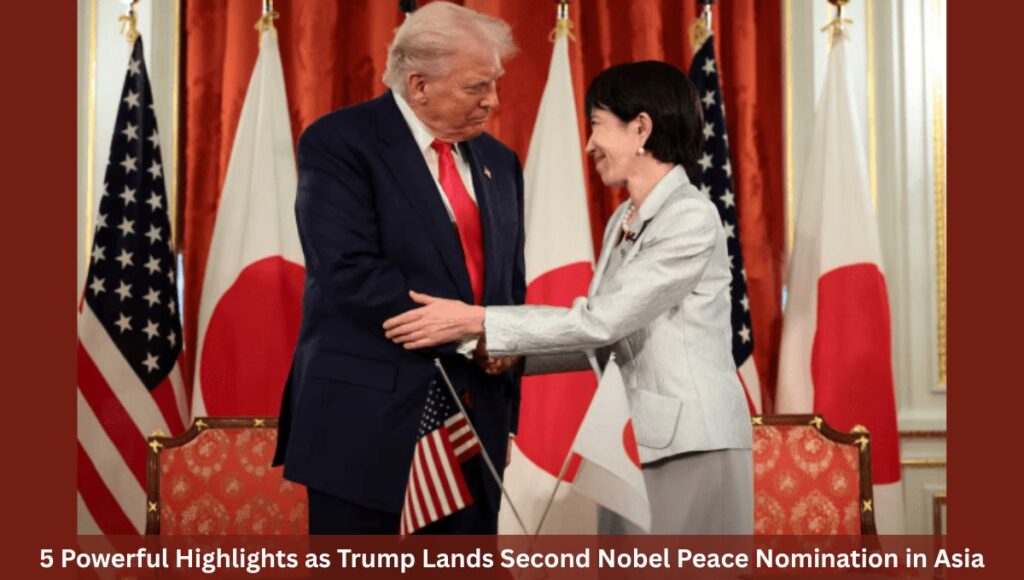
5 Powerful Highlights as Trump Lands Second Nobel Peace Nomination in Asia
From Cambodia to Japan: A Week of Nominations
Just days earlier, Cambodian Prime Minister Hun Manet had formally nominated Trump for the Nobel Peace Prize, citing his involvement in mediating peace between Cambodia and Thailand.
During a joint press conference in Kuala Lumpur, Hun praised Trump’s “unwavering dedication and resolute efforts to promote peace, not only between Cambodia and Thailand but also among other nations.”
“Reflecting the gratitude of the Cambodian peoples, I have nominated President Donald Trump for the Nobel Peace Prize,” Hun said.
The Cambodian leader’s comments followed Trump’s widely publicized role in the Thailand-Cambodia border ceasefire, which was signed during the ASEAN Summit in Malaysia — a move hailed by regional observers as a “rare moment of consensus” in Southeast Asia.
In July, Gabonese President Brice Oligui Nguema had also endorsed Trump’s peace credentials, referencing his involvement in ending hostilities between Rwanda and the Democratic Republic of Congo.
“Trump is now bringing peace back to a region where that was never possible,” Nguema said, calling the American president “a deserving candidate” for the prize.
Takaichi and Trump Pledge a ‘Golden Age’ in Japan–US Ties
During their meeting at the Akasaka Palace in Tokyo, Trump and Takaichi signed a series of strategic agreements, including a critical minerals and rare earths cooperation pact aimed at enhancing supply chain resilience and reducing dependency on China.
The Kyodo News Agency reported that the deal would help secure key resources like rare earths, permanent magnets, and optical materials used in high-tech industries, electric vehicles, and defense systems.
The White House described the accord as a “milestone in economic and national security cooperation between two allies.”
Takaichi lauded the move as part of a broader strategy to build what she called “a new golden era” of US–Japan relations.
“The bilateral relationship has now become the greatest alliance in the world,” Takaichi said.
Trump echoed her optimism, calling Takaichi “a great leader” and promising that the partnership would be “stronger than ever before.”
“Anytime you have any question, any doubt, anything you want — any favors you need, anything I can do to help Japan, we will be there,” Trump told the Japanese leader.
A Symbolic Meeting with Emperor Naruhito
Earlier in Tokyo, Trump met Emperor Naruhito at the Imperial Palace — marking their first meeting since 2019. The encounter, described by Trump as “warm and meaningful,” underscored the ceremonial and historical importance of the visit.
“A great man,” Trump said of the emperor following their half-hour meeting, which took place inside a modestly decorated reception room with wooden furnishings.
The Imperial Palace meeting served as a symbolic reaffirmation of the longstanding friendship between the United States and Japan. It also came amid growing anticipation for Trump’s first face-to-face talks with Japan’s new prime minister.
Across Tokyo, landmarks and government buildings were illuminated in honor of the visit, including the Tokyo Metropolitan Government Building, which featured special lighting displays symbolizing the US–Japan alliance.
Handshake Diplomacy: Trump and Takaichi Make Headlines
When Trump and Takaichi finally met, the encounter began with what has since gone viral — a “very strong handshake.”
“That’s a very strong handshake,” Trump quipped with a grin, setting a light-hearted tone for their first official engagement.
Observers noted that the gesture carried both symbolic and political weight — signaling firmness and mutual respect between the two leaders.
Takaichi, Japan’s first female prime minister and a protégé of the late Shinzo Abe, used the moment to demonstrate both strength and continuity in Japan’s foreign policy.
“Everything I know from Shinzo and others, you will be one of the great prime ministers,” Trump said, congratulating her on breaking the gender barrier in Japanese politics.
The prime minister presented Trump with several symbolic gifts, including Abe’s personal golf putter, a gold-leaf golf ball, and a golf bag autographed by Hideki Matsuyama, Japan’s major-winning golfer.
Photos of the exchange, shared by Trump’s assistant Margo Martin, quickly circulated on X (formerly Twitter), garnering millions of views within hours.
Strategic Deals and Economic Diplomacy
The Tokyo talks were not just ceremonial. The two leaders discussed expanding trade, defense cooperation, and technology partnerships.
According to reports from Reuters and the Associated Press, Japan will offer a $550 billion investment package in sectors such as shipbuilding, defense manufacturing, and energy imports — including US soybeans, liquefied natural gas (LNG), and pickup trucks.
Takaichi’s government is also considering a symbolic purchase of Ford F-150 trucks as a goodwill gesture, aimed at balancing Japan’s trade relations with the US.
Outside the meeting venue, a gold Ford pickup truck — flanked by white Toyota vehicles built in America — stood as a subtle but pointed photo opportunity, symbolizing Trump’s long-standing push for greater Japanese imports of US-made cars.
“This will be a fantastic relationship,” Trump said. “I have always had a great love and respect for Japan.”
Focus on Peace: From Southeast Asia to the Middle East
Takaichi’s decision to nominate Trump for the Nobel Peace Prize was driven largely by his recent involvement in conflict mediation efforts.
The Japanese leader highlighted two specific cases — the Thailand–Cambodia border truce and the Gaza ceasefire agreement — both of which she described as “historic.”
“In such a short period of time, the world started to enjoy more peace,” Takaichi said, adding that she was “impressed and inspired” by Trump’s diplomatic approach.
The White House has repeatedly emphasized Trump’s commitment to “peace through strength,” pointing to his administration’s success in ending or freezing multiple conflicts — including those involving India and Pakistan, Thailand and Cambodia, and Israel and Gaza.
While Trump did not win the Nobel Peace Prize this year, his multiple nominations from Cambodia, Japan, Israel, Pakistan, Thailand, and Gabon have strengthened his global image as a peacemaker.
Critical Minerals Pact: A Strategic Response to China
One of the key outcomes of the Trump–Takaichi meeting was the Critical Minerals Cooperation Agreement, seen as a strategic counterweight to China’s dominance in rare earth supplies.
Under the pact, both countries will identify and jointly develop projects to secure the supply of rare earth elements and related products — such as batteries, permanent magnets, catalysts, and optical materials.
The deal aims to enhance resilience in global supply chains and reduce vulnerability to market disruptions.
“This agreement marks a new chapter in our economic security partnership,” the White House said in a statement.
Analysts believe the move will also support Japan’s efforts to diversify its resource imports and strengthen US–Japan defense technology cooperation amid growing geopolitical tensions in the Indo-Pacific region.
Military and Trade Agendas: The Broader Context
The Tokyo visit also had a military dimension. Trump is expected to address US troops aboard the USS George Washington, docked near Yokosuka, to reaffirm America’s defense commitments to Japan and the broader Indo-Pacific.
The two nations are also advancing joint defense technology projects and expanded intelligence sharing, particularly concerning China’s growing military activity in the East China Sea.
At the same time, Trump’s trade delegation is working to finalize a new bilateral economic agreement, focused on reducing tariffs and encouraging Japanese investment in US industries.
According to officials, negotiations are centered on automotive trade, semiconductors, and agricultural exports.
Next Stop: South Korea and the APEC Summit
After wrapping up his Tokyo engagements, Trump is scheduled to depart for South Korea on Wednesday, where he will attend the Asia-Pacific Economic Cooperation (APEC) Summit in Seoul.
At the summit, Trump will meet with Chinese President Xi Jinping, where both leaders are expected to discuss a potential truce in the ongoing US–China trade war.
American and Chinese negotiators have indicated that a preliminary agreement could be announced during the summit, potentially easing months of economic strain between the world’s two largest economies.
Trump’s Asia tour, his most extensive since returning to office, is viewed by analysts as an effort to reassert US economic and diplomatic leadership in the Indo-Pacific while reinforcing ties with long-standing allies.
Conclusion: Trump’s Expanding Peace Diplomacy Footprint
Donald Trump’s second Nobel Peace Prize nomination in a week underscores the growing international recognition of his diplomatic efforts. From mediating the Thailand–Cambodia peace accord to facilitating the Gaza ceasefire, the US president’s Asia tour has been framed as both a diplomatic triumph and a strategic mission to deepen alliances.
For Japan’s Prime Minister Sanae Takaichi, her decision to nominate Trump reflects both gratitude and strategic alignment. For Trump, it adds to his campaign narrative of being the “President of Peace.”
As he continues his journey to Seoul for the APEC Summit — with a possible high-stakes meeting with Xi Jinping — the world watches to see whether Trump’s latest peace overtures can deliver not just awards and headlines, but lasting geopolitical stability in a tense and shifting global landscape.
Also Read: Trump’s Nobel Peace Prize Bid: Gaza Peace Plan, 8 Wars Claim, and Global Reactions
Related Posts:
- Sanae Takaichi Becomes Japan’s First Female Prime…

- Trump’s 2025 Gaza Peace Plan Signing and Historic…

- 7 Shocking Reasons FIFA’s Peace Prize for Trump…

- 7 Powerful Takeaways from Trump’s Thai-Cambodia Peace Deal
- Trump’s 2025 Nobel Peace Prize Snub: Politics Over…

- Trump’s 20-Point Gaza Peace Plan Gains Urgent Global…
