5 Key Shifts in Bangladesh–Pakistan Relations as Yunus Deepens Ties Amid ‘Map’ Row, reigniting debate over Dhaka’s foreign policy. Bangladesh’s interim head Muhammad Yunus has again triggered diplomatic unease — this time by presenting Pakistan’s top military officer with a book whose cover features a controversial map depicting India’s northeastern states as part of Bangladesh. The incident, which occurred during the visit of Pakistan’s Chairman of the Joint Chiefs of Staff Committee, General Sahir Shamshad Mirza, to Dhaka, has brought renewed attention to Bangladesh’s evolving ties with Pakistan and its shifting position in South Asia’s geopolitical landscape.
5 Key Shifts in Bangladesh–Pakistan Relations as Yunus Deepens Ties Amid ‘Map’ Row
The Gift That Sparked a Storm
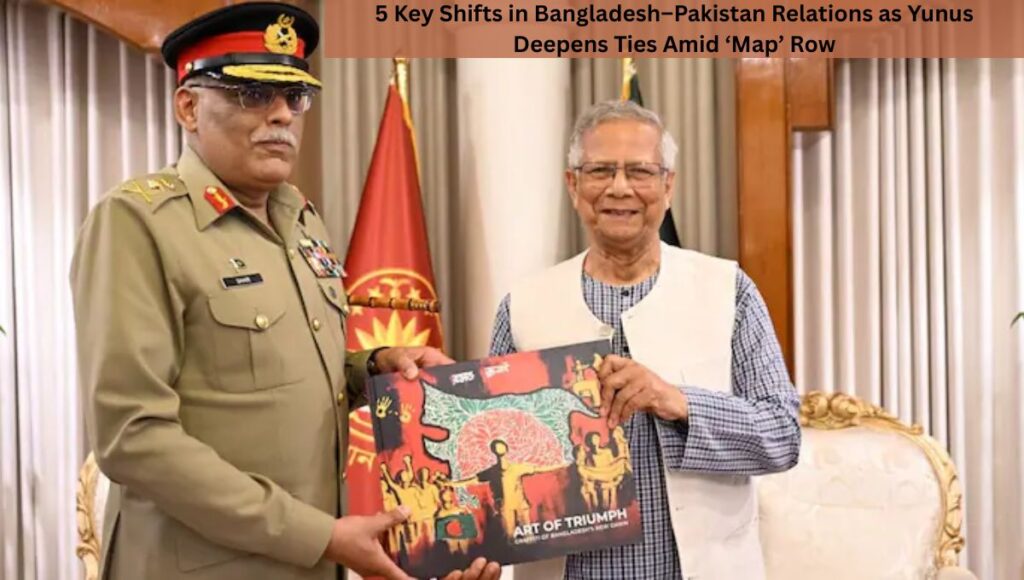
On Sunday, Yunus posted images on his official X (formerly Twitter) account showing his meeting with General Mirza. In one photograph, Yunus is seen gifting the Pakistani general a book titled “Art of Triumph: Bangladesh’s New Dawn”.
The book’s cover carries a distorted map showing Bangladesh extending over India’s entire northeastern region, including Assam, Meghalaya, Tripura, Mizoram, Manipur, Nagaland, and Arunachal Pradesh.
For many in India, this depiction echoed the long-circulated idea of a “Greater Bangladesh” — a controversial concept promoted by some fringe Islamist groups in Dhaka advocating a united region encompassing Bangladesh and parts of eastern India.
The visual triggered immediate outrage on social media, with Indian analysts, diplomats, and journalists calling it a direct affront to India’s territorial sovereignty. India’s Ministry of External Affairs has yet to comment officially, though the silence from New Delhi reflects a cautious approach amid an already tense phase in bilateral ties with Dhaka.
Why the Map Matters
The so-called “Greater Bangladesh” map has appeared periodically in fringe political circles in Dhaka over the past two decades. It depicts an expanded Bangladesh covering India’s northeast, West Bengal, and even parts of Bihar, Jharkhand, and Odisha — regions sharing deep linguistic and cultural ties with Bengal.
The concept gained renewed attention in 2024 and 2025 when close aides to Yunus circulated similar maps online. While dismissed by most Bangladeshi policymakers as fringe propaganda, the imagery’s reappearance during a high-level diplomatic meeting has raised concerns about Yunus’s intent and Dhaka’s strategic direction.
For India, the timing of the controversy is significant. It comes amid a visible cooling in India–Bangladesh relations since the ouster of Sheikh Hasina in August 2024, replaced by Yunus’s interim administration following a student-led uprising.
Yunus’s Meeting with Pakistan’s Top General
The meeting between Yunus and General Mirza took place at Dhaka’s State Guest House Jamuna during the Pakistani delegation’s official visit.
According to a statement from Bangladesh’s Chief Adviser’s Press Wing, the two leaders discussed a “wide range of issues concerning Bangladesh–Pakistan relations, including bilateral trade, investment, and defence cooperation.”
General Mirza reportedly emphasized the “shared historical, cultural, and people-to-people ties” between the two nations, expressing Pakistan’s desire to strengthen cooperation in multiple sectors.
“Our two countries will support each other,” Mirza said, noting that a two-way shipping route between Karachi and Chittagong had already become operational, while plans were underway to open a Dhaka–Karachi air route within months.
The Pakistani general also highlighted the potential for greater collaboration in logistics, education, and maritime connectivity — areas that could help revive bilateral ties after decades of limited engagement.
From Estrangement to Engagement: The Rebuilding of Ties
Relations between Bangladesh and Pakistan have long been strained by the legacy of the 1971 Liberation War, when what was then East Pakistan seceded from West Pakistan to form an independent Bangladesh.
For decades, both countries maintained only minimal contact, with historical grievances overshadowing economic and diplomatic exchanges.
However, since Yunus assumed office in August 2024, Dhaka has signaled a readiness to move beyond that past. His administration has revived diplomatic channels with Islamabad and reopened dialogue on trade, transport, and cultural exchange.
Within months, the two countries signed a visa-free travel agreement for holders of diplomatic and official passports — the first such arrangement in decades. Pakistan also announced 500 scholarships for Bangladeshi students, with 25 percent reserved for medical education, alongside specialized training programs for civil servants.
In September 2025, Bangladesh lifted long-standing restrictions on imports from Pakistan, allowing direct maritime shipments after 47 years. Previously, Pakistani goods had to be offloaded in third countries such as Sri Lanka or Malaysia before being transported to Bangladesh.
The Strategic Angle: Pakistan, China, and a Regional Realignment
The revival of Bangladesh–Pakistan ties is unfolding against a broader regional backdrop marked by shifting alliances.
India’s Chief of Defence Staff, General Anil Chauhan, warned earlier this year that “a growing alignment between Pakistan, Bangladesh, and China could pose serious challenges for India’s security.”
He noted the “possible convergence of interests” among the three nations, which might have “implications for India’s stability and security dynamics.”
Yunus’s outreach to both Beijing and Islamabad has reinforced that perception. During his visit to China in April 2025, the Bangladeshi leader described his country as “the only guardian of the ocean” for India’s landlocked northeast, inviting China to invest more deeply in the Bay of Bengal region.
Analysts in New Delhi view these remarks — coupled with the recent “map gift” episode — as part of a pattern suggesting Dhaka’s strategic tilt away from India and toward China and Pakistan.
Economic and Defence Cooperation: Signs of a New Partnership
General Mirza’s visit is the highest-level Pakistani military engagement with Bangladesh in recent years. Officials say the talks covered not only trade but also defence and maritime collaboration.
Both sides discussed establishing a bilateral defence cooperation framework focusing on training, counterterrorism, and disaster response. Bangladesh, which hosts the annual Aman Dialogue — a regional naval exercise — also invited Pakistani observers to future maritime events.
Bangladesh Navy Chief Admiral Mohammad Hasan, speaking at the Aman Dialogue 2025, remarked, “Land divides, but the sea unites.” His statement was widely interpreted as a subtle endorsement of expanded regional naval cooperation, including with Pakistan.
The reactivation of the Karachi–Chittagong shipping route and the planned Dhaka–Karachi air service represent concrete steps toward rebuilding connectivity. Pakistani officials believe these developments could boost bilateral trade, which currently stands at under $1 billion annually, far below potential.
Political Transition in Bangladesh and Regional Fallout
The Yunus-led interim government came to power following the collapse of Sheikh Hasina’s 15-year rule, toppled by a student-led movement in August 2024.
Since assuming charge, Yunus has banned Hasina’s Awami League, detained several of its senior leaders, and initiated investigations into alleged corruption and “crimes against humanity.”
Hasina herself remains in exile in India, a development that has further strained Dhaka’s relations with New Delhi.
Meanwhile, the political vacuum in Dhaka has allowed the re-entry of Jamaat-e-Islami, Bangladesh’s largest Islamist party, which had been banned under Hasina’s administration. The party has since gained ground and is reportedly aligning with other conservative factions ahead of the February 2026 elections.
Observers believe Yunus’s rapprochement with Pakistan — a country historically sympathetic to Jamaat’s ideological roots — could also help consolidate support among conservative and Islamist sections within Bangladesh.
Regional Concerns: India’s Unease and Security Implications
India’s unease with these developments is palpable, though its response has so far been measured.
New Delhi’s concerns extend beyond the “map row.” Indian security agencies fear that closer coordination between Islamabad and Dhaka could enable renewed militant activity along India’s eastern border.
The two countries share a porous 4,096-km boundary, which has long been vulnerable to smuggling and cross-border movement.
In 2004, Indian authorities intercepted a consignment of Chinese ammunition allegedly routed through Bangladesh and destined for insurgent groups in India’s northeast — including the banned United Liberation Front of Asom (ULFA).
With Pakistan’s Inter-Services Intelligence (ISI) suspected of facilitating such operations in the past, Indian analysts fear a potential revival of similar networks should Dhaka and Islamabad institutionalize defence cooperation.
The Diplomatic Balancing Act
For Dhaka, the challenge now lies in managing multiple diplomatic fronts. Yunus has sought to position Bangladesh as an “independent and neutral” actor in regional politics — yet his overtures toward Pakistan and China risk alienating India, its largest trading partner and key energy supplier.
While Yunus maintains that Bangladesh is open to cooperation “with all friendly nations,” his rhetoric and actions suggest a subtle reorientation.
In August, Dhaka declined to renew an Indian transshipment agreement that allowed Bangladeshi cargo to transit through Indian territory en route to Nepal, Bhutan, and Myanmar — a move seen as symbolic of deteriorating bilateral trust.
The map controversy, therefore, represents not merely a diplomatic faux pas but also a reflection of shifting strategic alignments in the region.
Reactions Within Bangladesh
Domestic opinion within Bangladesh remains divided. Supporters of Yunus argue that he is attempting to restore Bangladesh’s independent foreign policy after years of perceived overdependence on India under Hasina.
Critics, however, warn that aligning with Pakistan and China risks undoing decades of progress and may isolate Bangladesh from its key economic and security partner, India.
Prominent Bangladeshi columnist and former diplomat Farooq Sobhan wrote in The Daily Star that “reviving ties with Pakistan must not come at the cost of historical truth or national stability.”
Others note that the presentation of the controversial map — even if unintentional — damages Dhaka’s credibility and complicates its diplomatic balancing act.
Historical Memory and Political Messaging
The symbolic weight of Pakistan–Bangladesh relations cannot be divorced from history.
For many Bangladeshis, the memory of 1971 remains deeply personal. Any rapprochement with Pakistan must therefore navigate sensitive terrain shaped by historical trauma.
By contrast, Yunus’s administration has chosen to highlight “shared history” and “people-to-people ties,” emphasizing reconciliation and regional cooperation over historical grievances.
Yet the choice of symbols — such as the map on the book cover — carries potent political messaging. It suggests that Yunus may be using nationalist sentiment and cultural identity to appeal to domestic audiences while signalling strategic intent abroad.
The Road Ahead
Bangladesh is set to hold general elections in February 2026 — its first since the ouster of Sheikh Hasina. As Yunus navigates a fragile political landscape, his government’s foreign policy moves are likely calibrated for both domestic optics and international leverage.
His engagement with Pakistan and China could help diversify Bangladesh’s partnerships, attract investment, and position Dhaka as a regional bridge.
However, it also risks antagonizing India — a country whose cooperation remains critical for Bangladesh’s energy supply, cross-border trade, and infrastructure connectivity.
Whether Yunus can sustain this balancing act without deepening regional fault lines remains to be seen.
Conclusion: A Strategic Reset in South Asia
The episode of the “map gift” is more than a social media controversy — it encapsulates the broader realignment underway in South Asia.
Under Muhammad Yunus, Bangladesh appears to be recalibrating its foreign policy, warming up to Pakistan and China while distancing itself from India.
As General Mirza’s visit demonstrated, the Dhaka–Islamabad axis is no longer a diplomatic anomaly but a deliberate strategic choice. Whether this new partnership evolves into lasting cooperation or triggers renewed regional tensions will depend on how deftly Bangladesh navigates its next phase — between historical memory, geopolitical pragmatism, and domestic political pressures.
Also Read: Amid India-Bangladesh diplomatic row, China’s Xi vows deeper ties with Dhaka