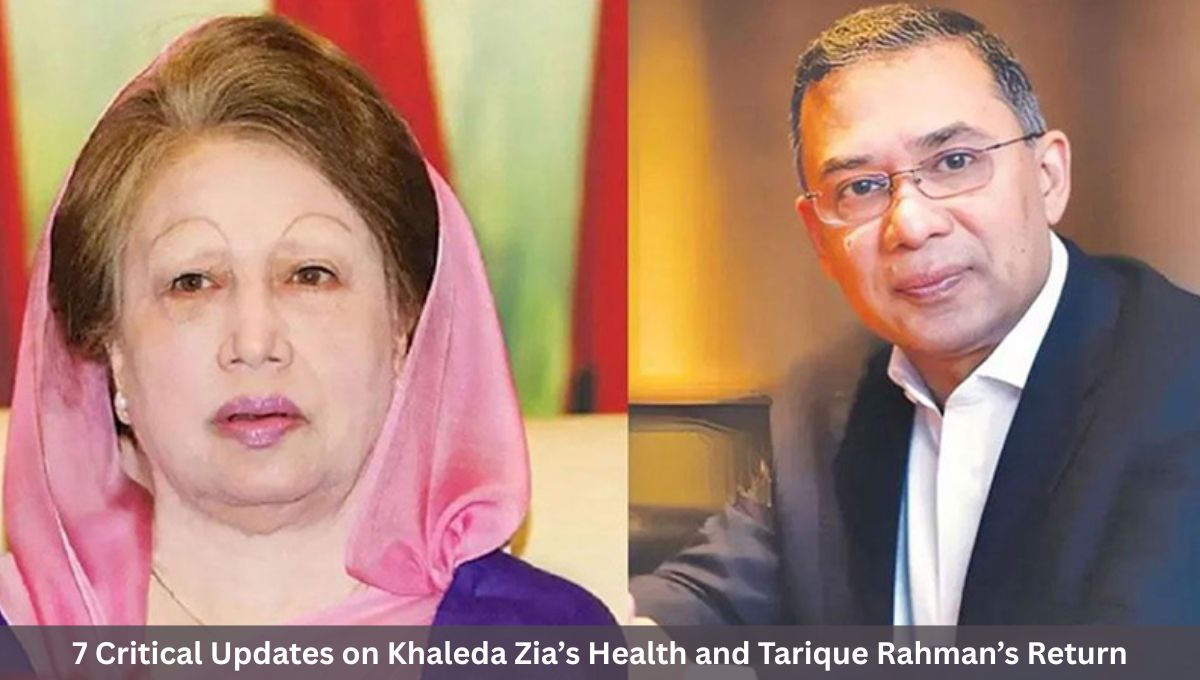
7 Critical Updates on Khaleda Zia’s Health and Tarique Rahman’s Return from London amid political uncertainty and upcoming elections. Bangladesh is witnessing a moment of political uncertainty and emotional upheaval as former Prime Minister Khaleda Zia fights for her life in Dhaka.
At the same time, her son and political heir Tarique Rahman, the acting chairman of the Bangladesh Nationalist Party (BNP), is poised to return from London after more than a decade in self-exile. The situation has intensified ahead of the country’s upcoming elections, with both national and international leaders closely watching developments.
Prime Minister Narendra Modi has expressed “deep concern” over Khaleda Zia’s deteriorating health and assured that India stands ready to extend “all possible support.” With the BNP emerging as a frontrunner in pre-poll surveys, the interplay between Zia’s health crisis and Tarique Rahman’s potential return is reshaping Bangladesh’s political landscape.
This article provides a comprehensive, human-toned narrative of the unfolding events, with detailed insights into Khaleda Zia’s condition, the political stakes surrounding Tarique Rahman, and the response from the interim government and international community.
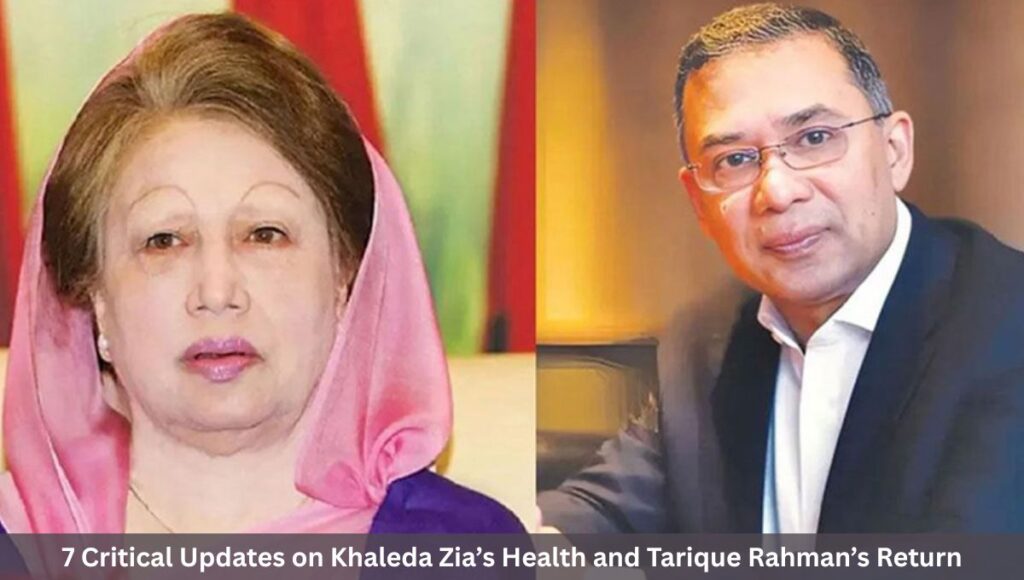
7 Critical Updates on Khaleda Zia’s Health and Tarique Rahman’s Return
PM Narendra Modi Voices ‘Deep Concern’ Over Khaleda Zia’s Health
Prime Minister Narendra Modi on Monday expressed strong concern about the health of former Bangladesh Prime Minister Khaleda Zia, noting her long-standing contributions to Bangladesh’s public life.
In a post on X (formerly Twitter), he wrote:
“Deeply concerned to learn about the health of Begum Khaleda Zia, who has contributed to Bangladesh’s public life for many years. Our sincere prayers and best wishes for her speedy recovery. India stands ready to extend all possible support, in whatever way we can.”
His statement came shortly after BNP leaders confirmed that the 80-year-old veteran politician had been placed on ventilation after her health took a severe turn.
Modi’s remarks carry diplomatic weight, especially as Bangladesh moves toward national elections that may reshape its political order following the ouster of former Prime Minister Sheikh Hasina in 2024.
Khaleda Zia’s Sudden Health Crisis and Hospitalisation
Admitted with Chest Infection on November 23
Khaleda Zia was admitted to Evercare Hospital Dhaka on November 23 after developing a chest infection affecting both her heart and lungs. Her health began deteriorating rapidly, prompting the medical board to shift her to the coronary care unit (CCU) four days later.
Multiple Organ Complications
According to BNP leaders and her doctors, Zia suffers from a combination of long-standing and acute ailments, including:
- Severe heart complications
- Chronic liver disease
- Kidney issues
- Diabetes
- Arthritis
- Respiratory infections
- Eye-related illnesses
Her medical team, comprising both local and foreign specialists, has been closely monitoring her condition.
‘Extremely Unwell’: BNP Leaders Confirm Khaleda Zia on Ventilation
A local BNP leader, Advocate Ahmed Aazam Khan, told reporters outside Evercare Hospital that Khaleda Zia had been placed on life support ventilation after her condition worsened significantly. “She is in a very critical condition.
There is nothing more to do except seek prayers from the whole nation,” he said. BNP Secretary General Mirza Fakhrul Islam Alamgir echoed these concerns, stating that she remained in a life-threatening state despite continuous efforts by medical experts from Bangladesh and abroad.
Tarique Rahman’s Emotional Message and Questions Over His Absence
While Khaleda Zia lies critically ill in Dhaka, her son Tarique Rahman remains in London, raising questions about why he has not yet returned to be by her side during her most difficult hours.
In a heartfelt Facebook post, Tarique wrote:
“Like any child, I have a strong desire to be touched by my mother’s affection in times of crisis. But like everyone else, I am not free to make my own decisions and am not under sole control… Our family is hopeful that once the political reality reaches the expected level, my long anxious wait for my return home will end.”
The cryptic tone of his message sparked debates over whether political or security forces are preventing his return.
Why Tarique Rahman Left Bangladesh—and Why He Hasn’t Returned
Exile Since 2008
Tarique Rahman has been living in London since 2008 after leaving Bangladesh for medical treatment with bail secured during the military-backed caretaker government. Over the years, he faced numerous cases and convictions in absentia.
All 84 Cases Against Him Cleared After Sheikh Hasina’s Ouster
After the fall of Sheikh Hasina’s government in August 2024, Bangladeshi courts acquitted him in several high-profile cases between December 2024 and May 2025. The cleared cases included:
- The 2004 Dhaka grenade attack
- Multiple corruption charges
- Money laundering
- Sedition allegations
- Hawa Bhaban bribery cases
With all legal obstacles reportedly removed, many expected his immediate return.
Security Concerns Remain a Key Obstacle
Bangladesh political analyst Zahed Ur Rahman suggested in Prothom Alo that despite the legal path being clear, security threats remain a significant concern:
“Unless the underlying problems are resolved, his return could be dangerous.”
He noted that the country’s internal security situation is fragile, and Tarique Rahman, as the head of a major party, could face risks from many actors.
BNP Insists Tarique Rahman ‘Will Return Soon’
BNP Standing Committee member Salahuddin Ahmed addressed reporters on Monday, declaring that Tarique Rahman “will return to Bangladesh soon.” His comments followed a high-level meeting of the BNP’s top decision-making body.
A BNP insider told India Today Digital that the party leadership expects him to return immediately after the election schedule is announced, likely after December 10.
Why the BNP Desperately Needs Tarique Rahman Now
Bangladesh is on the brink of announcing election dates, and early surveys show the BNP leading—but only slightly.
According to the International Republican Institute (IRI) survey:
- BNP: 33%
- Jamaat-e-Islami: 29%
The narrow margin means any misstep—including perceptions of weakness, such as the absence of its acting chairman—could shift voter sentiment.
With Khaleda Zia critically ill, Tarique Rahman’s leadership is more crucial than ever for:
- Election strategy
- Candidate selection
- Negotiations with allies
- Managing internal factions
- Projecting national leadership
His prolonged absence risks weakening party morale and voter confidence.
Interim Government Tightens Security Around Khaleda Zia
The situation surrounding Khaleda Zia has prompted significant security measures by the interim government led by Muhammad Yunus.
Declared a ‘Very, Very Important Person’
On Monday, the government designated Khaleda Zia as a “very, very important person (VVIP)”, enabling Special Security Force (SSF) deployment for her protection.
Heavy Police Presence at Evercare Hospital
According to The Daily Star:
- A police barricade was erected at Evercare Hospital around 2 a.m.
- Over two dozen police personnel have been deployed
- SSF members conducted a 3-hour inspection overnight
- Surrounding cabins on the 4th floor have been vacated for security reasons
The heightened security underscores both her political significance and the sensitive timing ahead of elections.
UK Specialist Team Arrives to Assess Khaleda Zia
BNP Standing Committee member and personal physician Dr. AZM Zahid Hossain said a specialist medical team from the UK is arriving to evaluate whether Khaleda Zia can be transported abroad for advanced treatment.
He added:
- Zia is “responding to treatment”
- The medical board must decide if travel is safe
- No decision can be taken without the coordinated medical team’s approval
Dr. Zahid also urged the public not to spread unofficial statements and to rely only on official communications.
International Leaders Express Concern
Apart from PM Modi, several global leaders and diplomats have reportedly expressed concern about Khaleda Zia’s health. BNP leaders described the responses as “overwhelming” and “deeply appreciated.”
Dr. Zahid added:
“We thank the heads of many states and diplomats who are inquiring about Khaleda Zia’s health and wishing her well.”
This international attention highlights the geopolitical significance of Bangladesh’s shifting political landscape.
Political Stakes Rise as Bangladesh Prepares for Elections
Bangladesh is entering one of its most critical pre-election phases in decades:
- Sheikh Hasina’s ouster has altered power dynamics
- The BNP has re-emerged as a key contender
- Jamaat-e-Islami threatens BNP’s lead
- Global powers are closely observing stability in Dhaka
Khaleda Zia’s condition and Tarique Rahman’s return could heavily influence:
- Voter sentiment
- International engagement
- Party alliances
- Election outcomes
What Happens Next? Key Scenarios to Watch
1. Will Tarique Rahman Return Before the Elections?
BNP insiders indicate he might return immediately after election dates are announced. His arrival could energize the party—but could also carry security risks.
2. Will Khaleda Zia Be Taken Abroad?
The UK specialist team will advise on whether she can be airlifted for treatment. Her condition remains critical.
A sudden leadership vacuum could destabilize the party at a crucial moment.
Conclusion
The health crisis of Khaleda Zia and the uncertain return of Tarique Rahman have arrived at a pivotal time in Bangladesh’s political history. With Prime Minister Narendra Modi offering support and international leaders monitoring the situation, the developments carry consequences beyond national borders.
As Bangladesh heads toward elections, the emotional, political, and strategic stakes continue to rise. The coming days will determine not only Khaleda Zia’s fate but also the future direction of the BNP and the country’s broader political trajectory.
Also Read: UK experts join global team treating Khaleda Zia in Dhaka; condition stays critical
Related Posts:
- 11 Powerful Moments as Tarique Rahman Returns to…

- 9 Defining Moments as Tarique Rahman Returns to…

- 15 Defining Moments of Khaleda Zia’s Powerful Political Life
- 13 Historic Shifts: Tarique Rahman Poised to Lead…

- 5 Key Shifts in Bangladesh–Pakistan Relations as…

- 9 Powerful Signals from PM Modi’s Letter to…