15 Defining Moments of Khaleda Zia’s Powerful Political Life that shaped Bangladesh.Bangladesh’s former Prime Minister and Bangladesh Nationalist Party (BNP) chairperson Begum Khaleda Zia has died at the age of 80 after a prolonged illness, marking the end of one of the most influential and polarising political careers in the country’s history.
The BNP confirmed that Khaleda Zia passed away at 6:00 am on Tuesday at Evercare Hospital in Dhaka, where she had been undergoing treatment since November 23. The party said she died shortly after the Fajr (dawn) prayer, surrounded by family members, senior party leaders, and her medical team.
“Our beloved national leader Begum Khaleda Zia is no longer with us,” the BNP said in a statement. “We pray for the forgiveness of her soul and request everyone to offer prayers for her departed soul.”
Her death comes at a politically sensitive moment for Bangladesh, just weeks before a general election in which her son and political heir Tarique Rahman is expected to lead the BNP.
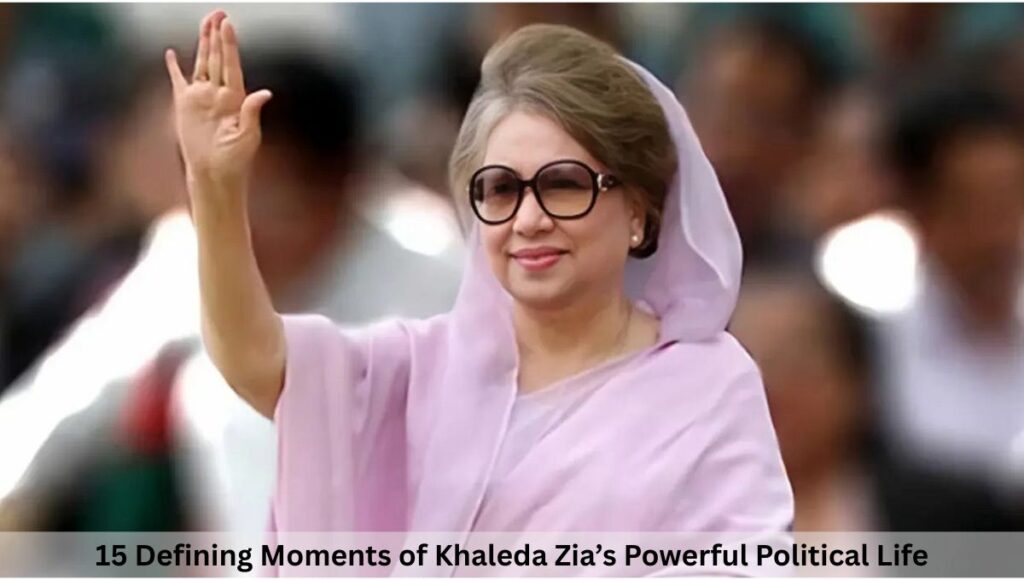
15 Defining Moments of Khaleda Zia’s Powerful Political Life
Final Days and Prolonged Illness
Khaleda Zia had been battling multiple serious health conditions for several years. Doctors said she suffered from advanced liver cirrhosis, arthritis, diabetes, chronic kidney disease, heart complications, and lung infections, including pneumonia.
She was admitted to Evercare Hospital on November 23 with symptoms of a severe lung infection. On December 11, her condition worsened, and she was placed on ventilator support to give rest to her lungs and other vital organs.
Her personal physician, Professor Dr AZM Zahid Hossain, repeatedly described her condition as “extremely critical,” warning that survival depended on whether she could pass through a critical phase.
Although there were efforts earlier this month to fly her to London for advanced medical treatment via a special air ambulance, doctors ruled out air travel due to her fragile condition.
Medical specialists from Bangladesh, the UK, the US, China, and Australia were involved in overseeing her treatment.
A Historic Political Figure
Khaleda Zia holds a unique place in Bangladesh’s political history.
She was:
- Bangladesh’s first woman Prime Minister
- A three-time elected premier
- One of the most dominant political figures in South Asia for over three decades
She served as Prime Minister from 1991 to 1996, briefly in February 1996, and again from 2001 to 2006.
Alongside her longtime rival Sheikh Hasina, Khaleda Zia shaped the political destiny of Bangladesh, with their rivalry earning them the nickname “the battling Begums.”
Early Life and Education
Begum Khaleda Zia was born in 1945 in Jalpaiguri, then part of British India (now in West Bengal). Following the Partition of India in 1947, her family moved to Dinajpur, in what was then East Bengal.
Her father, Iskandar Mazumder, was a businessman, while her mother, Tayeba Mazumder, was a homemaker. Known by her family nickname “Putul,” Khaleda was the second of five siblings.
She studied at Dinajpur Missionary School and Dinajpur Girls’ School, completing her matriculation in 1960. She later attended Surendranath College in Dinajpur.
Marriage to Ziaur Rahman and Entry into History
In 1960, Khaleda married Ziaur Rahman, then a captain in the Pakistan Army. During Bangladesh’s 1971 Liberation War, Ziaur Rahman emerged as a key military figure in the fight for independence.
After independence, Ziaur Rahman rose rapidly in politics, eventually becoming President of Bangladesh. Khaleda Zia served as First Lady and accompanied him on state visits, meeting world leaders such as UK Prime Minister Margaret Thatcher.
Ziaur Rahman was assassinated on May 30, 1981, during a failed military coup—an event that changed Khaleda Zia’s life permanently.
From Political Novice to BNP Leader
Following her husband’s assassination, the Bangladesh Nationalist Party, which Ziaur Rahman had founded, plunged into crisis. Though she had no prior political experience, Khaleda Zia stepped in to preserve the party.
She joined the BNP in 1982, became vice-chairperson in 1983, and was elected party chairperson in 1984.
Her rise coincided with mass opposition to military ruler Hussain Muhammad Ershad, who had seized power in 1982.
Role in Toppling Military Rule
Khaleda Zia joined forces with Sheikh Hasina, the daughter of Bangladesh’s founding father Sheikh Mujibur Rahman, to lead a nationwide pro-democracy movement.
The alliance culminated in 1990, when Ershad was forced to resign following widespread protests, clearing the way for democratic elections.
Historic Victory in 1991
In the 1991 general election, the BNP emerged as the largest party, and Khaleda Zia was sworn in as Bangladesh’s first woman Prime Minister.
Her government restored the parliamentary system of government, reversing years of presidential rule, and introduced the caretaker government system to oversee free and fair elections—one of her most enduring institutional legacies.
Tumultuous Second Term and Defeat
Khaleda Zia’s second term in early 1996 was short-lived amid boycotts and protests by opposition parties demanding elections under a neutral caretaker government.
After stepping aside, elections held later that year brought Sheikh Hasina’s Awami League to power, making Khaleda Zia the Leader of the Opposition.
Return to Power in 2001
In a dramatic comeback, Khaleda Zia led the BNP to a landslide victory in 2001, returning as Prime Minister for a third time.
Her second full term, however, was marked by controversy. Allegations of corruption, the rise of Islamist militancy, and deteriorating law and order dominated the period.
Grenade Attack and Political Fallout
In 2004, a grenade attack targeted an Awami League rally addressed by Sheikh Hasina. She survived, but over 20 people were killed, and hundreds were injured.
Hasina accused Khaleda Zia’s government and its allies of complicity. The BNP denied the allegations, calling later trials politically motivated.
End of Her Rule and Military-Backed Interim Government
By 2006, political unrest and street violence escalated, leading to the installation of an army-backed caretaker government.
Both Khaleda Zia and Sheikh Hasina were arrested in 2007 on corruption charges and jailed for nearly a year before being released ahead of elections in 2008.
Corruption Cases and Imprisonment
In 2018, Khaleda Zia was convicted in corruption cases involving the misuse of foreign donations meant for an orphanage trust. She was sentenced to prison, a move the BNP said was intended to sideline her politically.
Due to declining health, she was moved to house arrest in 2020 and later freed in August 2024, following the ouster of Sheikh Hasina. In early 2025, Bangladesh’s Supreme Court acquitted her in the remaining corruption cases.
Rivalry with Sheikh Hasina
The rivalry between Khaleda Zia and Sheikh Hasina defined Bangladeshi politics for decades. Their feud fueled cycles of strikes, protests, and violence that often paralysed the country.
Despite ideological differences, both women symbolised resilience, mass leadership, and dynastic politics in post-independence Bangladesh.
Family and Political Legacy
Khaleda Zia is survived by her elder son Tarique Rahman, his wife Dr Zubaida Rahman, and granddaughter Zaima Rahman. Her younger son, Arafat Rahman Koko, died in 2015.
Tarique Rahman returned to Bangladesh on December 25 after 17 years in exile and is expected to lead the BNP in the upcoming general election.
National and Political Reactions
Bangladesh’s interim leader Muhammad Yunus had earlier urged the nation to pray for Khaleda Zia, calling her a “source of inspiration for the nation.”
Her funeral prayers are expected to be held in Dhaka, with final arrangements to be announced by the BNP.
An Enduring Figure in Bangladesh’s History
Khaleda Zia’s life mirrored Bangladesh’s turbulent political journey—from military rule to democratic transition, fierce political rivalry, and institutional reform.
Loved by supporters and criticised by opponents, she leaves behind a legacy that will continue to shape Bangladesh’s politics for generations.
Her death closes a defining chapter in the nation’s history, but her influence—political, institutional, and symbolic—remains deeply embedded in Bangladesh’s democratic narrative.
Also Read: 11 Powerful Moments as Tarique Rahman Returns to Bangladesh After 17 Years
Also Read: The Phoenix of Bengal: The Uncompromising Journey of Begum Khaleda Zia