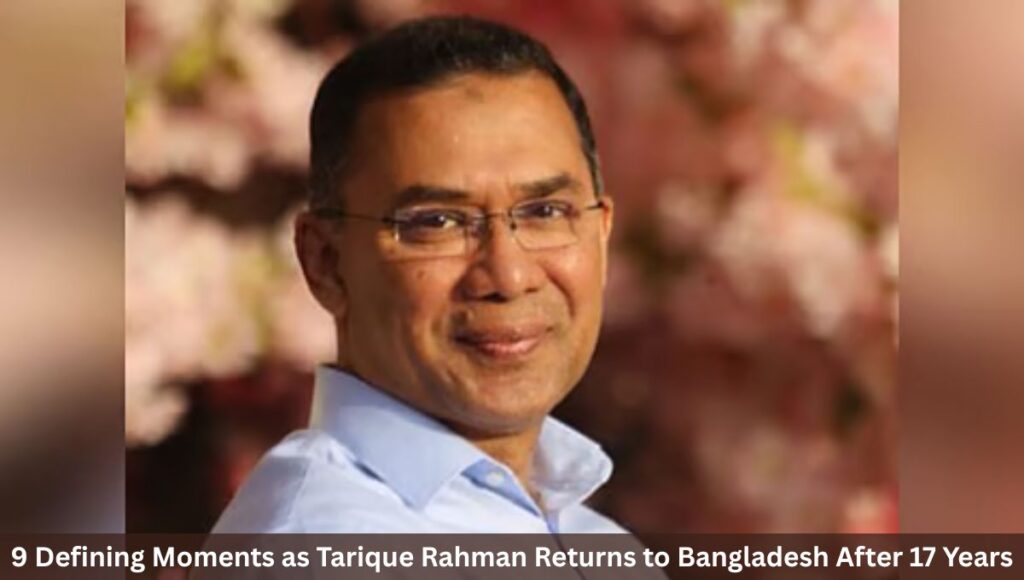
9 Defining Moments as Tarique Rahman Returns to Bangladesh After 17 Years in exile, shaking Bangladesh politics. Bangladesh witnessed one of its most consequential political moments in decades as Tarique Rahman, the acting chairman of the Bangladesh Nationalist Party (BNP), returned to Dhaka after nearly 17 years in exile.
His homecoming, marked by an unprecedented show of public support, has injected fresh momentum into the opposition and fundamentally altered the dynamics ahead of the country’s general election scheduled for February.
For years, Rahman’s presence in Bangladeshi politics was largely symbolic — his image on party posters, his recorded messages played at rallies, and his influence exercised from London. On December 25, that long absence ended.
Hundreds of thousands, and by some estimates millions, of BNP supporters flooded Dhaka’s streets, lining the route from Hazrat Shahjalal International Airport to the reception venue and onward to Gulshan, transforming the capital into a sea of party flags, slogans and celebration.
Rahman’s return comes at a time of deep political transition. The ouster of long-time Prime Minister Sheikh Hasina in a student-led uprising last year upended Bangladesh’s political order, leaving an interim administration under Nobel laureate Muhammad Yunus to oversee a return to democratic governance.
With Hasina’s Awami League barred from contesting the upcoming polls, the BNP now stands as the dominant electoral force — and Tarique Rahman as its most prominent standard-bearer.
9 Defining Moments as Tarique Rahman Returns to Bangladesh After 17 Years
A Homecoming Years in the Making
Tarique Rahman, 60, is the eldest son of former Prime Minister Khaleda Zia and the late President Ziaur Rahman, the founder of the BNP.
Since the early 1990s, Bangladesh’s politics has largely revolved around the rivalry between the Zia and Hasina families, a duopoly punctuated only by brief caretaker governments.
Rahman’s return therefore carries not only party significance but deep historical symbolism. Rahman left Bangladesh in 2008 after being arrested during the army-backed caretaker government that followed violent political unrest.
He was later convicted in absentia in several cases, including money laundering and charges linked to the 2004 Dhaka grenade attack that targeted Sheikh Hasina and killed 24 people.
The BNP consistently maintained that the cases were politically motivated. Following Hasina’s removal from office last year, courts overturned Rahman’s convictions, clearing the legal obstacles that had prevented his return.
BNP leaders describe his homecoming as the correction of a long-standing injustice. Critics, however, argue that Rahman’s past controversies will continue to shape public debate as he seeks national leadership.
BNP’s Show of Strength in Dhaka
The scale of the mobilisation surrounding Rahman’s return underscored the BNP’s confidence ahead of the election.
Party leaders said they coordinated closely with authorities to manage security and logistics for what they described as an “unprecedented” gathering.
Supporters began arriving in Dhaka days in advance, traveling by buses, trucks and special trains from across the country.
Local media reported that nearly ten special trains alone carried hundreds of thousands of activists into the capital.
Streets along the airport road and the Purbachal Expressway — also known as the 300-foot road — were packed hours before Rahman’s arrival.
Chants of “Tarique Rahman Asche, Ma-Mati Dakche” and “Dhaner Shis Marka” echoed through the crowd as supporters waved Bangladesh’s national flag and the BNP’s sheaf-of-paddy symbol.
Many described the moment as deeply emotional, a culmination of years of struggle during which the party faced repression, boycotted elections and endured internal uncertainty.
“This is a defining political moment,” senior BNP leader Ruhul Kabir Rizvi said, reflecting the party’s belief that Rahman’s physical presence will energise its campaign machinery nationwide.
Personal Urgency and Political Timing
Beyond politics, Rahman’s return also carries personal urgency. His mother, former Prime Minister Khaleda Zia, has been seriously ill for months and is undergoing treatment in Dhaka.
BNP officials said Rahman traveled directly from the reception venue to Evercare Hospital to visit her before heading to his residence in Gulshan.
Zia, who served twice as prime minister, remains a towering figure in Bangladeshi politics despite her declining health. Her prolonged absence from active leadership has placed increasing responsibility on Rahman’s shoulders.
Many within the BNP view him as the natural successor, capable of unifying the party and appealing to a new generation of voters.
The timing of his return — less than two months before the election — is widely seen as strategic. With legal barriers removed and the political field reshaped by Hasina’s exit, Rahman’s presence allows the BNP to project stability, continuity and readiness to govern.
Bangladesh’s Fragile Political Transition
Rahman’s homecoming unfolds amid a fragile national transition. The interim government led by Muhammad Yunus has pledged to restore democratic legitimacy after years of disputed elections, political violence and restrictions on dissent.
The February vote is widely regarded as a critical test of whether Bangladesh can move beyond its cycle of confrontation. Concerns persist, however, over sporadic violence, attacks on journalists and the influence of radical groups.
The killing of student leader Sharif Osman Hadi earlier this month triggered unrest and raised alarms about security conditions ahead of the polls.
Several Western embassies, including those of Germany and the United States, issued advisories warning of potential disruptions in Dhaka on the day of Rahman’s return.
Authorities responded by deploying heightened security across the capital, underscoring the sensitivity surrounding mass political mobilisation during the transition period.
Reactions From Political Rivals and Allies
Rahman’s return has drawn mixed reactions across Bangladesh’s political spectrum. The National Citizen Party (NCP), which emerged from the youth-led protest movement that toppled Hasina, welcomed his homecoming, calling it symbolically important for democratic restoration.
“Rahman was forced into exile under severe pressure and threats, so his return carries symbolic weight,” said NCP spokesperson Khan Muhammad Mursalin, adding that his arrival would energise political participation ahead of the election.
At the same time, analysts note potential tensions between the BNP and Islamist groups such as Jamaat-e-Islami, which has re-entered the political arena after being banned under Hasina.
Opinion polls suggest the Jamaat could emerge as a significant force, raising the prospect of competition — or confrontation — within the opposition space.
Rahman has publicly distanced himself from Islamist alliances, positioning the BNP as a nationalist and democratic alternative focused on stability and economic recovery.
Regional and International Implications
Rahman’s return is being closely watched beyond Bangladesh’s borders, particularly in India. Under Sheikh Hasina, Dhaka maintained close ties with New Delhi while carefully balancing relations with China and distancing itself from Pakistan.
Since her removal, India-Bangladesh relations have become strained amid rising anti-India sentiment and political uncertainty.
Indian policymakers view the BNP as a potentially more moderate and predictable partner, despite historically difficult relations.
Recent gestures, including Prime Minister Narendra Modi’s public expression of concern for Khaleda Zia’s health and the BNP’s unusually warm response, have fueled speculation of a possible reset in ties.
Rahman himself has articulated a “Bangladesh First” foreign policy, signaling an intent to maintain strategic autonomy rather than align closely with any single regional power.
Who Is Tarique Rahman?
Once dubbed the “dark prince” of Bangladeshi politics due to corruption allegations during the BNP’s 2001–2006 tenure, Rahman’s public image has evolved during his years in exile.
Supporters portray him as a victim of political persecution who kept the party united during its most difficult period.
Critics question whether he can overcome his controversial past and appeal to younger voters demanding accountability and reform.
Since leading the BNP from London, Rahman has focused on organisational discipline, grassroots mobilisation and messaging centered on democracy and justice.
His ability to translate mass enthusiasm into electoral victory and effective governance remains an open question.
The Road Ahead
Tarique Rahman’s return after 17 years is more than a personal milestone — it is a pivotal moment for Bangladesh’s opposition, its democratic transition and its future direction.
As the BNP gears up for February’s election, Rahman’s leadership will be tested not only at the ballot box but in his capacity to unify a fractured political landscape.
Whether his homecoming marks the beginning of a new political chapter or the revival of old rivalries will depend on the coming weeks.
What is clear is that Bangladesh has entered a defining phase, and Tarique Rahman now stands at the center of it.
Also Read: 7 Alarming Signs as Bangladesh Student Leader Shot Amid Pre-Poll Chaos
Also Read: Bangladesh: Is BNP heir Tarique Rahman’s return good news for India?