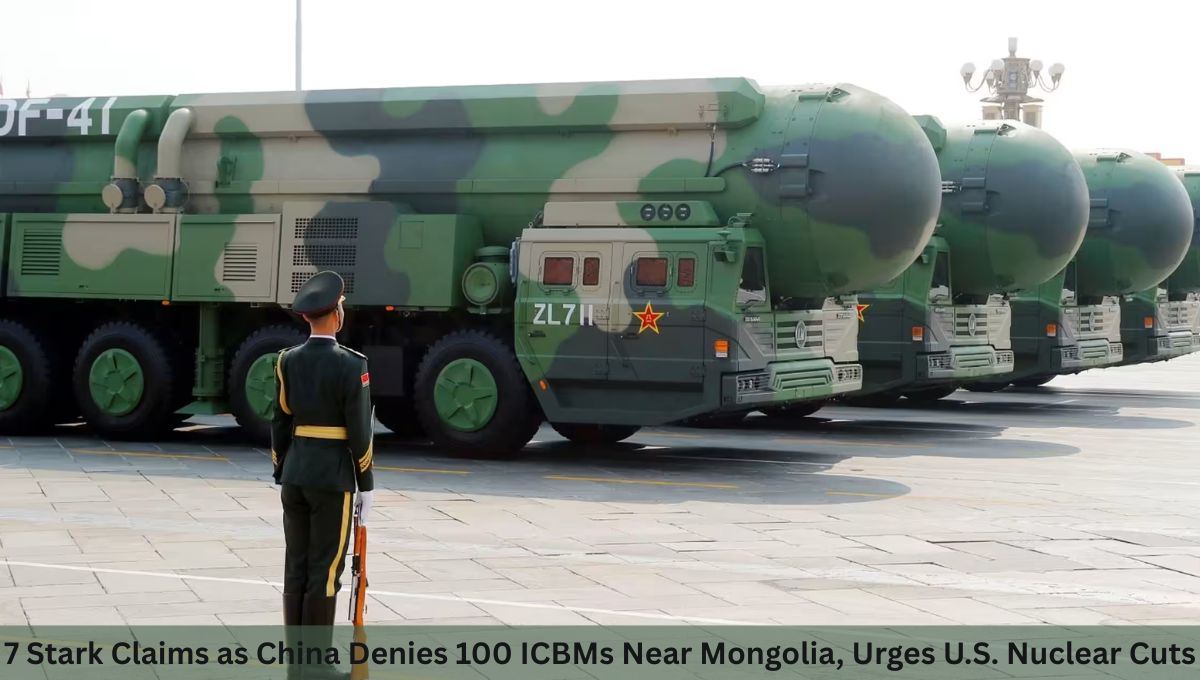
7 Stark Claims as China Denies 100 ICBMs Near Mongolia, Urges U.S. Nuclear Cuts, reaffirms no-first-use. China on Tuesday forcefully denied a U.S. Defense Department assessment claiming that Beijing has deployed more than 100 intercontinental ballistic missiles (ICBMs) in silo bases near its border with Mongolia, calling the allegations exaggerated and politically motivated.
The rebuttal underscores growing friction between the world’s two largest powers as nuclear modernization, arms control, and regional security dominate strategic discourse.
Speaking at a regular press briefing, Foreign Ministry spokesperson Lin Jian said China was “unaware” of any such large-scale missile deployment and accused Washington of recycling familiar narratives to justify expansion of its own nuclear forces.
According to Lin, such claims undermine global strategic stability and fuel mistrust at a time when major powers should be working toward disarmament rather than escalation.
7 Stark Claims as China Denies 100 ICBMs Near Mongolia, Urges U.S. Nuclear Cuts
Beijing Accuses Washington of Exaggeration
Lin argued that U.S. allegations regarding China’s nuclear posture have become a recurring tactic. He said Washington routinely amplifies perceived threats from Beijing to rationalize modernization of its own nuclear arsenal and missile defense systems.
In his view, the United States, as the world’s largest nuclear power, bears primary responsibility for reducing nuclear risks.
China, Lin stressed, maintains a defensive nuclear strategy and has repeatedly called on the U.S. to make “substantial and drastic” reductions in its nuclear stockpile.
Only through meaningful cuts by major nuclear powers, he said, can conditions be created for broader global nuclear disarmament.
China Reaffirms No-First-Use Nuclear Policy
Lin referenced a recently released white paper titled China’s Arms Control, Disarmament and Non-Proliferation in the New Era, which reiterates Beijing’s long-standing nuclear doctrine.
Central to that policy is China’s pledge of no-first-use of nuclear weapons under any circumstances.
According to the document, China will continue to maintain its nuclear forces at the minimum level required for national security.
Lin emphasized that Beijing has no intention of entering a nuclear arms race and views its arsenal strictly as a deterrent against external threats.
Participation in Global Arms Control Frameworks
China, Lin said, remains an active participant in international arms control mechanisms. Beijing continues to engage in Nuclear Non-Proliferation Treaty (NPT) review processes and dialogues among the five recognized nuclear-weapon states.
These forums, he noted, are essential for maintaining communication and preventing misunderstandings among major powers.
Despite U.S. claims that China is unwilling to engage in arms control negotiations, Beijing insists it remains committed to dialogue while opposing what it sees as discriminatory or unequal arrangements.
Pentagon Report Cites DF-31 Missiles Near Mongolia
The controversy stems from reporting by Reuters, which cited a draft Pentagon assessment alleging that China has likely deployed more than 100 solid-fuel DF-31 ICBMs across three silo bases near the Mongolian border.
While the U.S. Defense Department had previously acknowledged the construction of these silo fields, the draft report marked the first time an estimated missile count was disclosed.
The assessment suggested that the deployment is intended to enhance China’s early warning counterstrike capability, increasing the survivability of its nuclear forces in the event of a conflict.
China’s Expanding Nuclear Arsenal
According to the draft Pentagon report, China is rapidly expanding and modernizing its nuclear forces.
It projects that Beijing’s nuclear warhead stockpile could reach the low 600s by 2024 and exceed 1,000 warheads by 2030.
The report further assessed that China appears reluctant to engage in formal arms control negotiations, a conclusion that Beijing strongly disputes.
Chinese officials argue that such projections ignore the significantly larger arsenals maintained by the United States and Russia.
DF-31 Missile: Capabilities at a Glance
Design and Range
The DF-31 (Dong Feng-31), known by NATO as the CSS-10, is China’s third-generation road-mobile intercontinental ballistic missile.
Introduced in 2006, it is a three-stage, solid-fuel missile designed for rapid launch and high survivability.
The base DF-31 has an estimated range of 7,000 to 8,000 kilometers, while advanced variants such as the DF-31A and DF-31AG can reach between 11,000 and 11,700 kilometers.
This range allows the missile to strike targets across much of the continental United States, as well as Europe and Asia.
Payload and Accuracy
The DF-31 is believed to carry a single nuclear warhead with a yield of up to one megaton. Some variants are reported to feature Multiple Independently Targetable Reentry Vehicle (MIRV) capability, enabling one missile to strike multiple targets.
Guided by an inertial navigation system, the missile reportedly achieves an accuracy of 100 to 300 meters. Penetration aids such as decoy warheads are designed to complicate missile defense interception.
Mobility and Survivability
A key feature of the DF-31 family is its deployment flexibility. The missile can be launched from road-mobile transporter erector launchers as well as from hardened silos.
Analysts say silo-based deployment enhances protection against a potential first strike, increasing the resilience of China’s nuclear deterrent.
Strategic Implications of Silo Deployment
Experts note that placing ICBMs in silos near the Mongolian border could significantly strengthen China’s second-strike capability.
Fixed silos, when combined with mobility and early warning systems, complicate adversaries’ targeting calculations.
Such deployments, however, also raise concerns about escalation and miscalculation, particularly as U.S. and allied intelligence agencies closely monitor developments in northern China.
Pentagon Warns of Growing U.S. Vulnerability
The broader Pentagon report portrays China’s military modernization as a growing challenge to U.S. security.
It warns that China’s “historic military buildup” has made the American homeland increasingly vulnerable to a range of threats, including nuclear, cyber, space, and long-range conventional capabilities.
According to the assessment, China continues to learn from Russia’s setbacks in Ukraine while accelerating its own military reforms and technological advancements.
Taiwan and Regional Security Concerns
The report also highlights China’s preparations related to Taiwan. It states that the People’s Liberation Army is on track to meet President Xi Jinping’s directive to be capable of achieving a “strategic decisive victory” over Taiwan by 2027, should it be ordered to do so.
Exercises conducted in 2024 reportedly included simulations of strikes on sea and land targets, as well as scenarios involving U.S. forces in the Pacific and blockades of key ports.
Advances in Space and Cyber Capabilities
Beyond nuclear forces, the Pentagon assessment points to significant Chinese advances in space and cyber warfare.
By early 2024, China had tripled its intelligence, surveillance, and reconnaissance satellite platforms on orbit since 2018.
These assets, combined with cyber operations attributed to Chinese actors, have enhanced Beijing’s ability to monitor, track, and potentially disrupt U.S. and allied forces across multiple domains.
U.S.-China Strategic Relationship
Despite the sharp tone of the military assessment, U.S. officials have sought to balance deterrence with diplomacy.
President Donald Trump has repeatedly stated that he maintains a strong personal relationship with President Xi Jinping and does not view China as an inevitable adversary.
The Pentagon report echoes this dual-track approach, emphasizing that while the United States does not seek to dominate or humiliate China, it will ensure readiness to defend its interests in the Indo-Pacific.
China Pushes Back on Technology Restrictions
In addition to rejecting missile-related claims, Lin criticized recent U.S. measures targeting Chinese technology firms.
He specifically cited restrictions on foreign-made drones and unmanned aircraft systems, which he said reflect an expanded and discriminatory U.S. national security concept.
China, he argued, opposes such practices and urges Washington to provide a fair and non-discriminatory business environment for Chinese companies.
FCC Decision Adds to Tensions
Lin’s comments followed an announcement by the U.S. Federal Communications Commission that it had added certain foreign-made unmanned aircraft systems and components to its Covered List.
Equipment on the list is barred from receiving FCC authorization for import, sale, or distribution in the United States.
Beijing views the move as another example of technology containment under the guise of national security.
Global Arms Control at a Crossroads
The dispute over alleged ICBM deployments highlights deeper challenges facing global arms control. As the United States, China, and Russia modernize their nuclear forces, existing frameworks struggle to keep pace with new technologies such as hypersonic weapons and missile defense systems.
Analysts warn that without renewed dialogue and confidence-building measures, the risk of miscalculation will continue to grow.
Conclusion: Rising Stakes in Nuclear Debate
China’s denial of deploying more than 100 DF-31 ICBMs near Mongolia and its call for U.S. nuclear cuts underscore the widening gap between Washington’s threat assessments and Beijing’s stated intentions.
While China insists it remains committed to minimum deterrence and no-first-use, U.S. officials remain wary of the pace and scale of Beijing’s military modernization.
As strategic competition intensifies, the challenge for both sides will be to manage rivalry without tipping into confrontation, while preserving global strategic stability in an increasingly complex nuclear landscape.
Also Read: 7 Alarming Signs China–Japan Tensions Are Spiraling Over Taiwan
Also Read: China expands nuclear arsenal with 100+ ICBMs: Here’s what the Pentagon report reveals