7 Big Takeaways: Macron’s High-Stakes China Visit Reshapes Trade, Tech & Global Power, marking a pivotal moment for France–China relations. French President Emmanuel Macron arrived in China for a three-day state visit that has quickly become one of the most consequential diplomatic missions of his presidency.
From trade negotiations and energy cooperation to Airbus deals, agriculture, multilateral reform and even panda diplomacy, the trip reflects France’s ambition to reset and rebalance relations with Beijing at a moment of intense geopolitical change.
More than a bilateral encounter, Macron’s visit to China comes at a time when Europe is seeking clarity on its economic future, Beijing is deepening its global presence, and global institutions struggle to adapt to new multipolar realities.
With Xi Jinping emphasizing that China and the European Union should remain “partners,” Macron is entering discussions that could shape Europe’s economic competitiveness, strategic autonomy, and role in global innovation.
Below is a deep, structured, and comprehensive analysis of the stakes, goals, and implications of Macron’s state visit to China.
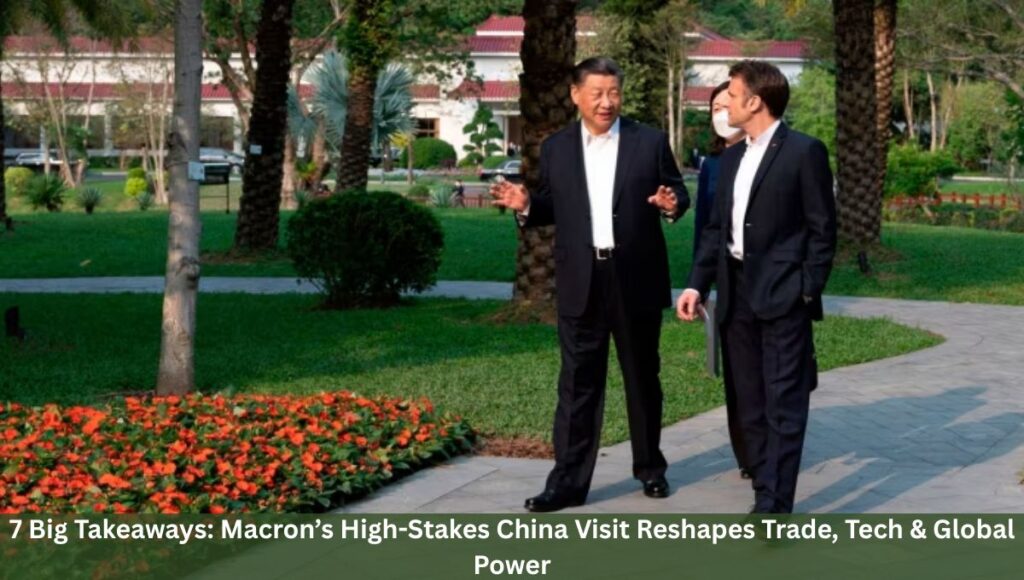
7 Big Takeaways: Macron’s High-Stakes China Visit Reshapes Trade, Tech & Global Power
Macron Arrives in Beijing: Trade, Diplomacy and a Red-Carpet Welcome
Macron landed in Beijing after nightfall, accompanied by First Lady Brigitte Macron, stepping onto a red-carpeted jetway where Chinese Foreign Minister Wang Yi welcomed them.
The French president’s agenda is packed:
defend fair and reciprocal access to China’s market, expand French exports, attract Chinese investment, and advocate Beijing’s role in promoting pressure on Russia regarding the Ukraine war.
Trade remains the backbone of the visit. The European Union currently faces a massive trade deficit with China—over €300 billion in 2023—and France alone accounts for 46% of the EU’s deficit. Macron has been vocal about rebalancing these numbers, insisting on “sustainable, solid growth that benefits everyone.”
Macron’s office signaled that the president will push hard for:
- Improved market access for French goods
- New Chinese investments in France
- Stronger cooperation in energy, aviation and food industries
- Progress on disputes involving pork, dairy and electric vehicle subsidies
The early optics of the visit—the Forbidden City tour and cultural diplomacy—underline the “special relationship” France and China have cultivated for six decades. But beneath the pageantry lie complex economic and geopolitical questions.
Why Macron’s Visit Comes at a Critical Moment for Europe
Beyond France-China relations, Macron is positioning this trip as a pivotal opportunity to redefine Europe’s engagement with China and the future of global innovation.
Europe, he argues, risks becoming a mere consumer rather than a co-creator of tomorrow’s technologies. China’s rapid advances in artificial intelligence, robotics, electric vehicles, low-altitude aviation and urban mobility are reshaping global industries. Macron warns that Europe cannot afford to stay reactive.
A Turning Point for European Competitiveness
Macron sees this visit as a chance to spark a European momentum based on:
- Early-stage technological cooperation
- Common standards for AI and emerging technologies
- Industrial partnerships with strategic depth
- Reduced dependence on US and Chinese tech giants
This vision aligns with Europe’s desire for “strategic autonomy”—a doctrine Macron has championed for years.
A Proposal for a New AI Governance Model
Perhaps the boldest idea connected to the visit is the potential creation of a World AI Cooperation Organization, which Macron’s advisers have discussed as part of a long-term global governance overhaul.
Such an institution would function as:
- A laboratory for testing AI governance models
- A platform for cross-border tech standards
- A mechanism to manage AI risks and disruptions
By linking innovation with governance, Macron aims to position Europe and China as co-leaders in defining global AI norms.
France-China Relations: A Unique Historical Relationship
China and France share one of the most distinctive diplomatic relationships between Beijing and a Western power. France was the first major Western nation to open ambassador-level relations with the People’s Republic of China during the Cold War.
It was also the first to host a Chinese head of state and the first Western head of state to visit China in the early years of the PRC.
Xi Jinping has repeatedly praised the “China–France spirit,” built on:
- Independence
- Mutual understanding
- Foresight
- Mutual benefit
- Win-win cooperation
The 60th anniversary of diplomatic relations, marked in 2024, served as a reminder of the enduring ties that continue to influence broader China-European Union dynamics.
Trade and Economic Cooperation: The Heart of Macron’s Mission
Economic cooperation remains the anchor of the France-China partnership.
Today:
- China is France’s largest trading partner in Asia
- France is China’s third-largest trading partner in the EU
- Over 2,000 French companies operate in China
- Chinese investments create nearly 60,000 jobs in France
The “French Farm to Chinese Table” Initiative
One of the most successful bilateral programs remains the “From French Farm to Chinese Table” initiative, announced during Macron’s 2023 visit.
It streamlines exports of:
- French beef
- Dairy
- Pork
- Wine
- Spirits
- Specialty foods
Macron arrives with several agriculture leaders, hoping to deepen this cooperation amid China’s investigations into European pork and dairy.
Energy Cooperation: EDF, CNNC and Carbon Neutrality
Energy is expected to be one of the top agenda items during Macron’s meeting with Xi Jinping.
France hopes to finalize agreements involving:
- Nuclear energy cooperation
- Joint development of advanced nuclear facilities
- Support for both nations’ carbon neutrality goals
In 2024, EDF and the China National Nuclear Corporation (CNNC) signed a major cooperation agreement. This aligns with Macron’s goal to strengthen France’s nuclear sector, which he sees as essential to Europe’s energy future.
EDF CEO Bernard Fontana is part of Macron’s delegation—an unmistakable signal that Paris is pushing for fresh nuclear partnerships.
Will China Sign a Major Airbus Deal?
Perhaps the most closely watched aspect of the visit is the potential signing of a major Airbus aircraft order.
What We Know So Far
- There is speculation China could order 100–200 Airbus jets
- Airbus CEO Guillaume Faury is traveling with Macron
- The last major deal came in 2019, when China ordered 300 aircraft
France desperately wants this deal—not only for economic reasons, but also as a symbol of Europe’s industrial relevance.
However, Macron’s 2023 China visit did not bring a deal, and Beijing has historically balanced Airbus orders with Boeing purchases to maintain geopolitical equilibrium. Even so, expectations are running high.
Agriculture and Food: A Growing Trade Priority
France’s agriculture sector sees China as a critical growth market. Macron’s delegation includes:
- The Agriculture Minister
- Leading dairy and meat CEOs
- Representatives from France’s pork, beef and dairy industries
The talks will address:
- China’s ongoing investigations into European pork
- Dairy product scrutiny
- Market access for French specialty foods
- New protocols for agricultural exports
France recently resolved China’s anti-dumping duties on French cognac—a move seen as a diplomatic breakthrough. Macron hopes to build on this momentum.
Panda Diplomacy: A Soft-Power Highlight of the Trip
A surprisingly emotional aspect of the visit is panda diplomacy. France’s Beauval Zoo recently returned two giant pandas, Huan Huan and Yuan Zi, to China after 13 years. Their departure sparked national attention.
Now, Macron’s scheduled visit to Chengdu—home of China’s premier panda breeding center—has fueled speculation that Beijing may gift or loan new pandas to France. Chinese officials have hinted that new pandas may be coming “in the future,” suggesting that panda diplomacy could be revived as a symbol of renewed goodwill.
Macron and Xi both emphasize the need for stronger global governance in a rapidly changing world. Macron argues that the UN, IMF, and other major institutions were designed for a different era—and must evolve to match today’s multipolar, technologically driven realities. China supports multilateralism as a core principle of its foreign policy.
The two countries collaborate on:
- Climate change
- Global financial reform
- Peacekeeping
- Nuclear non-proliferation
- Reform of international institutions
Their joint statement marking the 10th anniversary of the Paris Agreement reaffirmed deep cooperation on climate governance.
China-Europe Relations: A Balancing Act
China has described the EU as:
- A partner
- A competitor
- A systemic rival
Macron’s visit sits at the crossroads of these identities.
European concerns include:
- Electric vehicle subsidies
- Intellectual property
- Security issues
- Taiwan
- China’s closeness to Russia
Yet Macron has consistently argued that Europe must maintain strategic autonomy, not simply align with US hardline positions.
Paris hopes this visit can stabilize China-EU relations, which have been strained by:
- EV subsidy investigations
- China’s counter-probes into brandy, pork, and dairy
- Escalating trade tensions across multiple industries
Experts say France is uniquely positioned to help the EU shape a more balanced China strategy.
Security and Global Stability: Taiwan, WWII and Geopolitical Responsibility
China and France, as permanent members of the UN Security Council, share global responsibilities.
Recent discussions touched on:
- Taiwan
- Japan’s recent political statements
- World War II historical outcomes
- Territorial integrity and sovereignty
China hopes France will continue to firmly uphold the one-China principle. Paris, in turn, expects China to play a stabilizing role in global geopolitical tensions.
Wang Yanhang, a senior Chinese researcher, notes that:
- China and France fought on the victorious side of WWII
- They have shared responsibility to uphold post-war global order
- Their cooperation strengthens global stability in turbulent times
Macron’s Delegation: 80+ Ministers, CEOs and Strategists
Macron’s three-day visit comes with one of the largest delegations France has ever taken to China:
- Over 80 delegates
- Nearly 40 top CEOs
- Key ministers from energy, agriculture, transport and foreign affairs
- Leaders in nuclear energy, aviation, food, wine, dairy, and meat industries
The scale signals one clear message:
France sees this visit as a strategic turning point—and wants to secure deals now, not later.
What’s at Stake for Europe?
Macron’s China visit is more than a diplomatic engagement. It’s a test of Europe’s ability to shape its own destiny.
Europe stands at a crossroads:
- Engage deeply with China and co-create the future,
or - Stand on the sidelines while the US and China set global rules.
For Macron, the choice is clear.
He wants Europe to:
- Lead in emerging technologies
- Partner intelligently with Beijing
- Reform global institutions
- Build strategic autonomy
- Secure balanced trade relations
- Co-shape the next era of global governance
The world is moving fast—and Macron believes Europe must move with it.
Conclusion: A Visit That Could Define a Decade
Macron’s state visit is a convergence of timing, opportunity and responsibility. With trade deficits soaring, supply chains shifting, and technological revolutions accelerating, France and China have a rare chance to redefine their relationship—and perhaps shape the next chapter of global politics.
From potential Airbus megadeals and energy cooperation to AI governance and panda diplomacy, the outcomes of this visit will resonate far beyond Beijing or Paris.
This is not just a diplomatic mission. It is a moment where Europe must decide whether to shape the future, or simply adapt to it. Macron seems determined that France—and the EU—will choose the former.
Also Read: 5 Shocking Developments in Macron’s Political Crisis
Also Read: Macron calls on China to work for peace, rebalance trade
Related Posts:
- 7 Critical Revelations Behind the Global Airbus A320…

- In 8 Moves, EU Targets China-Linked Refineries and…

- China Hosts SCO Summit 2025 and Military Parade as…
- ‘Dragon and Elephant Must Come Together’: PM Modi…
- U.S.–China Trade War 2025: 500% Tariff Threat Sparks…
- 5 Major Takeaways from the US Supreme Court's…