7 Explosive Diplomatic Flashpoints: India Slams UK–France–Germany Op-Ed Ahead of Putin Visit, with the MEA calling it “Unacceptable and Unusual.” Just days before Russian President Vladimir Putin is set to arrive in New Delhi for a high-stakes two-day visit, a rare diplomatic storm has erupted.
India has publicly criticized a joint op-ed written by the ambassadors of the United Kingdom, France, and Germany, a move senior officials in the Ministry of External Affairs (MEA) have described as “unusual,” “unacceptable,” and contrary to diplomatic norms.”
The controversy—now snowballing across New Delhi’s diplomatic circuit—comes at a sensitive geopolitical moment. India is preparing to host a leader who remains central to its strategic, defense, and energy partnerships, even as Western nations intensify pressure over Russia’s war in Ukraine.
From stern statements by the MEA to a fiery counter-editorial by the Russian ambassador, from private European outreach to New Delhi to heated commentary by veteran diplomats, the episode has become a defining moment in India’s balancing act between major global powers.
This is the full story.
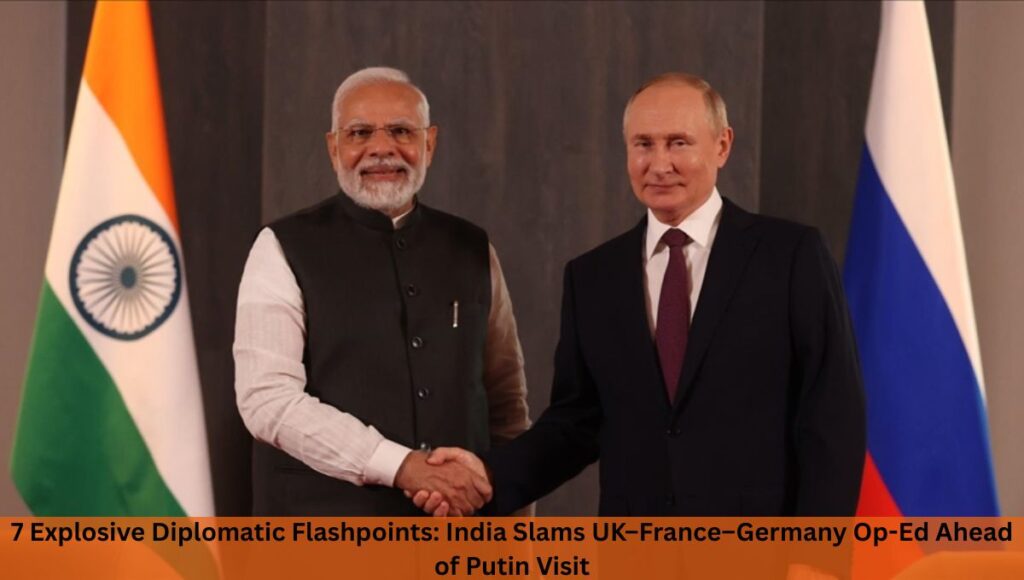
7 Explosive Diplomatic Flashpoints: India Slams UK–France–Germany Op-Ed Ahead of Putin Visit
The Op-Ed That Sparked a Diplomatic Storm
The controversy began after British High Commissioner Lindy Cameron, French Ambassador Thierry Mathou, and German Ambassador Philipp Ackermann jointly authored a strongly worded opinion piece in The Times of India. The article—titled “World Wants the Ukraine War to End, But Russia Doesn’t Seem Serious About Peace”—was published just days before Putin’s scheduled arrival.
What the Op-Ed Said
The three envoys accused Russia of:
- launching an “unprovoked war of aggression”
- refusing to engage sincerely in peace negotiations
- escalating air attacks even during ceasefire discussions
- committing war crimes by targeting civilians
- destabilizing Europe through disinformation and cyberattacks
They wrote that Russia could end the war “tomorrow” if it chose to withdraw or agree to a real ceasefire. The op-ed also invoked Prime Minister Narendra Modi’s remark that “a solution cannot be found on the battlefield,” implying India’s position aligns with Western expectations. But the timing and tone hit a nerve in New Delhi.
MEA’s Sharp Response – ‘Unacceptable and Unusual’
Senior officials in the Ministry of External Affairs promptly expressed strong displeasure.
A senior MEA official told The Hindu:
“It is very unusual. Not acceptable diplomatic practice to give public advice on third country relations.”
The official said India had “taken note” of the article and found it inappropriate for foreign diplomats to comment publicly on India’s ties with another country.
Why India Is Upset
India’s annoyance stems from several factors:
- The timing—the op-ed was published right before Putin’s visit.
- The messaging—it indirectly questioned India’s close ties with Russia.
- The method—three ambassadors acting together appeared like coordinated pressure.
The MEA’s reaction underscores India’s longstanding position:
Strategic autonomy is non-negotiable.
India’s Strong Signalling: Russia Ties Are ‘Enduring and Important’
While declining to escalate the matter officially, New Delhi has made it clear that the upcoming Putin visit is significant.
Senior officials reiterated:
- India-Russia relations have been “stable for decades.”
- The partnership contributes to regional and global stability.
- Key strategic issues, including defense, energy, and geopolitics, will be discussed.
Counterterrorism as a Pillar of Cooperation
Officials emphasized that Russia was the first nation with which India established a dedicated counterterrorism working group back in 2002.
Trade and Economic Priorities
India aims to:
- boost exports of pharmaceuticals, agriculture products, processed foods, and consumer goods,
- reduce trade imbalance with Russia,
- insulate bilateral trade from Western sanctions pressures.
Putin’s visit is expected to advance discussions on energy, nuclear cooperation, defense procurement, and emerging technologies.
Russian Ambassador Fires Back With Explosive Counter-Op-Ed
Not one to let the Western article go unanswered, Russian Ambassador Denis Alipov authored a fierce rebuttal, also in The Times of India. His editorial, titled “Europe’s 4 Treacheries Are Impeding Peace in Ukraine,” presented Moscow’s version of events and directly accused European powers of instigating the Ukraine conflict.
Alipov’s Main Claims
Alipov argued:
- Russia never sought war with Ukraine.
- Europe and the Obama administration “engineered” the 2014 crisis by supporting the ouster of President Yanukovych.
- The Minsk Accords were signed in bad faith by Germany and France.
- Europe encouraged Ukraine to escalate the Donbass conflict.
- Former UK PM Boris Johnson sabotaged a near-final peace deal in 2022.
He repeatedly referred to “European treachery”, listing four major episodes where he says Europe frustrated peace initiatives. Alipov also accused Europe of sabotaging the U.S. peace plan proposed by President Trump, arguing that European countries want to prolong the war to weaken Russia.
Europe Responds – ‘Russia Is an Aggressor’
Soon after, the EU Ambassador struck back during a public event, dismissing Russia’s claims and reiterating Europe’s position:
“Russia has been invading a neighbouring country… cyber warfare, drone threats, disinformation — all of this is documented. Russia is an aggressor.”
He also defended the controversial op-ed by his European colleagues, saying:
“Facts are stubborn. Which country has invaded another?”
Private Diplomatic Outreach: Europe Asks India to ‘Speak to Putin’
While the public exchange grabbed headlines, behind the scenes, European nations have taken a softer tone.
The Indian Express reported that several European envoys privately approached Indian officials with a request:
“Putin is a friend of yours… he listens to you… please ask him to stop the war.”
Officials reportedly offered a “patient hearing.”
How This Differs From 2022
At the start of the war:
- Europe pressured India to condemn Russia,
- reduce ties,
- and take the Western position.
Now, recognizing India’s unique leverage with Moscow, European countries are urging India to play the role of a peace facilitator.
Kanwal Sibal: ‘Trade Union Diplomacy’ and Violation of Norms
Former Foreign Secretary Kanwal Sibal sharply criticized the joint op-ed.
He called it:
- “vicious”
- “propagandist intent”
- “interference in India’s internal affairs”
- “a diplomatic insult”
Sibal accused the envoys of using “group action” to shield themselves from individual accountability—calling it “trade unionism type diplomacy.”
Why He Believes the Op-Ed Crossed a Line
Sibal argued:
- If Russia’s visit has nothing to do with India’s foreign policy toward Europe, Europe should not comment.
- The envoys attempted to create controversy ahead of a friendly state visit.
- Their aim was to influence public opinion, not state policy.
This criticism aligns closely with the MEA’s unhappiness.
What Putin’s India Visit Means for New Delhi
Putin arrives in India with:
- Defense Minister Andrei Belousov
- Leading business executives
- Senior officials
The visit marks 25 years of the India–Russia Strategic Partnership, elevated in 2010 to a “Special and Privileged Strategic Partnership.”
Key Issues Likely on the Table
- Defense ties – including missile systems, naval assets, and joint production.
- Energy and oil trade – safeguarding trade from sanctions.
- Small modular reactors – proposed cooperation in nuclear energy technology.
- Financial mechanisms – bypassing Western-dominated payment frameworks.
- Regional security – including Ukraine, Central Asia, and Indo-Pacific dynamics.
Western Capitals Watching Closely
The U.S., EU nations, and NATO members are closely monitoring the visit, especially:
- defense agreements,
- India’s stance on Ukraine,
- and any Russia–India coordination on energy or payment systems.
India’s Strategic Autonomy: The Core of Its Response
At the heart of India’s displeasure is a simple but powerful message:
India will not allow foreign governments to comment publicly on its sovereign diplomatic choices.
India has maintained a consistent position since 2022:
- It neither condemns nor endorses Russia’s actions.
- It emphasizes dialogue and diplomacy.
- It rejects Western pressure campaigns.
- It keeps relations with both Russia and the West balanced.
This approach has enhanced India’s credibility as a nation that navigates global conflicts without aligning blindly with any bloc.
Why This Episode Matters: A Turning Point in India–Europe Relations?
This diplomatic clash is significant because it reveals:
- Western frustration with their inability to isolate Russia.
- Recognition that India has unique influence over Moscow.
- A widening gap between how India and Europe view global power shifts.
- India’s growing assertiveness in pushing back against Western commentary.
- Russia’s confidence in India as a strategic counterweight to Western pressure.
Conclusion: A Diplomatic Triangle Resetting Global Equations
The joint UK–France–Germany op-ed has triggered one of the most dramatic diplomatic episodes in recent years.
India’s strong response, Russia’s fiery rebuttal, and Europe’s private outreach all point to one truth:
India has become an indispensable geopolitical player—one that neither Russia nor Europe can afford to ignore.
As Vladimir Putin arrives in New Delhi, the world will be watching not only what India and Russia agree upon, but how India manages its increasingly complicated relationships with competing global powers.
For now, one thing is unmistakably clear:
India will decide its Russia policy on its own terms—public pressure or op-eds will not change that.
Also Read: 5 Shocking Reasons Trump’s Putin Summit Plan Collapsed
Also Read: Why Is Europe Rattled With Putin’s Visit to India?
Related Posts:
- 7 Powerful Facts About Ayatollah Ali Khamenei’s…
- 5 Shocking Facts About the Kidnapping of Indian…
- 5 Key Shifts in Bangladesh–Pakistan Relations as…

- 5 Major Takeaways from the US Supreme Court's…

- 5 Key Signals from PM Modi’s Virtual ASEAN Summit Appearance
- 7 Heartbreaking Facts About Venezuela's Earthquake Disaster