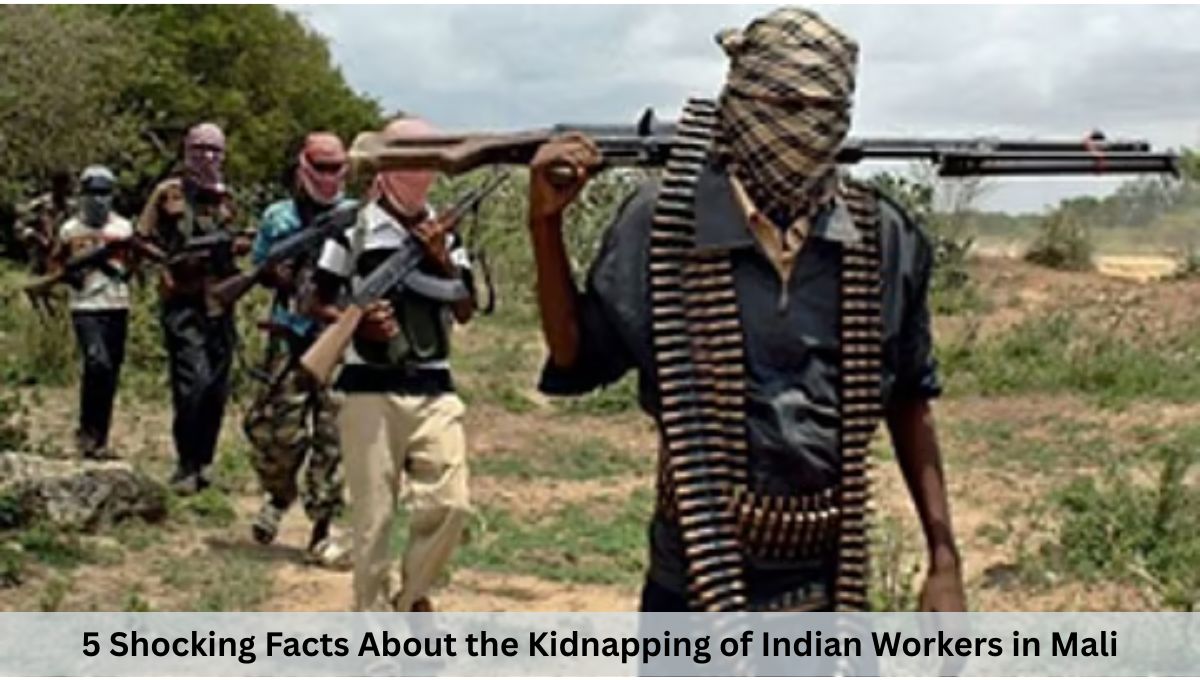
5 Shocking Facts About the Kidnapping of Indian Workers in Mali amid surging jihadist violence. India’s Ministry of External Affairs (MEA) has confirmed that five Indian nationals, all from Tamil Nadu, were kidnapped in Mali on November 6, 2025. The abduction has triggered an intense diplomatic response from New Delhi as efforts continue to secure their safe release.
In an official statement, the Indian Embassy in Bamako said it is “aware of the unfortunate incident of kidnapping of five of our nationals” and is “working closely with Malian authorities and the company concerned to secure their safe release as quickly as possible.”
The embassy’s post on X, tagged to @MEAIndia and @PMOIndia, underscored the seriousness with which the government is treating the matter. Officials confirmed that the embassy is in constant contact with Malian security forces and that the MEA is coordinating with international partners familiar with the region’s security dynamics.
5 Shocking Facts About the Kidnapping of Indian Workers in Mali
Who Are the Kidnapped Workers?
All five abducted workers hail from Thoothukudi and Tenkasi districts in southern Tamil Nadu. They have been identified as:
- P. Ponnudurai (41) from Naraikinaru
- S. Puthiyavan (52) from Kodiankulam
- M. Petchimuthu (42) from Kalappaipatti
- Esakkiraja (36) from Muthu Krishnapuram near Kadai Nallur
- Thalapathy Suresh (26) from Kadayanallur
According to officials, the men were employed by Troying Rail Lighting, a Mumbai-based company involved in electrification projects. They were working near Kobri, a small town in western Mali, when armed militants intercepted their camp.
Family members in Tamil Nadu say they lost contact with the workers shortly after the incident and have been “living in fear and uncertainty” ever since.
Local authorities in Thoothukudi and Tenkasi have assured the families that both the state and union governments are pursuing all avenues for the men’s rescue.
Political Leaders Urge Swift Action
Tamil Nadu political leaders have urged the Centre to take immediate steps to bring the workers home safely. AIADMK leader E. Palaniswami and PMK’s Anbumani Ramadoss have both appealed for urgent intervention.
Dr Ramadoss posted on X, “The five Tamils kidnapped by terrorists in Mali must be rescued immediately. Their poverty forced them to go to a dangerous country for low-paying jobs. The Centre and the state must act urgently to bring them home safely.”
He further emphasized that the Tamil Nadu government must focus on creating dignified employment opportunities within the state so that citizens are not compelled to work in high-risk regions abroad.
Embassy Mobilizes Emergency Efforts
According to MEA officials, the Indian Embassy in Bamako has been working “round the clock” with Malian authorities and the company concerned. Other Indian workers employed on similar projects have reportedly been moved to safe locations in the capital to avoid further risk.
Sources confirmed that the embassy is in close touch with local law enforcement agencies and international organizations operating in the region.
“All necessary efforts are being made to secure their release at the earliest,” said an MEA spokesperson in New Delhi.
No group has claimed responsibility for the kidnapping so far, but officials suspect the involvement of armed groups linked to Al-Qaeda or the Islamic State, both of which have been active in the region.
Mali’s Volatile Security Landscape
Mali has endured years of instability and insurgency, particularly in its central and northern regions. The country has faced multiple military coups since 2012 and continues to battle jihadist insurgencies affiliated with Al-Qaeda in the Islamic Maghreb (AQIM) and the Islamic State in the Greater Sahara (ISGS).
Armed groups have routinely targeted foreign workers, humanitarian staff, and infrastructure projects as part of their campaign to destabilize the state and extract ransoms.
Security analysts say that the kidnapping of Indian nationals reflects both the growing reach of jihadist networks and the ongoing collapse of state authority in the Sahel region.
What Is Happening in Mali Right Now?
Mali is currently governed by a military junta that came to power through consecutive coups in 2020 and 2021. The junta, led by President Assimi Goïta, promised to restore stability and defeat jihadist groups but has instead presided over worsening insecurity and economic hardship.
A crippling fuel blockade, allegedly enforced by jihadist groups, has paralyzed large parts of the country. Schools have closed, crops remain unharvested, and electricity access is severely restricted.
President Goïta recently urged citizens to limit unnecessary travel while pledging to “do everything possible to deliver fuel.”
However, former UN independent expert Alioune Tine described the statement as a “terrible admission of failure”, warning that the Malian state’s collapse could have “catastrophic consequences” for the entire region.
JNIM — The Rising Threat Behind Mali’s Chaos
The Group for the Support of Islam and Muslims (JNIM) — an umbrella organization affiliated with Al-Qaeda — has emerged as the most powerful jihadist faction in Mali. The UN calls JNIM “the most significant terrorist threat in the Sahel.”
Formed in 2017, JNIM seeks to implement Sharia law and undermine the legitimacy of Sahelian states. It operates through local alliances, offering “protection” to villages in exchange for compliance and taxes.
In recent months, JNIM has extended its control over key territories, funding its operations through ransom kidnappings and illegal taxation.
Security sources say that last week, JNIM received at least $50 million for the release of two Emirati citizens and an Iranian engineer who were abducted near Bamako in September.
Experts believe that JNIM’s latest operations — including a fuel-truck blockade that destroyed over 50 vehicles — demonstrate a growing ambition to topple the junta and establish a Taliban-style regime in Mali.
Foreign Nationals — Frequent Targets
Kidnappings of foreign nationals are not new to Mali. The country’s vast, sparsely governed terrain makes it an ideal operating ground for insurgent networks.
In September 2025, two Emirati citizens and an Iranian were abducted near Bamako and released only after a multimillion-dollar ransom was paid, according to AFP.
Several humanitarian workers and contractors from France, Germany, and China have also been abducted in recent years, many of them during development projects in rural areas.
Analysts warn that the kidnapping of Indian nationals fits into this pattern of strategic abductions, where jihadist groups seek both ransom and international attention.
How India Is Responding
India’s foreign ministry has adopted a multi-layered approach to the crisis, combining diplomatic outreach with security coordination.
According to officials familiar with the matter, the Indian Embassy in Bamako has intensified communication with Malian counterparts while New Delhi is liaising with friendly nations experienced in hostage-negotiation efforts in the Sahel.
MEA officials said, “We remain fully committed to ensuring the safe and early release of our nationals. All necessary measures are being pursued through diplomatic and security channels.”
The Indian government has also issued a travel advisory cautioning citizens against travelling to Mali and other Sahelian countries due to “the unpredictable security environment.”
Families Wait in Anguish
Back in Tamil Nadu, the families of the abducted workers are living through agonizing uncertainty.
“We have not spoken to him since the day of the incident,” said a relative of one of the abductees. “We appeal to the state and central governments to bring them home safely. We will approach the district collector and other officials to seek help.”
Local NGOs and community organizations have also urged authorities to expedite diplomatic negotiations and provide psychological and financial support to the families.
Why Indians Are Working in High-Risk Zones
Many of the abducted workers took up employment in Mali due to limited job opportunities at home. Tamil Nadu, particularly the southern districts, has long seen migration to Africa and the Gulf for low-paying construction and technical work.
Analysts say the latest kidnapping underscores the need for better safeguards for Indians working abroad and stronger coordination between state governments and the MEA to track citizens in volatile regions.
Dr Anbumani Ramadoss highlighted that “poverty forced them to go to a dangerous country for low-paying jobs,” urging both the central and state governments to create safer employment alternatives domestically.
Global Concern Over Sahel Instability
The Sahel region — stretching across Mali, Niger, Burkina Faso, and Chad — has become one of the world’s most dangerous zones for foreign nationals.
According to UN reports, the area now accounts for over 40 percent of global terrorism-related deaths, with jihadist groups exploiting weak governance and widespread poverty.
The Soufan Center think tank warns that if Mali collapses, a “domino effect” could destabilize neighboring juntas in Burkina Faso and Niger, leading to a broader regional crisis.
Western nations, including the United States, United Kingdom, and Germany, have already issued urgent advisories urging their citizens to leave Mali. Many have also suspended development operations in the country.
Experts Warn of a Deepening Humanitarian Crisis
Security analysts argue that the junta’s inability to contain the jihadist threat has compounded Mali’s humanitarian and economic woes.
James Barnett, a research fellow at the Hudson Institute specializing in African politics, said JNIM’s actions point to an attempt to “bring down the regime and establish a government aligned with its ideological agenda.”
“The growing intensity of the fuel blockade, operations near major cities, and even reports that the group is engaging with political actors opposed to the government suggest they may now be considering a Taliban-type takeover,” Barnett said.
The UN Office for the Coordination of Humanitarian Affairs (OCHA) estimates that nearly nine million Malians require urgent humanitarian assistance.
What Lies Ahead
As diplomatic efforts continue, the focus remains on securing the safe return of the five Indian nationals.
Indian authorities are working discreetly to avoid jeopardizing ongoing negotiations, while international partners are assisting with intelligence and mediation.
For now, there is no confirmation regarding the group responsible or the demands made, but officials are optimistic that sustained diplomatic engagement will lead to a breakthrough.
Conclusion
The kidnapping of five Indian workers in Mali is a stark reminder of the growing instability gripping the Sahel region. It highlights the vulnerability of foreign laborers working in high-risk zones and underscores the need for stronger international cooperation to combat terrorism and protect civilian lives.
As families in Tamil Nadu wait anxiously, India’s diplomatic machinery continues to work tirelessly behind the scenes — a testament to the country’s expanding global responsibilities amid a rapidly changing security landscape.
Also Read: ‘Working Closely’: India Steps Up Efforts For ‘Quick Release’ Of 5 Nationals Kidnapped In Mali
Also Read: Tragedy in Washington DC: Two Israeli Embassy Staffers Killed in Suspected Antisemitic Terror Attack