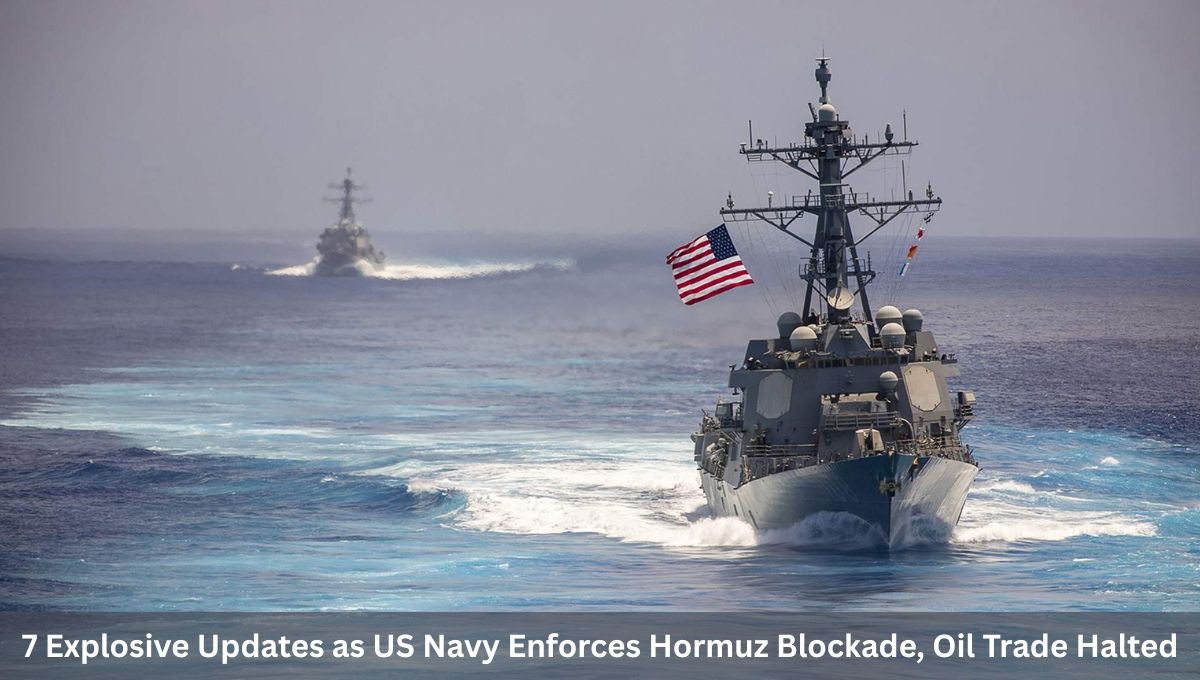
7 Explosive Updates as US Navy Enforces Hormuz Blockade, Oil Trade Halted threatening global supply. The United States has escalated its confrontation with Iran by enforcing a sweeping naval blockade targeting maritime trade routes connected to Iranian ports. In a dramatic development, a US Navy destroyer intercepted two oil tankers attempting to leave Iran, marking a critical step in Washington’s strategy to exert economic pressure on Tehran.
The blockade, centered around the strategically vital Strait of Hormuz, represents one of the most consequential military-economic actions in recent years.
With roughly one-fifth of the world’s oil supply passing through this narrow waterway, the implications extend far beyond the Middle East, affecting global energy markets, geopolitical stability, and international trade.
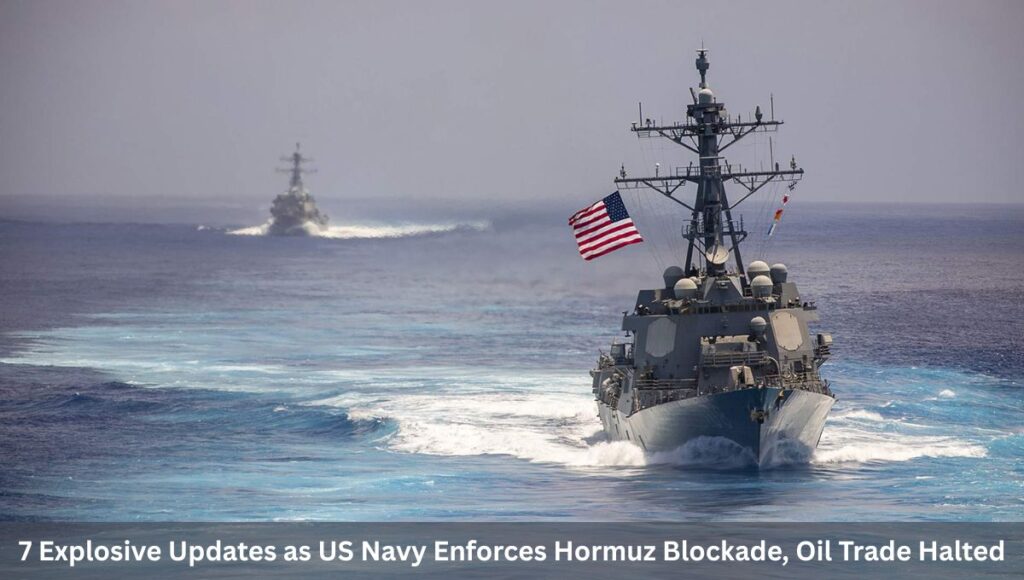
In the early phase of the blockade, a US Navy destroyer intercepted two oil tankers that had departed from Iran’s Chabahar port in the Gulf of Oman.
The vessels were contacted via radio and instructed to turn back, signaling Washington’s firm intent to enforce the blockade.
This incident is widely seen as the first tangible enforcement action since the blockade was announced.
While details remain limited, officials confirmed that multiple vessels have already complied with US directives, reinforcing the credibility of the operation.
The interception underscores a shift from rhetoric to active maritime control, placing US naval forces in direct operational contact with commercial shipping.
Scope of the Blockade: A Massive Military Operation
The scale of the blockade is substantial.
According to military sources, the operation involves:
- Over 10,000 US personnel
- More than a dozen warships
- Multiple aircraft deployed across the region
The United States Central Command (CENTCOM) has described the blockade as “fully implemented,” claiming that it has effectively halted economic trade entering and leaving Iran by sea within just 36 hours.
Given that approximately 90% of Iran’s economy depends on maritime trade, the blockade aims to deliver a severe economic blow.
Strait of Hormuz: The World’s Most Critical Energy Chokepoint
The Strait of Hormuz remains central to the unfolding crisis. This narrow passage connects the Persian Gulf to the Gulf of Oman and is essential for global oil transportation.
Why Hormuz Matters
- Handles nearly 20% of global oil supply
- Critical route for exports from Gulf nations
- Essential for energy-importing economies in Asia and Europe
Any disruption in this region sends immediate shockwaves through global markets, as seen in the recent surge in oil prices.
Conflicting Signals: Has Trade Really Been Stopped?
While US officials claim that maritime trade has been “completely halted,” independent data paints a more complex picture.
Maritime tracking firms have identified several vessels that managed to pass through the Strait despite the blockade.
These include:
- Bulk carriers
- Oil tankers linked to Iran
- Sanctioned vessels with altered tracking data
Some ships reportedly disabled their tracking systems or manipulated destination signals to evade detection, highlighting the challenges of enforcing such a blockade.
This discrepancy raises critical questions about the effectiveness and sustainability of the operation.
Oil Markets React: Volatility and Uncertainty Rise
The blockade has had an immediate impact on global oil markets.
Key Developments
- Oil prices surged by up to 50% earlier in the conflict
- Prices briefly crossed $100 per barrel
- Markets later stabilized on hopes of renewed negotiations
Despite short-term price fluctuations, analysts warn that prolonged disruption could lead to sustained volatility and inflationary pressure worldwide.
Economic Warfare: Targeting Iran’s Lifeline
The US strategy is rooted in economic warfare.
By blocking maritime trade, Washington aims to:
- Cut off Iran’s oil export revenues
- Weaken its military capabilities
- Force compliance in nuclear negotiations
Iran exports approximately 1.8 million barrels of oil per day, representing a significant portion of global supply.
Removing even a fraction of this volume can disrupt markets and strain supply chains.
However, Iran has historically demonstrated resilience under sanctions, often finding alternative routes and methods to sustain exports.
Ceasefire Under Threat: Rising Risk of Escalation
The blockade comes amid a fragile two-week ceasefire in the ongoing conflict involving the US, Iran, and Israel.
While diplomatic efforts continue, the blockade risks undermining these negotiations. Iran has already indicated that it views the move as a violation of the ceasefire agreement.
Potential Consequences
- Renewed military confrontation
- Retaliatory attacks on US assets
- Expansion of conflict across the region
Analysts warn that even a single miscalculation could trigger a broader escalation.
Global Implications: Beyond the Middle East
The impact of the Hormuz blockade is not limited to the immediate region.
Key Global Effects
- Disruption to energy supplies in Asia and Europe
- Increased shipping and insurance costs
- Strain on global economic growth
Countries heavily dependent on Gulf oil imports, including India and China, are particularly vulnerable.
Supply chain disruptions could force nations to seek alternative sources, reshaping global energy dynamics.
Enforcing a maritime blockade in the Strait of Hormuz presents significant operational challenges.
Key Difficulties
- Narrow and congested waterways
- Use of small boats and drones by Iran
- Potential mining of shipping lanes
- Ships disguising or disabling tracking systems
The US Navy must maintain constant vigilance while avoiding direct confrontation that could escalate into open conflict.
Iran’s Possible Response: Strategic Patience or Retaliation?
Iran’s response remains uncertain but critical to the trajectory of the crisis.
Possible Scenarios
- Direct retaliation against US naval forces
- Attacks on regional energy infrastructure
- Expansion of proxy conflicts
- Continued evasion tactics to bypass the blockade
Iran has previously demonstrated its ability to operate under pressure, suggesting that the blockade alone may not achieve immediate compliance.
Diplomatic Signals: Talks May Resume
Despite the escalation, diplomatic channels remain open. US officials have indicated that negotiations with Iran could resume soon, potentially in Pakistan.
Both sides have expressed cautious optimism, though significant differences remain, particularly regarding nuclear activity and sanctions.
The coming days are expected to be crucial in determining whether diplomacy can de-escalate the situation.
The “Game of Chicken”: Who Will Blink First?
The current standoff has been described as an economic and strategic “game of chicken.”
- The US is betting on its economic and military superiority
- Iran is relying on resilience and asymmetric tactics
Both sides face significant risks, including economic damage, military casualties, and political fallout.
Impact on Global Shipping and Trade
Shipping activity through the Strait of Hormuz has already declined sharply.
Current Trends
- Traffic reduced to a fraction of pre-conflict levels
- Increased rerouting and delays
- Higher insurance premiums for vessels
These disruptions are likely to have cascading effects on global trade, particularly in energy and commodities markets.
Conclusion: A Defining Moment in Global Energy Politics
The US Navy’s enforcement of a blockade against Iranian maritime trade marks a pivotal moment in the ongoing conflict.
While the operation has demonstrated immediate impact, its long-term effectiveness remains uncertain.
With global oil markets on edge, diplomatic efforts in flux, and military tensions rising, the situation in the Strait of Hormuz represents one of the most significant geopolitical flashpoints of the decade.
The next phase will depend on whether diplomacy can prevail over confrontation—or whether the world is heading toward a deeper and more dangerous escalation.
Also Read: 10 Explosive Updates as Trump Orders Hormuz Blockade After Iran Talks Fail
Also Read: No ships got through in first 24 hours: How US is enforcing a sweeping blockade on Iranian ports
Related Posts:
- 7 Powerful Insights as North Korea Tests Missiles…
- 7 Critical Ways Iran’s Yuan Oil Plan Could Shake the…
- 7 Powerful Reasons the U.S. Is Letting Countries Buy…
- 7 Critical Reasons Kharg Island Is Iran’s Oil “Crown…

- 7 Explosive Developments as US Navy Enforces Iran…
- 7 Explosive Reasons Oil Prices Are Surging as Trump…