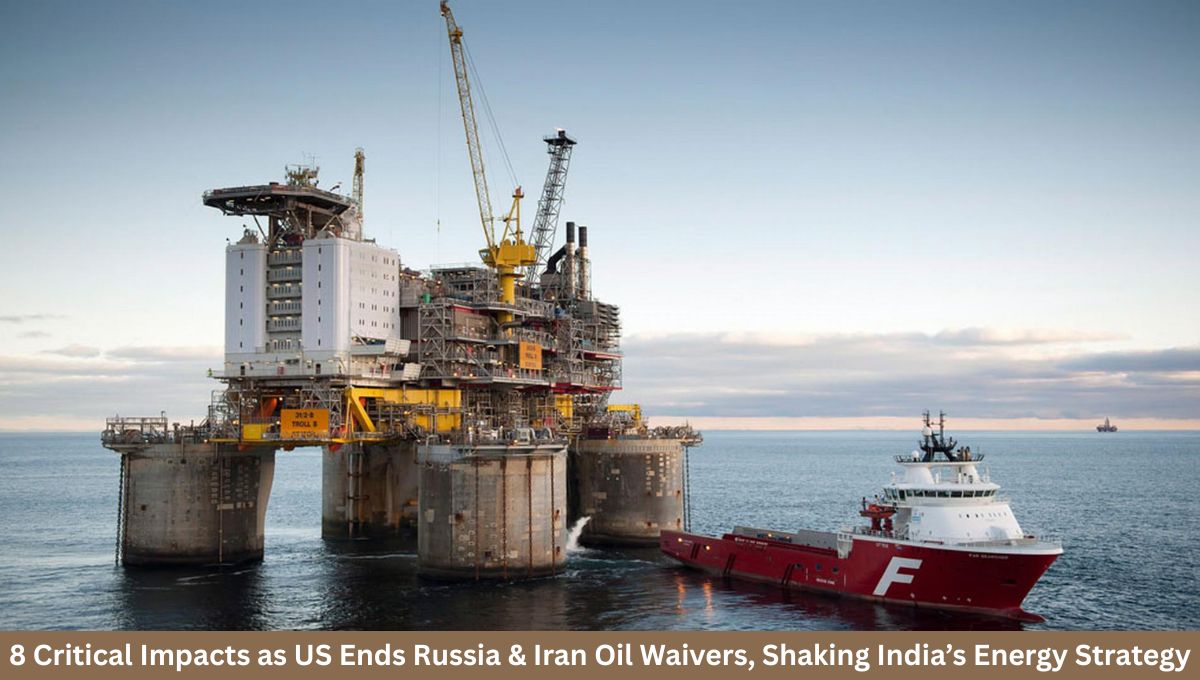
8 Critical Impacts as US Ends Russia & Iran Oil Waivers, Shaking India’s Energy Strategy and global oil markets. The United States’ decision to end temporary sanctions waivers on Russian and Iranian oil marks a pivotal moment in global energy geopolitics.
The move, announced by US Treasury Secretary Scott Bessent, signals a return to stricter enforcement under Washington’s “maximum pressure” policy—particularly toward Iran, but with ripple effects extending to Russia and beyond.
For India, one of the world’s largest crude oil importers, the decision comes at a delicate time.
The country had briefly benefited from a narrow window that allowed it to secure discounted oil supplies amid a war-driven disruption in global energy markets.
Now, with those waivers expiring, New Delhi faces a complex recalibration of its energy strategy.
This development is not just about oil shipments—it is about geopolitics, supply chains, inflation, and the balance of power in a rapidly evolving global order.
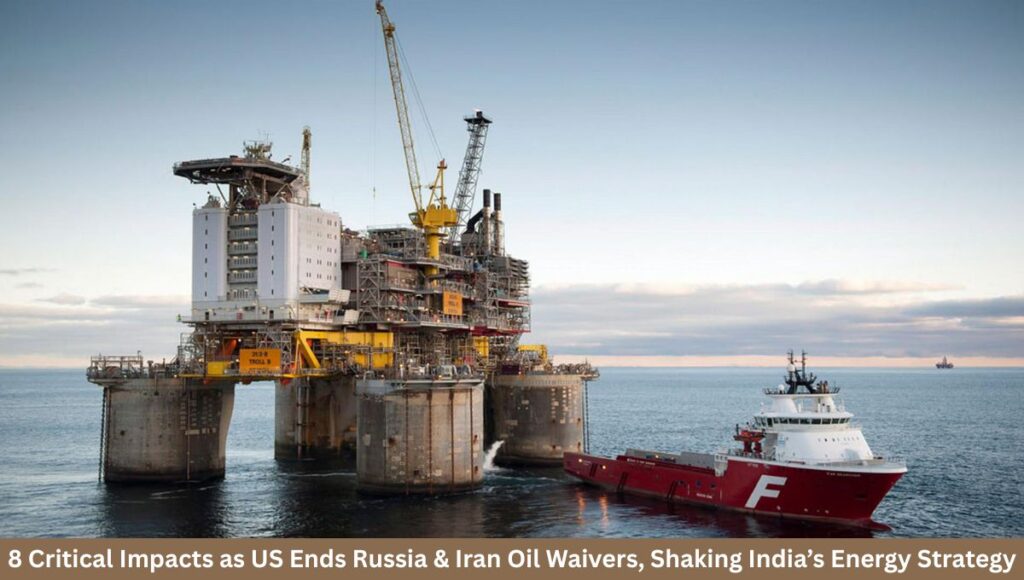
8 Critical Impacts as US Ends Russia & Iran Oil Waivers, Shaking India’s Energy Strategy
What Were the US Sanctions Waivers?
A Temporary Lifeline for Global Oil Supply
In March, the United States introduced short-term sanctions waivers allowing limited transactions involving Russian and Iranian oil.
These waivers were highly specific:
- They applied only to oil already loaded onto tankers before set deadlines
- They were valid for just 30 days
- Their primary goal was to stabilise global energy markets
The waiver for Russian oil covered shipments loaded before March 12 and expired on April 11.
A similar waiver for Iranian oil, covering shipments loaded before March 20, is set to expire on April 19.
Why the US Introduced Them
The waivers were introduced during a period of intense disruption:
- The Middle East war had severely impacted oil supply routes
- Iran had effectively restricted traffic through the Strait of Hormuz
- Oil prices were surging globally
To prevent a full-blown energy crisis, Washington temporarily relaxed sanctions to allow stranded oil to reach global markets.
Why the US Has Now Ended the Waivers
Return to “Maximum Pressure”
The decision not to renew the waivers reflects a strategic shift. The US is now doubling down on its economic pressure campaign, particularly against Iran.
Washington has made it clear that:
- Countries buying Iranian oil could face secondary sanctions
- Banks holding Iranian funds may also be targeted
- Enforcement will be stricter and more aggressive
This approach has been described as the “financial equivalent” of military action—highlighting the seriousness of the policy shift.
Political and Strategic Pressure
The waivers also faced strong criticism within the United States.
Lawmakers argued that:
- The policy indirectly benefited Russia’s war economy
- It undermined sanctions designed to pressure adversaries
- It weakened US geopolitical leverage
Ending the waivers addresses these concerns while reinforcing Washington’s hardline stance.
How India Benefited from the Waivers
A Strategic Buying Opportunity
India was one of the biggest beneficiaries of the temporary waivers.
During the 30-day window:
- Indian refiners secured tens of millions of barrels of Russian crude
- Imports of Iranian oil resumed briefly after nearly seven years
- Supply gaps caused by global disruptions were partially filled
This helped India stabilise its energy needs during a highly volatile period.
Key Shipments and Logistics
Several shipments highlight the scale of India’s purchases:
- Iranian crude was delivered to major ports like Paradip and Sikka
- Tankers under sanctions managed to unload cargo during the waiver period
- Additional vessels remain in limbo, awaiting clearance or rerouting
These transactions demonstrate how critical the waiver window was for securing supply.
The Return of Sanctions: What Changes Now
Immediate Impact on Oil Procurement
With the waivers ending:
- Indian refiners can no longer legally purchase sanctioned Russian or Iranian oil under relaxed conditions
- Existing shipments must comply with stricter rules
- Future purchases face legal and financial risks
Risk of Secondary Sanctions
The biggest concern is the threat of secondary sanctions.
This means:
- Countries and companies dealing with Iranian oil could be penalised
- Financial institutions facilitating such transactions could face restrictions
- Global trade networks could become more cautious
For India, this significantly complicates procurement strategies.
Impact on India’s Energy Strategy
Increased Dependence on Alternative Suppliers
India will now need to diversify its oil sources further.
Potential alternatives include:
- Middle Eastern producers such as Saudi Arabia and the UAE
- The United States
- African oil exporters
However, these alternatives may not offer the same pricing advantages as Russian crude.
Cost Implications
Russian oil had been attractive due to discounted pricing.
Without it:
- Import costs may rise
- Refining margins could shrink
- Fuel prices may face upward pressure
This could have broader economic implications, including inflation.
Strait of Hormuz Crisis: A Compounding Factor
A Critical Global Chokepoint
The situation is further complicated by disruptions in the Strait of Hormuz, through which roughly 20% of global oil supply passes.
Iran’s actions to restrict traffic in the region have:
- Reduced shipping volumes
- Increased insurance and transportation costs
- Created uncertainty in global markets
Impact on India
As a major importer, India is particularly vulnerable:
- Supply delays could disrupt refinery operations
- Shipping costs could rise sharply
- Strategic reserves may need to be utilised
Global Oil Market Repercussions
Supply Tightening
The combined effect of sanctions and geopolitical tensions is tightening global oil supply.
This can lead to:
- Higher crude prices
- Increased volatility
- Reduced availability of discounted oil
Market Rebalancing
Countries are now adjusting their strategies:
- Some may reduce dependence on sanctioned oil
- Others may seek alternative trade arrangements
- Major buyers like China could temporarily pause purchases
India’s Long-Term Energy Strategy
Push for Energy Self-Reliance
The current crisis underscores the need for India to reduce dependence on imports.
Efforts include:
- Expanding renewable energy capacity
- Investing in nuclear power
- Increasing domestic production
Strategic Diversification
India is also focusing on:
- Building stronger ties with multiple oil suppliers
- Enhancing storage capacity
- Developing flexible procurement strategies
Geopolitical Implications
Shifting Alliances
The sanctions decision reflects broader geopolitical shifts:
- Increased tension between the US and Iran
- Continued economic pressure on Russia
- Growing importance of regional mediators
India’s Diplomatic Balancing Act
India must carefully navigate:
- Its relationship with the United States
- Its economic ties with Russia
- Its historical engagement with Iran
Maintaining this balance will be critical for its strategic autonomy.
Criticism and Controversy
Opposition Within the US
The waiver policy faced strong criticism from US lawmakers, who argued it:
- Provided financial relief to adversaries
- Undermined sanctions regimes
- Sent mixed geopolitical signals
Global Concerns
Other concerns include:
- Potential escalation of tensions
- Impact on developing economies
- Risk of global economic slowdown
What Lies Ahead
Short-Term Outlook
In the immediate future:
- Oil markets are likely to remain volatile
- Supply chains will adjust to new constraints
- Countries will reassess procurement strategies
Medium-Term Scenarios
Possible developments include:
- Stabilisation through diplomacy
- Continued volatility with partial supply recovery
- Escalation leading to severe supply disruptions
Conclusion: A Defining Moment for Energy Security
The US decision to end sanctions waivers on Russian and Iranian oil marks a significant turning point in global energy dynamics.
For India, the impact is immediate and multifaceted—ranging from procurement challenges to broader economic implications.
While the country has managed to secure short-term supplies, the road ahead will require strategic agility, diversification, and a renewed focus on energy self-reliance.
At a global level, the move reinforces the interconnected nature of geopolitics and energy markets.
As tensions continue to evolve, the decisions made today will shape the future of energy security for years to come.
Also Read: 7 Explosive Signals as Donald Trump Eyes Iran Oil Seizure and Kharg Island Strike
Also Read: US Says It Will Not Renew Sanctions Waiver Allowing India To Buy Russian Oil
Related Posts:
- 9 Strategic Reasons the US Allowed India to Buy…
- 7 Powerful Measures: Trump Sanctions Russian Oil…

- In 8 Moves, EU Targets China-Linked Refineries and…

- 7 Powerful Reasons the U.S. Is Letting Countries Buy…
- U.S.–China Trade War 2025: 500% Tariff Threat Sparks…
- 7 Critical Ways Iran’s Yuan Oil Plan Could Shake the…