7 Powerful Measures: Trump Sanctions Russian Oil Giants After Nuclear Drills, choking Kremlin war funding. In a major shift in American policy toward Moscow, the Donald Trump administration announced sweeping sanctions on Russia’s two largest oil companies, Rosneft and Lukoil.
The move comes as Russia staged large-scale nuclear training drills and after a scheduled meeting between Trump and Putin was abruptly postponed. The sanctions are aimed at disabling key parts of the Kremlin’s war-finance apparatus while signaling that the United States is prepared to escalate economic pressure if diplomacy stalls.
Below, we unpack the key measures, the context, global reactions, and what lies ahead.
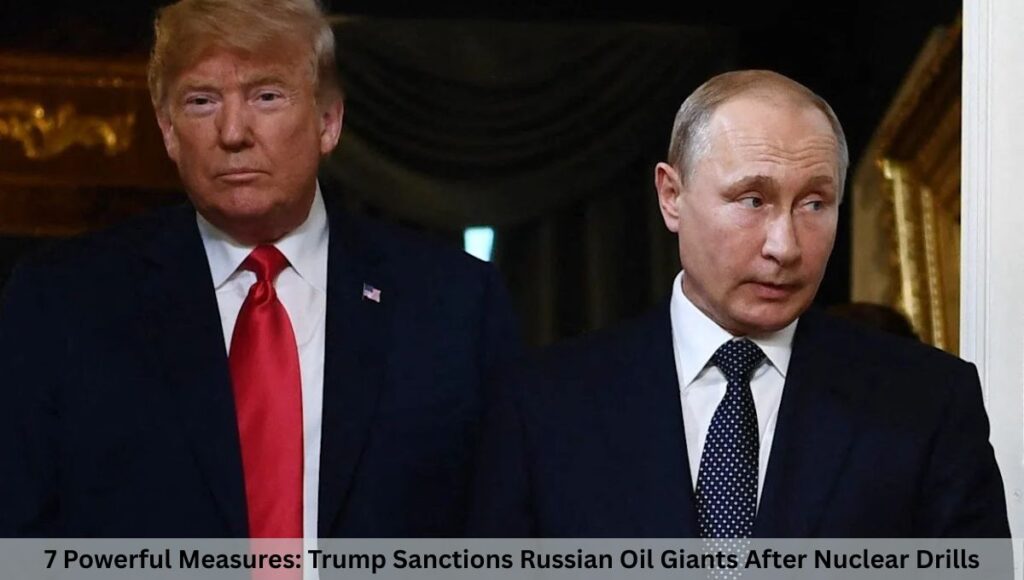
7 Powerful Measures: Trump Sanctions Russian Oil Giants After Nuclear Drills
What the Sanctions Entail
Targeting Rosneft and Lukoil
The U.S. Department of the Treasury’s Office of Foreign Assets Control (OFAC) announced on Wednesday that Rosneft and Lukoil, along with several dozen of their subsidiaries, will be designated for engaging in the “energy sector of the Russian Federation economy” — a classification that effectively freezes their U.S. assets and prohibits American persons or institutions from transacting with them.
Treasury Secretary Scott Bessent declared:
“Given President Putin’s refusal to end this senseless war, Treasury is sanctioning Russia’s two largest oil companies that fund the Kremlin’s war machine.”
President Trump described the sanctions as “tremendous”, saying:
“These are very big ones … and we hope that they won’t be on for long. We hope that the war will be settled.”
Scope and Mechanisms
The designations extend to firms in which Rosneft or Lukoil hold 50 per cent or more ownership, meaning dozens of additional entities are now under restriction. All U.S.‐based assets are blocked, and U.S. persons are barred from dealings unless licenced.
Officials warned that further sanctions — including secondary sanctions on foreign banks or firms dealing with the sanctioned companies — may follow.
Link to U.S. Diplomacy and War Effort
The timing of the announcement is significant: it arrived shortly after both (1) Russia’s large‐scale “nuclear training drills” and (2) cancellation of a planned Trump-Putin summit in Hungary. The White House pointed to Moscow’s lack of progress toward peace negotiations as justification.
As Bessent put it:
“Now is the time to stop the killing and for an immediate cease-fire.”
Also Read: EU Unveils 19th Sanctions Package on Russia: LNG Ban, Banking Crackdown, and Trump Pressure
Why the United States Acted Now
Moscow’s War Funding Machinery
Oil and gas remain central to the Russian state’s fiscal health. Rosneft and Lukoil combined account for a significant portion of Russia’s oil output and export revenues — funds that the U.S. and its allies believe help bankroll the war in Ukraine.
By targeting these firms, Washington aims to choke a key artery of Kremlin funding and raise the economic cost of continued military operations.
Stalled Diplomacy and Escalating Threats
The sanctions also reflect growing frustration in Washington that Moscow has not shown serious intent toward negotiated peace. The cancelled summit, along with the nuclear drills and continued fighting in Ukraine, pushed U.S. policymakers toward more aggressive measures.
One senior Treasury official said the action was triggered by Russia’s “lack of serious commitment to a peace process.”
Signal to Global Buyers
Another layer of the strategy: The sanctions serve as a warning to third-party purchasers of Russian oil, such as refiners in India or China, that their business may be exposed to future U.S. penalties. While buyers were not immediately sanctioned, U.S. officials repeatedly called on allies to join them.
Global Energy & Market Impacts
Oil Price Reaction
The news sparked immediate market reaction. Brent crude prices rose roughly 3.1 per cent, while U.S. West Texas Intermediate saw similar gains. Traders cited fears that tighter sanctions and Russian export disruption could strain global supplies.
India’s Role and Supply Chain Shifts
India, one of Russia’s biggest oil importers since the 2022 invasion, is now reassessing supply chains to avoid sanction risk. Sources told Reuters that state-refiners and private company Reliance Industries are considering significant reductions or suspensions of Russian crude purchases.
Analysts warn: Should Indian and Chinese buyers retreat, Russian oil may be forced to reroute and global flows may tighten.
Long-Term Questions on Effectiveness
While the sanctions signal a strong stance, some experts caution the impact may be limited unless combined with broader enforcement.
“So far, almost all the sanctions against Russia for the past three and a half years have mostly failed to dent either the volumes produced by the country or the oil revenues,” remarked Claudio Galimberti of Rystad Energy.
The key will be whether the U.S. follows up with secondary sanctions and whether global buyers change behaviour.
Reactions from Allies and Adversaries
Ukraine’s Response
Ukraine’s Ambassador to the U.S., Olga Stefanishyna, welcomed the sanctions, stating:
“This decision is fully aligned with Ukraine’s consistent position: peace is possible only through strength and pressure on the aggressor using all available international tools.”
Kyiv has long pushed for tougher U.S. measures and views the sanctions as a milestone.
European Union & United Kingdom
London backed the U.S. move, with UK officials calling it a sign that “there is no place for Russian oil on global markets.” The EU simultaneously approved its own 19th package of sanctions, including a ban on Russian liquefied natural gas (LNG) imports and sanctions on a “shadow tanker fleet”.
Moscow’s Reaction
The Kremlin issued cautious warnings, noting that targeting major energy firms would have “detrimental impact on global energy security”. Russian officials accused the West of trying to force Ukraine into surrender.
Analysts suggest Moscow will seek alternate buyers and accelerate trade with Asian partners to bypass the sanctions.
Strategic Background and Context
Why Oil & Energy Sanctions?
Oil and gas exports have been Russia’s lifeline — providing foreign currency and tax revenue. Sanctions targeting the energy sector are therefore seen as a way to hit the war machine at its root rather than just ammunition supplies.
U.S. Policy Shift under Trump
This marks the first major Russia-related oil sanction by the Trump administration in his second term, a notable departure from earlier reluctance. Trump had previously said sanctions cost the US economy and had held back from imposing them on Russia directly over the Ukraine war.
Now, with mounting war fatigue and a desire for progress, the U.S. appears ready to align with a tougher strategy.
The Nuclear Drill Trigger
Russia’s large-scale nuclear training drills added urgency for the U.S. The simulations were seen in the West as a provocation and reminder of the potential escalation of the war. The timing of the sanctions was closely linked to these drills and the U.S. perception that Moscow was not serious about negotiations.
What Comes Next — Monitoring, Implementation & Risks
Tracking Implementation
The real test will be how the sanctions are enforced. The U.S. must monitor transactions, flag third-party entities, and possibly impose further penalties on non-U.S. firms facilitating Russian oil exports.
Eddie Fishman of the Atlantic Council observed:
“The key then will be if there’s a threat of secondary sanctions on banks, oil refineries and traders in third countries who are dealing with Rosneft and Lukoil.”
Economic Risk for Europe and Global Markets
The sanctions raise short-term risk for global energy supply and prices. Europe, while less dependent on Russian oil now, still faces supply chain logistics and infrastructure issues. Any disruption in Russian output or alternative routes may add pressure to energy markets.
Diplomatic Fallout and China/India’s Role
China and India remain major buyers of Russian crude. If they reduce purchases, Russia will be under additional pressure — if they don’t, sanctions may have limited impact. The U.S. will monitor their behaviour closely.
Further, the U.S. will attempt to persuade allied nations to follow suit — a step that could redefine energy trade flows.
Escalation Risks
Russia may retaliate by cutting output, redirecting supply, or using energy as a geopolitical weapon. Further escalation of the war or side-effects in global trade are possible. Some analysts caution that the sanctions strategy may trigger unintended consequences if not coordinated internationally.
Potential Peace Leverage
From Washington’s perspective, the goal is simple: less money in Russia = fewer missiles aimed at Ukraine. If the sanctions take hold and Russia’s war funding severely tightens, Ukraine and its allies hope Moscow may be forced to negotiate rather than attack.
The Big Picture: War, Energy and Global Order
War Economies and Resource Leverage
The war in Ukraine has exposed how deeply energy and defence policy are intertwined. Nations rely on fossil-fuel exports and ammunition manufacturing for war-fighting. Disrupting those linkages changes the calculus of war.
Energy Security for Europe
For Europe, reducing dependency on Russian energy is both an economic and strategic imperative. The U.S. sanctions add momentum to Europe’s efforts to diversify energy sources, accelerate renewables, and break the link between Russian supplies and diplomacy.
America’s Diplomatic Repositioning
The sanctions reflect a recalibration of U.S. foreign policy: instead of relying simply on arms and diplomacy, Washington is deploying economic tools to enforce deterrence. The move suggests the U.S. is willing to push higher stakes to secure an outcome in Ukraine.
The Global Supply Chain Game
As major buyers reconsider Russian oil, alternative supply chains from the Middle East, Africa or North America may gain importance. The sanctions may shift the geography of energy trade for years to come.
Voices From the Field
- President Trump: “I just felt it was time. We waited a long time.”
- Treasury Secretary Bessent: “We encourage our allies to join us and adhere to these sanctions.”
- Ukrainian Ambassador Stefanishyna: “Peace is possible only through strength and pressure on the aggressor.”
- Analyst Claudio Galimberti: “Almost all the sanctions against Russia … have mostly failed to dent … the oil revenues.”
- Eddie Fishman: “The key … will be if there’s a threat of secondary sanctions on banks … in third countries dealing with Rosneft and Lukoil.”
Conclusion
The U.S. move to sanction Rosneft and Lukoil represents a significant escalation in the effort to choke off Kremlin revenue and tilt the war in Ukraine. While the immediate effects on Russia’s economy and the battlefield will take time to unfold, the message is clear: the United States is no longer content with symbolic measures — it is shifting toward direct economic warfare.
If fully implemented and paired with international coordination, these sanctions could challenge the very foundation of Russia’s war effort. That said, success depends on broad global compliance, effective enforcement, and the ability to manage backlash and market instability.
In the coming months, attention will focus on how global energy flows adapt, how Russia responds, and whether the financial leverage will translate into diplomatic pressure. For now, the world is watching as sanctions become front-line weapons in a war once defined by missiles and boots — now joined by bank accounts and oil tankers.
Also Read: Russia holds nuclear drills, Ukraine seeks Swedish jets as Trump delays summit
Related Posts:
- 3 Key Signals Putin Envoy Dmitriev Says Show US,…

- 5 Powerful Highlights as Trump Lands Second Nobel…

- Can the EU and NATO Impose Tariffs on India and…

- Trump’s 2025 Gaza Peace Plan Signing and Historic…

- Dramatic Moments Behind Trump’s Gaza Peace Push and…

- Impacts of the Trump-Putin Call on Ukraine’s 2025 Strategy