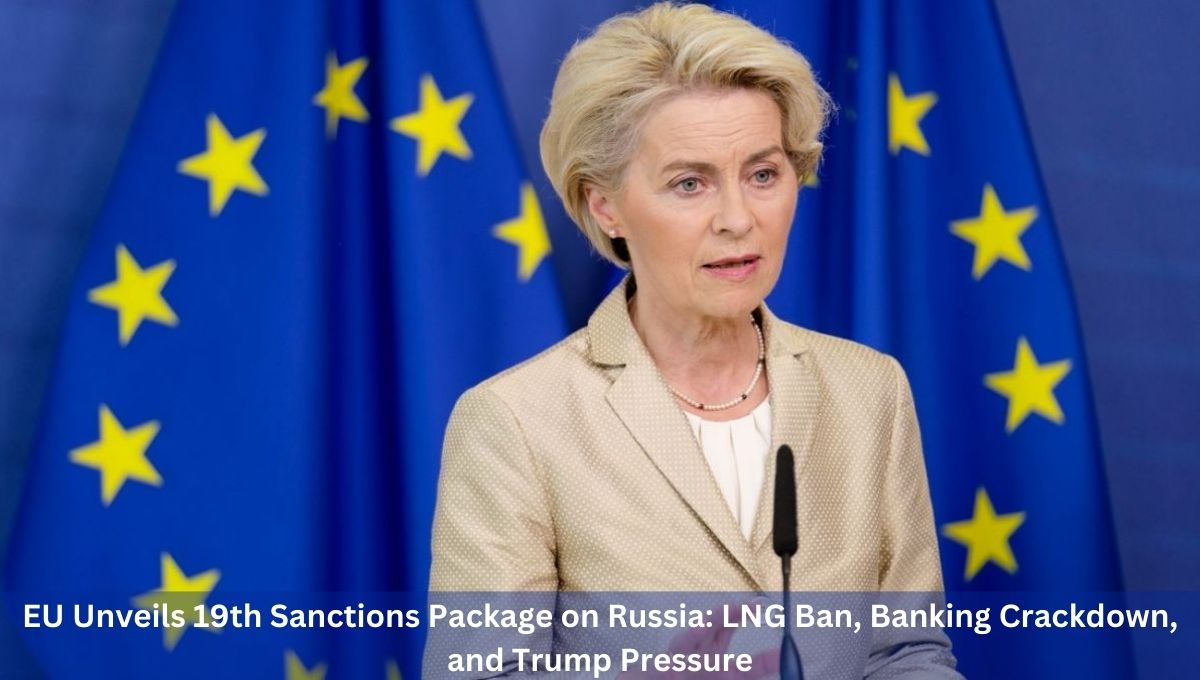
Aimed at crippling Moscow’s war and forcing Putin to the negotiating table, EU Unveils 19th Sanctions Package on Russia: LNG Ban, Banking Crackdown, and Trump Pressure. The European Commission has announced its 19th package of sanctions against Russia, intensifying economic pressure on Moscow as the Ukraine war drags into its third year.
The sweeping measures target Russian liquefied natural gas (LNG) imports, expand financial restrictions on Russian and foreign banks, and blacklist companies and ships accused of helping Moscow bypass previous sanctions.
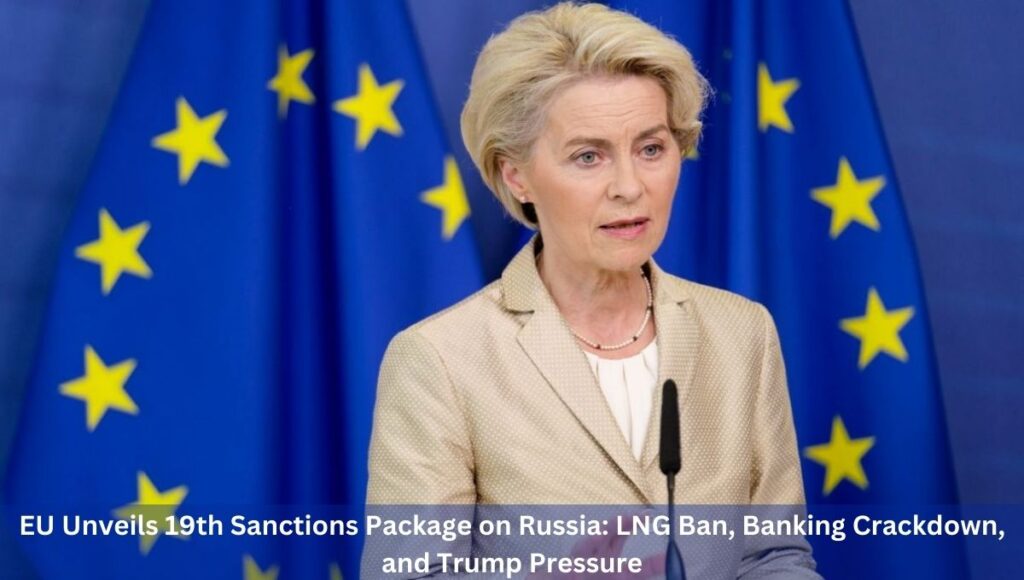
The announcement, made by European Commission President Ursula von der Leyen, comes as the EU faces growing demands from Washington—particularly from U.S. President Donald Trump—to move faster in choking off Russia’s energy revenues.
EU Unveils 19th Sanctions Package on Russia: LNG Ban, Banking Crackdown, and Trump Pressure
Why the EU is Targeting Russian LNG
Von der Leyen framed the ban on Russian LNG as a crucial step in undermining Moscow’s war machine.
“Russia’s war economy is sustained by revenues from fossil fuels,” she declared on Friday. “We want to cut these revenues. So we are banning imports of Russian LNG into European markets. It is time to turn off the tap.”
Until now, Russian LNG had escaped direct bans, with several EU countries heavily dependent on imports. Last year, Russian LNG accounted for 16% of Europe’s total gas imports, making the bloc Russia’s largest buyer.
By advancing the phase-out deadline from January 2028 to January 2027, Brussels is signaling a faster pivot toward U.S. and Qatari LNG, as well as renewable energy sources.
Trump’s Pressure on Brussels
The EU’s timing is not coincidental. Reports confirm that Donald Trump pressured European allies to act more aggressively against Russia.
Trump has repeatedly demanded:
- A faster end to Russian energy imports, particularly oil and LNG.
- Tariffs as high as 100% on Chinese goods, to punish Beijing for buying Russian oil.
- Joint sanctions to show a united Western front before Washington takes further unilateral measures.
According to analysts, Trump’s ultimatum has accelerated Brussels’ decision-making.
“Trump’s pressure on Europe to move faster on banning Russian energy imports seems to have worked,” said Simone Tagliapietra, a senior fellow at the Bruegel think tank.
Still, EU officials are cautious about adopting U.S.-style extraterritorial sanctions, which target non-European companies and are often criticized in Brussels as overreach.
Key Elements of the 19th Sanctions Package
The proposed sanctions cover multiple sectors of Russia’s economy and seek to close loopholes from earlier rounds.
1. Ban on Russian LNG Imports
- A full ban on imports of Russian LNG by January 1, 2027.
- Targeted restrictions on European ports handling Russian LNG cargo.
- Measures to reduce reliance by diversifying energy sources.
2. Shadow Fleet Crackdown
- Blacklisting of 118 oil tankers suspected of violating the EU’s oil price cap of $47.60 per barrel.
- Restrictions on ship-to-ship transfers of Russian oil.
- Ban on EU companies insuring or financing shadow fleet operations.
3. Banking Sanctions
- New bans on Russian state-owned banks and financial institutions.
- Restrictions on foreign banks in Central Asia and China accused of helping Moscow evade sanctions.
- Enhanced monitoring of crypto transactions linked to Russian entities.
4. Sanctions on Individuals
- Expanded blacklist targeting Russian lawmakers, oligarchs, and military officials.
- Focus on individuals involved in the abduction of Ukrainian children and their deportation to Russian-controlled camps.
EU foreign policy chief Kaja Kallas stressed: “We will make it easier to sanction individuals involved in abducting and indoctrinating Ukrainian children. We will not let Russia weaponise childhood itself.”
5. Additional Sectoral Measures
- Transaction bans on major Russian oil companies Rosneft and Gazpromneft.
- Export restrictions on high-tech goods and chemicals.
- New rules against Russian disinformation networks in Europe.
Moscow’s Reaction
The Kremlin immediately condemned the EU’s move.
Dmitry Peskov, President Vladimir Putin’s spokesman, warned:
“Any new EU sanctions will be seen as hostile acts and will not force Moscow to change its position on Ukraine.”
Moscow insists that sanctions have failed to derail its war effort. Russia’s economy has shown resilient growth of about 4% in 2023 and 2024, largely fueled by military spending and redirected energy exports.
However, EU officials argue that the cracks are widening. Von der Leyen pointed to soaring inflation, rising interest rates, and capital flight as evidence that sanctions are squeezing Russia’s war economy.
Opposition Inside the EU
Despite von der Leyen’s calls for unity, the 27 EU member states must unanimously approve the sanctions package. That remains a challenge.
- Hungary and Slovakia have consistently opposed phasing out Russian gas, citing energy security concerns.
- Both countries rely on cheap Russian supplies and have used veto threats to gain concessions in previous negotiations.
Diplomats expect weeks of debate before final approval, with potential compromises needed to appease resistant states.
UK Joins with Sanctions on Georgia-Linked Figures
The United Kingdom also announced fresh sanctions on Friday, aimed at Georgia-linked individuals and companies accused of helping Russia.
Those targeted include:
- Levan Vasadze, a Georgian media mogul and politician accused of spreading pro-Russian disinformation.
- Otar Partskhaladze, Georgia’s former prosecutor general, sanctioned for “extensive links to Russia.”
- Two tankers accused of transporting Russian oil to Batumi, Georgia, in violation of Western restrictions.
UK Minister of State Stephen Doughty said:
“Putin’s war machine relies on an international web to spread lies and fund this network. We’re cutting off another lifeline by targeting those in Georgia who support Putin’s illegal war.”
Impact on Europe’s Energy Market
The LNG ban will reshape Europe’s energy landscape.
- Before the war, Russia supplied over 40% of Europe’s gas. That share has now dropped to just 10%, mostly via LNG.
- U.S. LNG has surged to fill the gap, now accounting for 57% of EU imports, compared with just 28% in 2021.
- Russian LNG’s share has fallen to 14% this year, but remains Europe’s second-largest source after the U.S.
By advancing the cutoff date, the EU hopes to accelerate investment in renewables, hydrogen, and energy efficiency, while relying more heavily on the United States and Qatar in the interim.
Sanctions, Diplomacy, and the Battlefield
Von der Leyen emphasized that sanctions are not an end in themselves but a means to bring Russia to the negotiating table.
“We want Russia to leave the battlefield and come to the negotiation table. This is the way to give peace a real chance,” she said.
Still, critics argue that sanctions may hurt Europe as much as Russia, by raising energy costs and straining industrial competitiveness. Headlines such as “EU shoots itself in the foot amid US pressure” reflect skepticism in some European capitals.
What Comes Next?
The sanctions package now goes to EU member states for approval. If adopted, it would mark one of the most far-reaching economic offensives against Moscow since the war began.
The stakes are high:
- For Ukraine, the sanctions provide hope that Moscow’s financial and military capacity will be weakened.
- For the EU, the challenge is maintaining unity despite internal divisions and U.S. pressure.
- For Russia, the measures pose yet another hurdle for an economy already struggling under inflation, capital flight, and battlefield costs.
As winter approaches and Europe prepares for another energy crunch, the political and economic consequences of the 19th sanctions package will become clear.
Conclusion
The EU’s 19th sanctions package on Russia—centered on a ban of Russian LNG imports, banking restrictions, and shadow fleet crackdowns—marks a decisive escalation in Europe’s effort to cripple Putin’s war machine. But with U.S. pressure driving the pace, internal EU resistance complicating approval, and Russia adapting to sanctions, the road ahead remains uncertain.
What is clear, however, is that energy remains the central battlefield in the West’s economic war against Moscow.
Also Read: EU Unveils 19th Sanctions Package on Russia
Also Read: Putin at Valdai 2025: Paper Tigers, Trump, NATO, Oil & Ukraine
Related Posts:
- In 8 Moves, EU Targets China-Linked Refineries and…

- 7 Powerful Measures: Trump Sanctions Russian Oil…

- Can the EU and NATO Impose Tariffs on India and…

- 5 Major Takeaways from the US Supreme Court's…

- 7 Heartbreaking Facts About Venezuela's Earthquake Disaster
- 9 Explosive Claims as Trump Says US Winning Iran War