
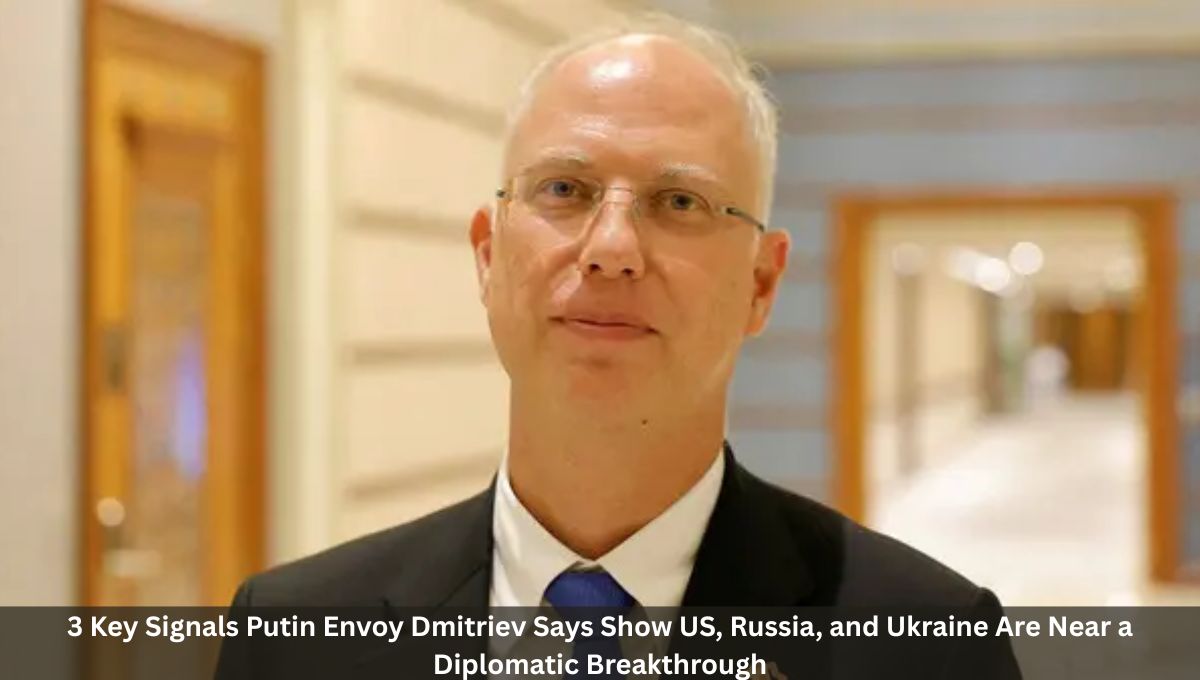
3 Key Signals Putin Envoy Dmitriev Says Show US, Russia, and Ukraine Are Near a Diplomatic Breakthrough to end the war. Russian President Vladimir Putin’s special envoy, Kirill Dmitriev, has said that Moscow, Washington, and Kyiv are “reasonably close” to achieving a diplomatic settlement to end the ongoing war in Ukraine.
His remarks come amid heightened tensions between the United States and Russia following new American sanctions targeting Moscow’s major oil companies, Rosneft and Lukoil. Dmitriev, who heads Russia’s sovereign wealth fund (RDIF) and serves as a special envoy for the Kremlin, made the comments in interviews with CNN and Fox News during his visit to the United States this week.
Despite the backdrop of fresh sanctions and a postponed summit between President Donald Trump and President Vladimir Putin, Dmitriev insisted that dialogue between Moscow and Washington remains active and that a diplomatic breakthrough may be closer than expected.
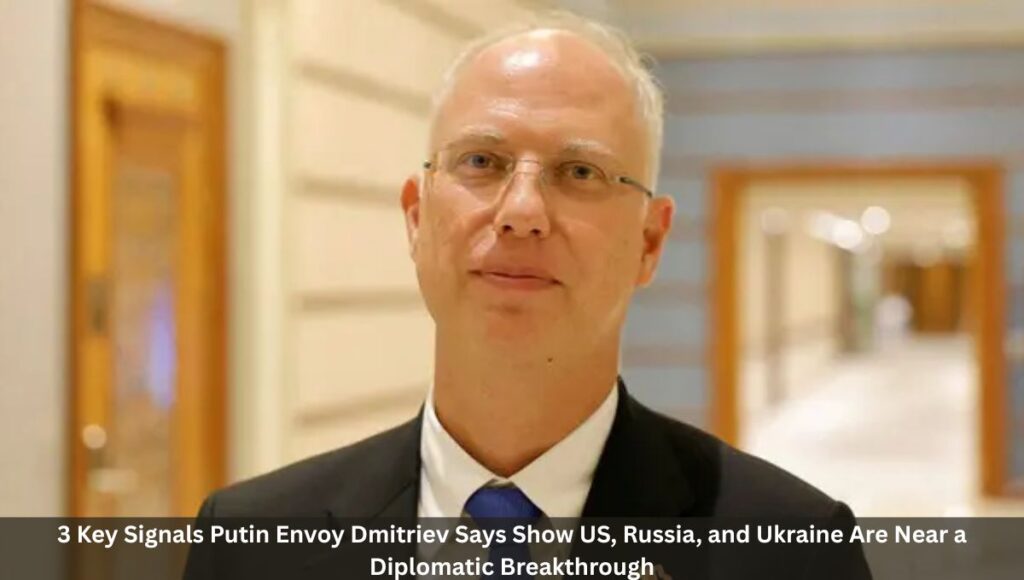
3 Key Signals Putin Envoy Dmitriev Says Show US, Russia, and Ukraine Are Near a Diplomatic Breakthrough
“Reasonably Close” to Ending the War
In his interview with CNN, Dmitriev said he believes all three parties — Russia, the United States, and Ukraine — have moved significantly closer to an agreement.
“I believe Russia and the US and Ukraine are actually quite close to a diplomatic solution,” Dmitriev said. “It’s a big move by President Zelenskyy to already acknowledge that it’s about battle lines.
His previous position was that Russia should leave completely — so actually, I think we are reasonably close to a diplomatic solution that can be worked out.”
His remarks echoed recent reports from European diplomats, who told Reuters that several EU member states are working with Kyiv on a new ceasefire proposal that would freeze the conflict along current battle lines — an idea that has gained traction in backchannel discussions.
The proposal reportedly aims to maintain U.S. involvement in mediating talks while ensuring that Ukraine’s sovereignty is not compromised.
Trump-Putin Meeting “Not Cancelled,” Just Delayed
Dmitriev also addressed confusion surrounding a planned summit between Putin and Trump, which had been announced by the U.S. president earlier this month.
Trump had said the two leaders would meet in Budapest to discuss a ceasefire and a potential peace framework, but later told reporters the meeting was “on hold” due to “a lack of progress in negotiations.”
Contrary to that statement, Dmitriev told CNN that the meeting was still in the works.
“The planned meeting between President Putin and President Trump has not been cancelled,” he said. “It will probably take place at a later date.”
The White House has not yet confirmed a new date for the summit, though officials indicated that backchannel talks between the two sides are ongoing.
Sanctions Won’t Derail Talks, Says Dmitriev
Dmitriev’s trip to the United States coincided with Trump’s decision to impose sweeping sanctions on two of Russia’s biggest energy firms, Rosneft and Lukoil.
The move, announced earlier this week, was part of Washington’s broader strategy to pressure the Kremlin into accepting an immediate ceasefire in Ukraine.
However, Dmitriev dismissed the impact of the sanctions, calling them counterproductive and economically self-defeating.
“We do not believe these sanctions will have a significant impact,” Dmitriev told Fox News’ Special Report. “Oil prices will rise, and Russia will sell fewer barrels — but at a higher price. They will only lead to gasoline costing more at American gas stations.”
He argued that the sanctions might ultimately backfire by driving up global oil prices, thereby offsetting Moscow’s revenue losses.
“Sanctions are short-term politics,” he said. “They may create headlines but do not build stability.”
High-Level Meetings Planned in the U.S.
According to Axios, Dmitriev’s visit includes a series of high-level meetings in Washington, D.C., and Miami. He is scheduled to meet Trump’s special envoy, Steve Witkoff, on Saturday in Miami.
Sources also told CNN that Republican Congresswoman Anna Paulina Luna is expected to meet with Dmitriev during his visit.
Luna had previously posted on social media that she planned to engage the Russian envoy, saying the U.S. must continue to “foster conversations of peace and trade.”
“Our two countries do not need to be enemies,” Luna wrote. “Allies in trade benefit everyone.”
Dmitriev confirmed on X (formerly Twitter) that his visit was “planned a while ago” based on an official U.S. invitation.
“Dialogue between our countries is vital for the world and must continue with full understanding and respect for Russia’s national interests,” he wrote.
Putin’s Reaction: “No Self-Respecting Country Acts Under Pressure”
Reacting to the sanctions, President Vladimir Putin downplayed their economic impact, describing them as an attempt to exert political pressure on Moscow.
“No self-respecting country ever does anything under pressure,” Putin said during a press briefing on Thursday.
He claimed that he had warned Trump that the measures could lead to higher global oil prices, including in the United States, and insisted that Russia’s economy had “adapted” to Western restrictions since 2022.
“The Russian economy has proven resilient,” Putin said. “Sanctions will not change our strategic decisions.”
Background: Dmitriev’s Role as Kremlin Envoy
Kirill Dmitriev, 49, is widely regarded as one of Putin’s most influential envoys in the West. As the head of the Russian Direct Investment Fund (RDIF), he has long been a central figure in efforts to maintain economic dialogue with Washington despite political tensions.
Born in Soviet-era Ukraine, Dmitriev studied economics at Harvard University and earned an MBA from Stanford University before working as a consultant at McKinsey & Company and later as an investment banker at Goldman Sachs.
His Western education and experience made him a key intermediary for Russian economic diplomacy. After the 2022 invasion of Ukraine, the U.S. Treasury Department sanctioned him, labeling him a “close associate of President Putin.”
Nonetheless, in April 2025, the U.S. government temporarily lifted those sanctions to allow him to enter the country for official meetings — marking the first Russian official visit to Washington since the start of the full-scale war.
A History of Quiet Backchannel Engagement
Dmitriev’s April visit to Washington, during which he met Trump envoy Steve Witkoff, was viewed as a tentative thaw in U.S.–Russia relations. That meeting reportedly focused on economic cooperation, investment, and energy security, though officials provided few details.
Since then, Dmitriev has continued to advocate for economic diplomacy, even proposing the construction of a symbolic “Trump-Putin Tunnel” connecting Alaska and the Russian Far East, meant to signify renewed cooperation between the two nations.
While the proposal has been dismissed as unrealistic by many in Washington, it underscored Moscow’s attempt to reframe engagement with the U.S. through trade and investment discussions rather than military confrontation.
Kyiv’s Stance: “No Deal That Legitimizes Occupation”
While Dmitriev struck an optimistic tone about peace talks, Ukrainian officials have not confirmed participation in any direct backchannel negotiations.
President Volodymyr Zelenskyy has repeatedly said that Ukraine will not accept any peace deal that legitimizes Russian occupation or cedes territory seized since the 2022 invasion.
Speaking at a press conference in Kyiv earlier this week, Zelenskyy said:
“Ukraine’s position remains unchanged — there will be no compromise on sovereignty, independence, or territorial integrity.”
However, Western diplomats say there has been a subtle shift in tone, with Kyiv now more open to discussions about “battle lines” rather than insisting on a full Russian withdrawal as a precondition for peace.
That shift, Dmitriev suggested, represents “a big move” that could create the groundwork for a negotiated truce.
European Mediation Efforts Intensify
Diplomatic sources told Reuters that European Union nations are intensifying their mediation efforts, particularly France, Germany, and Hungary, which have been exploring frameworks for a ceasefire based on current frontlines.
One EU diplomat said the latest proposal seeks to “keep the United States involved as a stabilizing force while ensuring Ukraine maintains political agency.”
While Washington remains cautious, several U.S. officials privately acknowledge that a negotiated freeze could become politically attractive if it limits further U.S. financial exposure and reduces global instability.
Economic Interests and the Oil Factor
Beyond the battlefield, energy remains a major sticking point. The new U.S. sanctions on Rosneft and Lukoil are designed to cripple Russia’s oil exports, which finance much of its war effort. But Dmitriev suggested the sanctions could backfire by tightening global supply.
“Oil is a global commodity,” Dmitriev said. “When you remove Russian oil from the market, prices rise everywhere. That’s simple economics.”
He also indicated that Russia might redirect energy exports to Asia, deepening ties with China and India, which have remained major buyers of Russian crude.
At the same time, Russian officials have hinted that Moscow is open to limited cooperation with Washington on global energy stability, provided that discussions occur “on equal footing.”
“Dialogue Is Only Possible With Respect”
Throughout his U.S. visit, Dmitriev repeated one central message — that Russia will engage in diplomacy only if its interests are respected.
“Dialogue between Russia and the United States will continue,” he said. “But it is only possible if Russia’s interests are taken into account and treated with respect.”
This framing reflects the Kremlin’s long-standing view that Western pressure and sanctions are incompatible with meaningful diplomacy.
Trump’s Strategy: Pressure and Persuasion
President Trump’s decision to reimpose severe sanctions on Russia marks a return to pressure tactics, but also a balancing act. He has framed the sanctions as part of a dual strategy — applying economic pressure while keeping diplomatic channels open.
In remarks earlier this week, Trump said:
“We want peace, but peace comes from strength. Russia needs to know we’re serious about ending this war.”
Despite that tough rhetoric, U.S. officials privately acknowledge that the administration is exploring potential frameworks for “managed de-escalation”, possibly under a Trump-Putin bilateral track.
Also Read: Putin Praises Trump’s Ukraine Peace Push, Eyes Nuclear Arms Deal at Alaska Summit
Outlook: Fragile Hope for Diplomacy
As Dmitriev continues his U.S. meetings, analysts caution that optimism should be tempered. While his statements suggest backchannel momentum, deep mistrust remains between Moscow, Kyiv, and Washington.
Still, his remarks indicate that all sides may be inching toward a pragmatic understanding — one that accepts the battlefield realities while seeking to prevent further escalation.
For now, Dmitriev’s trip underscores a paradox of wartime diplomacy: even amid sanctions and rhetoric, talking remains the only path to ending the war. “There’s no victory in silence,” Dmitriev said. “Only through dialogue can the world move forward.”
Also Read: Why Trump made breakthrough in Gaza but can’t with Putin over Ukraine
Related Posts:
- 7 Powerful Measures: Trump Sanctions Russian Oil…

- 5 Major Takeaways from the US Supreme Court's…

- In 8 Moves, EU Targets China-Linked Refineries and…

- 7 Heartbreaking Facts About Venezuela's Earthquake Disaster
- 7 Powerful Facts About Ayatollah Ali Khamenei’s…
- Afghanistan–Pakistan War 2025: Inside the 48-Hour Ceasefire
