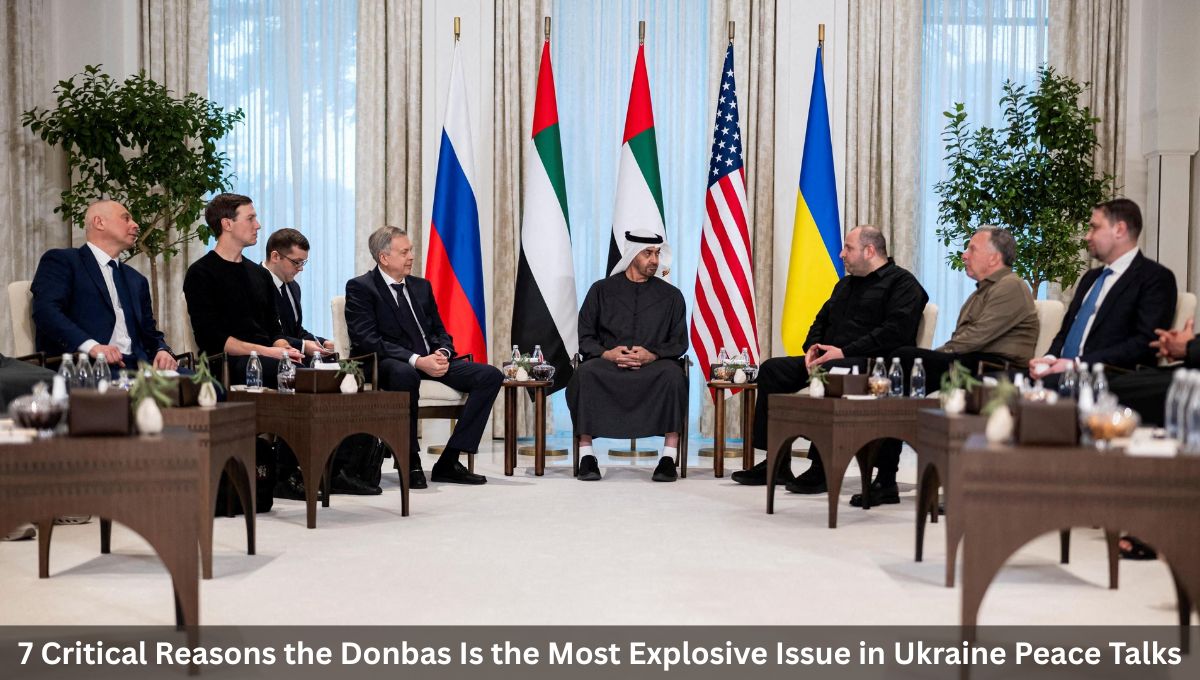
7 Critical Reasons the Donbas Is the Most Explosive Issue in Ukraine Peace Talks — and neither Kyiv nor Moscow is willing to compromise. As the United States, Russia, and Ukraine sit down in Abu Dhabi for their first trilateral talks since Moscow launched its full-scale invasion in February 2022, one reality has become unavoidable:
nearly every other issue has been pushed aside. The fate of Ukraine’s eastern Donbas region now dominates the negotiations.
Despite deep disagreements on responsibility for the war, sanctions, security guarantees, and reconstruction, Washington, Moscow, and Kyiv appear aligned on one conclusion. Any potential ceasefire or peace deal will rise or fall on the question of territory — specifically, who controls the Donbas.
Ukrainian President Volodymyr Zelensky has been explicit. “It’s all about the eastern part of our country, it’s all about the land,” he said, rejecting Russia’s demand that Ukraine surrender areas it still holds. The Kremlin, for its part, has made clear that there can be no lasting settlement without Kyiv yielding full control of Donetsk and Luhansk.
To understand why the Donbas has become the war’s central fault line, it is necessary to examine the region’s history, economic importance, strategic geography, and symbolic value to Russian President Vladimir Putin.
7 Critical Reasons the Donbas Is the Most Explosive Issue in Ukraine Peace Talks
What Is the Donbas?
The Donbas — short for Donets Basin — refers to two eastern Ukrainian regions: Donetsk and Luhansk. Together, they form a territory that for decades served as Ukraine’s industrial and mining powerhouse.
Located along Ukraine’s eastern border with Russia, the Donbas stretches from the outskirts of Kharkiv in the north to the Sea of Azov in the south. Its cities grew rapidly during the Soviet era, fueled by coal mining, steel production, and heavy industry.
Before the war, the region was home to millions of people and generated a substantial share of Ukraine’s industrial output. Even today, despite devastation from years of fighting, it remains economically and militarily significant.
The Economic Heartland of Eastern Ukraine
For much of the 20th century, the Donbas functioned as Ukraine’s economic engine. The region contains vast coal reserves, dense networks of factories, and key steel plants that supplied both domestic and export markets.
Coal, Steel, and Heavy Industry
Donetsk and Luhansk were synonymous with coal mining. The coal extracted from the Donbas powered factories, railways, and cities across Ukraine and the broader Soviet Union.
Steel mills, chemical plants, and machine-building facilities followed, transforming the region into a hub of heavy industry.
Even after Ukraine gained independence in 1991, the Donbas remained vital to the national economy. Its industrial output underpinned exports, employment, and energy security.
Agriculture and Natural Resources
Beyond industry, the Donbas also features fertile agricultural land and significant mineral deposits. Its rivers and man-made canals connect inland production centers to the Sea of Azov, enabling trade and logistics.
This combination of industrial, agricultural, and transport infrastructure makes the Donbas far more than just contested land. It is a region that shapes Ukraine’s economic resilience and future recovery.
Strategic Geography and Military Significance
From a military perspective, the Donbas is one of the most strategically important areas in Ukraine.
The Fortress Belt
Eastern Ukraine contains a dense belt of industrial cities, railways, and roads that function as a natural defensive line.
Ukrainian forces have spent years fortifying this area, transforming cities such as Kramatorsk, Sloviansk, and Pokrovsk into strongpoints.
Losing the remaining Ukrainian-held parts of the Donbas would remove this defensive buffer and expose central and eastern Ukraine to future Russian offensives.
Access to the Sea of Azov
Control of the Donbas also strengthens Russia’s grip on southern Ukraine. Combined with the annexation of Crimea, dominance over Donetsk’s southern areas solidifies Russian access to the Sea of Azov, tightening control over maritime trade routes.
Why Putin Is Fixated on the Donbas
Vladimir Putin’s interest in the Donbas is not purely military or economic. It is deeply ideological.
Putin’s View of Ukraine
Putin has repeatedly questioned Ukraine’s right to exist as an independent state. He has described Ukrainians and Russians as “one people” and framed Ukraine’s sovereignty as a historical mistake following the collapse of the Soviet Union in 1991.
In this worldview, the Donbas occupies a special place. It is portrayed by the Kremlin as historically Russian, culturally aligned with Moscow, and unfairly separated from Russia by post-Soviet borders.
The Russian-Speaking Population
The Donbas historically had a large Russian-speaking population, a legacy of Soviet industrialization that encouraged migration from across the USSR.
Moscow has used this demographic reality to justify its claims, falsely accusing Kyiv of persecuting Russian speakers.
International observers and human rights groups have found no evidence of the “genocide” claims repeatedly made by Putin, but the narrative has been central to Russia’s justification for intervention.
The War Begins: 2014 and the First Seizure of Donbas Territory
Russia’s campaign to control the Donbas began long before the full-scale invasion of 2022.
Crimea and Covert Operations
In 2014, following Ukraine’s pro-European Maidan revolution, Russia illegally annexed Crimea. Almost simultaneously, Moscow backed armed separatist movements in eastern Ukraine.
Pro-Russian fighters, supplied and supported by Russia, seized parts of Donetsk and Luhansk, including the regional capitals.
While Moscow denied direct involvement, evidence showed Russian weapons, intelligence support, and personnel embedded with separatist forces.
MH17 and International Condemnation
One of the most notorious episodes of the early Donbas war occurred in July 2014, when Malaysia Airlines Flight MH17 was shot down by a Russian-supplied Buk missile system, killing 298 civilians.
A Dutch court later convicted two Russians and a Ukrainian separatist for their roles in the attack. The incident hardened international opinion against Moscow and underscored the global stakes of the Donbas conflict.
Eight Years of Low-Intensity War
From 2014 to early 2022, the Donbas remained the site of a grinding, low-intensity conflict.
A Frozen but Deadly Frontline
Despite multiple ceasefire agreements, fighting never truly stopped. Sniper fire, artillery exchanges, and sporadic offensives claimed an estimated 14,000 lives over eight years, according to Ukrainian figures.
The conflict destabilized Ukraine, strained relations between Russia and the West, and created a humanitarian crisis along the frontline.
Full-Scale Invasion and the Battle for the Donbas
In February 2022, Putin formally recognized the self-proclaimed Donetsk People’s Republic and Luhansk People’s Republic as independent entities. Three days later, Russia launched a full-scale invasion of Ukraine.
Russia’s Objectives
One of Moscow’s primary goals was to seize the entire Donbas. Despite committing vast resources and manpower, Russian forces have struggled to achieve this objective.
As of now, Russia controls nearly all of Luhansk but only about 70% of Donetsk. The remaining Ukrainian-held areas have become the focus of relentless assaults.
The Cost of Slow Progress
NATO estimates suggest Russia is losing between 20,000 and 25,000 soldiers each month. Independent analysts calculate that at the current pace, it could take Russia another year and a half to fully occupy the Donbas.
Human Rights Under Occupation
Russian-occupied parts of the Donbas have been marked by widespread allegations of human rights abuses.
Allegations and Evidence
International organizations and Ukrainian authorities have documented reports of arbitrary detentions, enforced disappearances, torture, sexual violence, and suppression of free speech.
Residents describe being forced to accept Russian passports, having their children subjected to ideological indoctrination, and facing violence for resisting occupation.
A United Nations report released in November concluded that Russian occupying authorities continued to violate fundamental principles of international humanitarian law.
Why Ukraine Refuses to Give Up the Donbas
For Kyiv, surrendering the Donbas is a red line.
Legal and Moral Constraints
Under international law, territory cannot be acquired through force. Zelensky has argued that even if Ukrainians voted to give up land, such an agreement would remain illegal.
Strategic Vulnerability
Ceding the remaining parts of the Donbas would weaken Ukraine’s defenses and invite future aggression. The region’s infrastructure underpins Ukraine’s ability to defend its eastern flank.
The U.S., Pressure, and Peace Proposals
Washington has intensified pressure on Kyiv to explore a negotiated settlement.
Free Economic Zone Proposal
Zelensky has disclosed that one U.S. proposal involved creating a free economic zone in Ukrainian-controlled parts of the Donbas, coupled with Ukrainian withdrawal in exchange for security guarantees.
Details remain unclear, and Russia has shown no sign of accepting compromises short of full territorial control.
Why the Donbas Will Decide the War’s End
The Donbas encapsulates every dimension of the Ukraine war: history, identity, economics, security, and international law.
As long as Moscow insists on full control and Kyiv refuses permanent concessions, the region will remain the central obstacle to peace.
The Abu Dhabi talks may produce frameworks or temporary freezes, but without resolution of the Donbas question, any settlement is likely to be fragile.
Conclusion: A Region That Defines Ukraine’s Future
The Donbas is not just a piece of land. It is the cornerstone of Ukraine’s sovereignty and the symbol of Russia’s ambitions.
For Putin, controlling the Donbas validates his vision of a diminished Ukraine.
For Zelensky, defending it safeguards the country’s future.
Until that contradiction is resolved, the Donbas will remain the most explosive and decisive issue in the search for peace.
Also Read: Zelensky Rejects Putin’s Donbas Demand Ahead of Trump-Putin Alaska Summit
Also Read: Abu Dhabi hosts Russia-Ukraine peace talks, with territorial issues a priority
Related Posts:
- 5 Major Takeaways from the US Supreme Court's…

- Trump’s 20-Point Gaza Peace Plan Gains Urgent Global…

- 7 Heartbreaking Facts About Venezuela's Earthquake Disaster
- In 8 Moves, EU Targets China-Linked Refineries and…

- 7 Powerful Facts About Ayatollah Ali Khamenei’s…

- 7 Crucial Developments as Zelenskyy Says US Security…