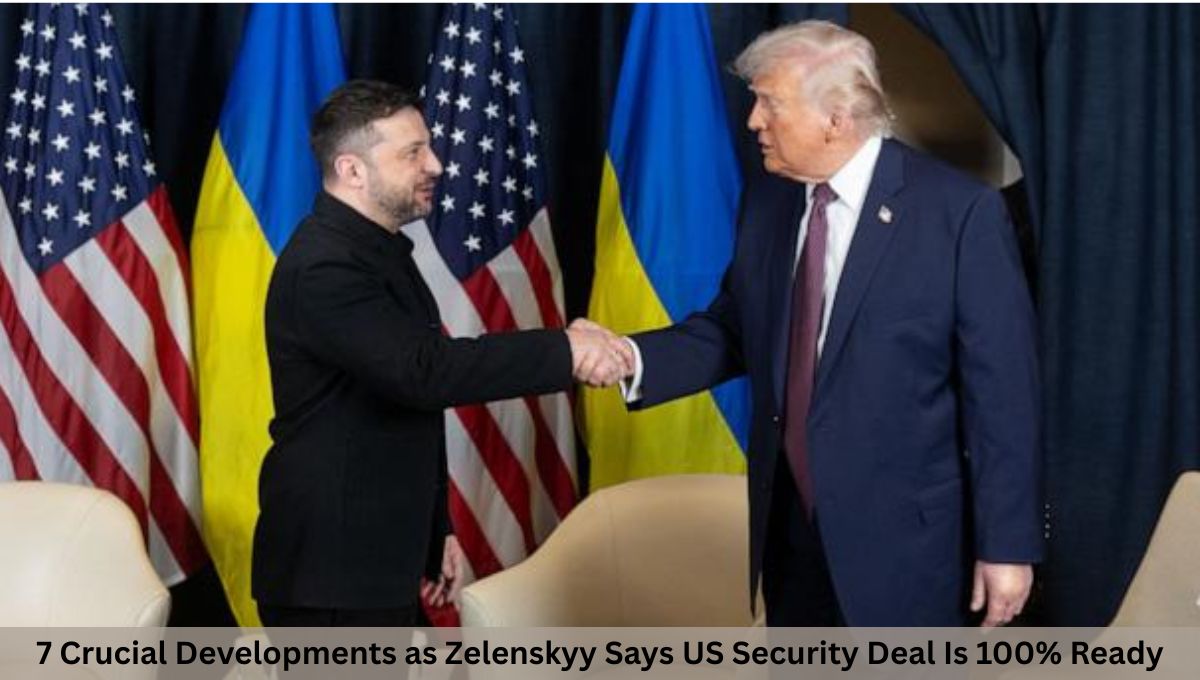
7 Crucial Developments as Zelenskyy Says US Security Deal Is 100% Ready amid stalled peace talks.Ukrainian President Volodymyr Zelenskyy has announced that a long-anticipated agreement on US security guarantees for Ukraine is “100 percent ready” to be signed, marking a potentially decisive moment in Ukraine’s diplomatic efforts to secure lasting protection as the war with Russia approaches its fourth year.
Speaking at a news conference in Vilnius, Lithuania, on Sunday, Zelenskyy said Kyiv is now waiting for Washington to confirm the date and location for signing the document, which would then be sent to the US Congress and the Ukrainian parliament for ratification.
“For us, security guarantees are first and foremost guarantees of security from the United States,” Zelenskyy said. “The document is 100 percent ready, and we are waiting for our partners to confirm the date and place when we will sign it.”
The announcement came just hours after the conclusion of two days of US-brokered trilateral talks between Ukraine, Russia, and the United States in Abu Dhabi — talks that yielded no breakthrough but laid the groundwork for continued negotiations.
7 Crucial Developments as Zelenskyy Says US Security Deal Is 100% Ready
Security Guarantees at the Heart of Ukraine’s Strategy
For Kyiv, security guarantees are central to any future peace settlement. Ukrainian officials have long argued that without firm and enforceable commitments from the United States and its allies, any ceasefire or political agreement would leave Ukraine vulnerable to renewed Russian aggression.
Zelenskyy underscored that the proposed agreement with Washington goes beyond political assurances and is designed to anchor Ukraine’s postwar stability.
“The document will then be sent for ratification to the US Congress and the Ukrainian parliament,” he said, emphasizing that the agreement would require legislative approval on both sides to carry lasting weight.
Ukraine has repeatedly pointed to past failures of international guarantees, including the 1994 Budapest Memorandum, as evidence that vague promises are insufficient.
The new US security guarantees document is intended to avoid those shortcomings by embedding bilateral commitments into a formal framework.
Abu Dhabi Talks: First Trilateral Format in Years
The Abu Dhabi meetings marked the first time since Russia’s full-scale invasion in 2022 that officials from Ukraine, Russia, and the United States sat down together in a trilateral format.
Zelenskyy described the talks as unusual not only for their setting but also for the level of representation involved.
“This was probably the first such trilateral format in quite a long time that included not only diplomats, but also military representatives from all three sides,” he said.
The discussions focused on Washington’s revised 20-point framework for ending the war, addressing issues ranging from security guarantees and territorial control to economic reconstruction and postwar governance.
While no agreement emerged, both Moscow and Kyiv described the talks as constructive, and US officials confirmed that further meetings are expected.
US Officials Signal Cautious Optimism
A US official speaking after the talks said the atmosphere in Abu Dhabi had been respectful and detailed, even if deeply contentious.
“We got to real granular detail,” the official said, adding that plans were made to continue discussions as early as next Sunday, February 1, again in Abu Dhabi.
US President Donald Trump’s special envoy, Steve Witkoff, echoed that assessment, calling the talks “very constructive” and stressing the administration’s commitment to ending the conflict.
“President Trump and his entire team are dedicated to bringing peace to this war,” Witkoff said.
Despite the lack of a breakthrough, US officials framed the talks as a significant step forward after months of quiet diplomacy conducted largely through bilateral channels.
Territory Remains the Core Obstacle
If security guarantees are the cornerstone of Ukraine’s position, territory remains the principal fault line dividing Kyiv and Moscow.
Zelenskyy was unequivocal that Ukraine has not shifted its stance on territorial integrity, particularly regarding the eastern regions of Donetsk and Luhansk, collectively known as the Donbas.
“These are two fundamentally different positions — Ukraine’s and Russia’s,” Zelenskyy said. “The Americans are trying to find a compromise.”
Russia continues to insist that Ukraine must withdraw its forces from the eastern territories that Moscow illegally annexed but has not fully captured militarily.
Ahead of the Abu Dhabi talks, Kremlin spokesperson Dmitry Peskov reiterated that Ukraine’s withdrawal from the Donbas remains a key condition for any peace agreement.
Russian Deputy Foreign Minister Sergei Ryabkov later reinforced that position, saying Moscow seeks a settlement aligned with understandings reached between President Vladimir Putin and President Trump during their summit in Alaska last year.
That understanding, according to Russian officials, envisioned Ukraine ceding the remainder of Donetsk and Luhansk in exchange for a ceasefire — a proposal Kyiv has consistently rejected.
Zelenskyy Rejects Territorial Concessions
Zelenskyy dismissed the idea that Ukraine could trade land for peace, framing the issue as one of sovereignty rather than negotiation.
“We are fighting for our country — for what is ours,” he said. “We are not fighting on foreign territory. What questions could there be for us?”
He accused Moscow of using the peace process to pursue objectives it has failed to achieve on the battlefield, arguing that Russia is seeking through diplomacy what it could not secure through force.
Zelenskyy also acknowledged that compromise would be necessary to bridge the gap between the two sides, but stressed that compromise does not mean capitulation.
“For a compromise, all sides must be ready to compromise,” he said, adding pointedly that “this includes the American side as well.”
EU Membership as an ‘Economic Security Guarantee’
Beyond military and security guarantees, Zelenskyy reiterated Ukraine’s push for European Union membership by 2027, describing it as a critical pillar of the country’s long-term stability.
He called EU accession an “economic security guarantee,” arguing that integration into the bloc would anchor Ukraine’s recovery, attract investment, and reduce vulnerability to external pressure.
The push for EU membership runs parallel to Kyiv’s security talks with Washington and reflects Ukraine’s broader strategy of locking in Western commitments across political, economic, and military domains.
Diplomacy Overshadowed by Intensifying Russian Strikes
Even as diplomats met in Abu Dhabi, the war on the ground showed no signs of abating.
Russia launched its largest overnight aerial attack on Ukraine so far this year during the talks, firing a barrage of missiles and drones at multiple cities, including Kyiv and Kharkiv.
In the Ukrainian capital, at least one person was killed and four others wounded, according to Mayor Vitali Klitschko.
Falling debris sparked fires and damaged buildings, while nearly 6,000 apartment blocks lost heat amid sub-zero temperatures.
Ukraine’s Foreign Minister Andrii Sybiha accused Moscow of acting cynically by escalating attacks while negotiations were underway.
“Every such Russian strike on our energy infrastructure proves that there must be no delays in supplying air defenses,” Zelenskyy said. “No blind eye can be turned to these strikes; they must be met with a strong response.”
Peace Talks and the Reality of War
The contrast between diplomatic engagement and military escalation highlighted the fragility of the current peace process.
Zelenskyy said Russia had used the negotiations to “do everything possible” to gain full control of eastern Ukraine, something he noted Moscow has still failed to achieve militarily.
US officials acknowledged that the talks are occurring under extraordinarily difficult circumstances, with neither side willing to halt military operations during negotiations.
Still, they argued that dialogue remains essential, even amid ongoing violence.
What Happens Next: February 1 Talks Loom
US officials confirmed that the next round of talks is expected to begin in Abu Dhabi on February 1, provided all parties remain willing to engage.
A spokesperson for the UAE government said the recent meetings involved rare face-to-face exchanges between Ukrainian and Russian negotiators and addressed “outstanding elements” of the US peace framework.
The official also raised the possibility of future meetings in Moscow or Kyiv before any direct summit involving Zelenskyy, Putin, and Trump.
For now, the process remains incremental, with progress measured not in agreements signed but in positions clarified and channels kept open.
A Pivotal Moment for Ukraine’s Future
Zelenskyy’s declaration that the US security guarantees document is “100 percent ready” places the focus squarely on Washington’s next move.
If signed and ratified, the agreement would represent one of the most significant bilateral security commitments the United States has made to Ukraine since the war began — and could reshape the balance of negotiations with Russia.
Yet the path forward remains fraught with uncertainty. Territorial disputes, ongoing violence, and political pressures in all three capitals continue to complicate efforts to reach a durable settlement.
As Ukraine waits for a date and place to sign its security agreement with the United States, one reality is clear:
peace remains elusive, but diplomacy — however fragile — is once again firmly on the table.
Also Read: 7 Crucial Security Guarantees Ukraine Wants After Dropping NATO Bid
Also Read: Ukraine war nearing its end? No peace deal yet, but Kyiv upbeat after trilateral talks