7 Crucial Security Guarantees Ukraine Wants After Dropping NATO Bid from the US and Europe. Ukraine has taken one of the most consequential diplomatic steps since Russia launched its full-scale invasion in February 2022.
President Volodymyr Zelenskyy has indicated that Kyiv is prepared to abandon its long-standing ambition to join NATO in exchange for firm, legally binding security guarantees from the United States and key Western allies.
The proposal marks a historic shift in Ukraine’s security doctrine and comes amid intense US-led efforts to broker an end to the war with Russia. At the centre of these talks is a critical question: if Ukraine gives up NATO membership, can Western guarantees realistically deter future Russian aggression?
As negotiations unfold in Berlin involving US special envoy Steve Witkoff, presidential adviser Jared Kushner, Ukrainian officials, and European leaders, the contours of a potential deal are beginning to emerge—along with its limitations, risks, and unresolved obstacles.
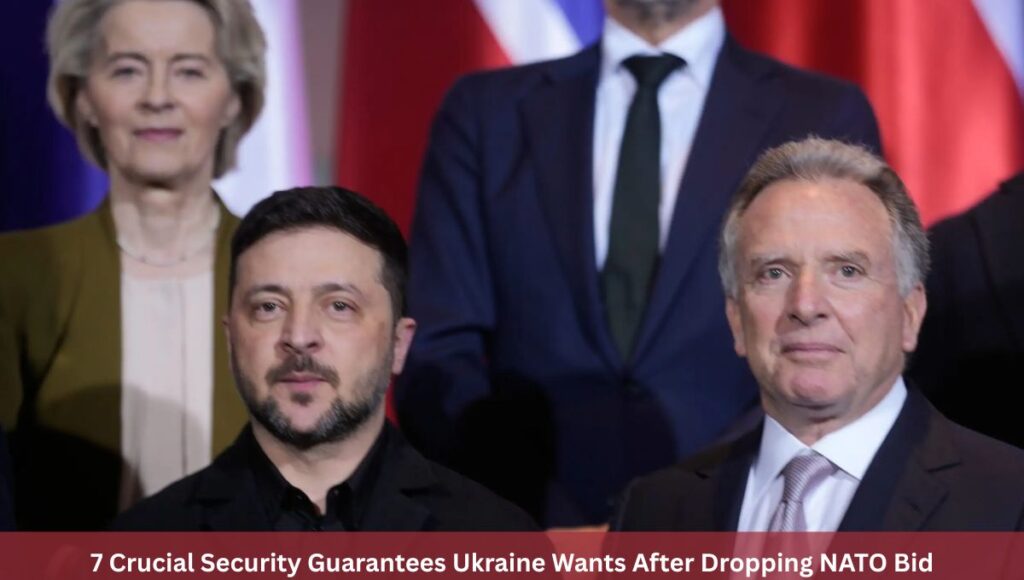
7 Crucial Security Guarantees Ukraine Wants After Dropping NATO Bid
Why Ukraine’s NATO Bid Has Been Central to Its Security
For years, NATO membership has been the cornerstone of Ukraine’s national security strategy. Article 5 of the NATO treaty—under which an attack on one member is treated as an attack on all—was seen in Kyiv as the only credible deterrent against future Russian invasions.
Since 2014, and especially after 2022, Ukrainian leaders repeatedly argued that NATO integration was not merely aspirational but existential. The alliance’s collective defence guarantee would make another Russian assault prohibitively costly.
However, despite strong rhetorical support from some NATO members, Ukraine’s path to accession remained blocked. Several alliance members, including Hungary and Slovakia, were openly resistant. Others feared that admitting Ukraine would automatically drag NATO into a direct war with Russia.
In practical terms, Ukraine’s chances of joining NATO in the near future were increasingly slim—well before Zelenskyy’s latest concession.
What Did Zelenskyy Actually Say About Dropping NATO Membership?
Zelenskyy’s remarks were delivered via audio messages shared with journalists in a WhatsApp group ahead of high-level meetings in Berlin. His language was careful but unambiguous.
“From the very beginning, Ukraine’s desire was to join NATO; these are real security guarantees,” Zelenskyy said. “Some partners from the US and Europe did not support this direction.”
He framed Kyiv’s willingness to abandon NATO membership as a concession—one made reluctantly and only in exchange for alternative guarantees that would offer comparable protection.
According to Zelenskyy, Ukraine is now seeking:
- Bilateral security guarantees from the United States
- Article 5–like guarantees from Washington
- Security commitments from European allies
- Support from other partners such as Canada and Japan
“These security guarantees are an opportunity to prevent another wave of Russian aggression,” he said, stressing that they must be legally binding and formally endorsed by the US government.
What Are ‘Article 5–Like’ Security Guarantees?
The phrase “Article 5–like guarantees” has become central to the current negotiations—but it does not mean NATO membership by another name.
Under the emerging framework, Ukraine would receive bespoke security guarantees from individual countries or coalitions of countries rather than automatic collective defence through NATO.
How They Would Work
- Guarantees would be set out in bilateral or plurilateral treaties
- They would commit partners to swift military, financial, and intelligence support if Ukraine were attacked again
- Assistance could include weapons deliveries, intelligence sharing, sanctions, and economic aid
- Each guarantor’s obligations would be defined separately
How They Differ from NATO Article 5
- No automatic obligation to deploy troops
- No NATO integrated command structure
- No binding requirement for collective military defence
- Responses would depend on the terms of each agreement
In essence, Ukraine would gain strong assurances—but not the ironclad protection NATO provides.
What Is the United States Offering Ukraine?
According to American officials involved in the Berlin talks, the Trump administration has put forward its strongest security proposal yet.
A senior US official described the offer as “really, really strong guarantees, Article 5–like,” while making clear that the deal comes with urgency.
“These guarantees will not be on the table forever,” the official said. “They are on the table right now if there’s a conclusion reached in a good way.”
Key Elements of the US Offer
- Security guarantees ratified by US Congress, ensuring they outlast Trump’s presidency
- Continued US military and intelligence support
- Coordination with European allies
- Support for Ukraine’s eventual EU membership
President Donald Trump later confirmed that he had spoken with Zelenskyy, European leaders, and Russian President Vladimir Putin, saying, “I think we’re closer now than we have been ever.”
Why the Offer Comes With an Implicit Deadline
While the guarantees are more explicit than anything Washington has previously offered, they also come with pressure.
US officials have indicated that future iterations of the deal may be less generous if Kyiv delays. This reflects Trump’s growing frustration with the pace of negotiations and his desire to bring the war to a conclusion.
For Ukraine, this creates a dilemma: accept imperfect guarantees now or risk facing a weaker offer later.
How Europe Is Responding
European leaders have cautiously welcomed the progress made in Berlin.
German Chancellor Friedrich Merz described the US proposal as “remarkable,” while France, Britain, and several Nordic countries issued a joint statement committing to continued support for Ukraine’s security.
French President Emmanuel Macron reaffirmed that France would remain “at Ukraine’s side to build a robust and lasting peace.”
However, European leaders are also acutely aware of the broader implications. Merz warned that Russian President Vladimir Putin’s objectives go beyond Ukraine.
“If Ukraine falls, he won’t stop,” Merz said, arguing that European security itself is at stake.
What Russia Thinks About the New Security Proposals
Moscow has long opposed Ukraine’s NATO ambitions, describing them as a direct threat to Russian security. Kremlin spokesperson Dmitry Peskov said the NATO issue remains “one of the cornerstones” of any peace settlement and requires “special discussion.”
Russia is now waiting for Washington to formally brief it on the Berlin talks. While US officials believe Moscow may accept the proposed arrangement, Russian officials have been more sceptical.
Putin’s adviser Yuri Ushakov warned that revisions suggested by Ukraine and Europe had “worsened” US proposals and said Moscow would have “very strong objections” to certain elements.
Territorial Disputes: The Biggest Obstacle
Security guarantees are only one part of a much larger negotiation. Territorial control remains the most intractable issue.
Russia continues to demand that Ukraine withdraw from parts of Donetsk still under Kyiv’s control—something Zelenskyy has flatly rejected.
The US reportedly floated the idea of:
- Ukraine withdrawing from parts of Donetsk
- Creating a demilitarised free economic zone
Zelenskyy dismissed the proposal as unfair and impractical.
“If Ukrainian troops withdraw 5–10 kilometres, why do Russian troops not withdraw deeper into occupied territories by the same distance?” he asked.
Instead, Zelenskyy said a freeze along the existing line of contact may be the most realistic option.
Other Proposals on the Table
Beyond Donetsk, talks have also touched on:
- A possible split arrangement for the Zaporizhzhia nuclear power plant
- Demilitarised buffer zones
- A European-led multinational force supported by the US
However, Russia has insisted that its police and national guard forces would remain in certain areas even under a demilitarised framework.
What’s Happening on the Battlefield
Diplomacy is unfolding against a backdrop of intensified fighting.
Over the past week:
- Russia launched more than 1,500 drones, 900 guided bombs, and 46 missiles
- Ukrainian air defences intercepted the majority, but damage was reported across multiple regions
- Hundreds of thousands of civilians remain without electricity following infrastructure attacks
- Fighting has intensified in the Black Sea, with strikes on Ukrainian ports and grain facilities
The ongoing violence underscores the urgency—and fragility—of the negotiations.
Will Security Guarantees Actually Protect Ukraine?
The effectiveness of any new security arrangement will depend on three key factors:
1. Legal Binding Power
Ukraine insists that guarantees must be enshrined in law, particularly in the US, to prevent future administrations from abandoning them.
2. Speed and Certainty of Response
Unlike NATO’s Article 5, responses would not be automatic. Delays or political hesitations could weaken deterrence.
3. Russian Perception
Ultimately, the guarantees must convince Moscow that renewed aggression would carry unacceptable costs.
Without these elements, critics fear the deal could resemble past assurances that failed to prevent war.
Why Many Ukrainians Remain Sceptical
Despite the diplomatic momentum, scepticism runs deep within Ukraine.
As Al Jazeera reported from Kyiv, many Ukrainians see the talks as yet another round of diplomacy that could fizzle out.
There is also concern that abandoning NATO membership—even symbolically—could weaken Ukraine’s long-term security posture if guarantees prove insufficient.
A Defining Moment for Ukraine and the West
Ukraine’s willingness to drop its NATO bid represents one of the most significant strategic compromises of the war.
For Kyiv, it is a calculated gamble that Western security guarantees can substitute for NATO’s collective defence. For Washington and Europe, it is a test of credibility—whether they can provide meaningful protection without formal alliance commitments.
The coming weeks will determine whether the proposed guarantees are robust enough to deter Russia and whether Moscow is willing to accept a settlement that leaves Ukraine secure, sovereign, and aligned with the West.
For now, Ukraine has shifted the dial. Whether the West can deliver remains the unanswered question.
Also Read: 9 Decisive Moves as EU Freezes Russian Assets to Back Ukraine
Also Read: France calls for ‘robust security’ deal for Ukraine after Trump hails ‘good talks’ with Zelensky