9 Shocking Revelations About China’s ‘First Father’ and His 100+ US-Born Children via surrogacy.
A Chinese gaming billionaire who openly calls himself “China’s first father” has become the face of a controversial global phenomenon:
ultra-wealthy Chinese elites quietly using America’s surrogacy system to build families on a scale unimaginable in most of the world.
Xu Bo, the 48-year-old founder of online gaming company Duoyi, is alleged to have fathered more than 100 children through surrogacy arrangements in the United States. Some claims—made by Xu himself or through accounts linked to his company—suggest the number could be even higher. His former partner has alleged the figure may exceed 300 children.
While Xu and his company dispute parts of the reporting, court filings, social media posts, and a detailed investigation by The Wall Street Journal have pulled back the curtain on an industry operating in legal gray zones, raising profound ethical, legal, and geopolitical questions.
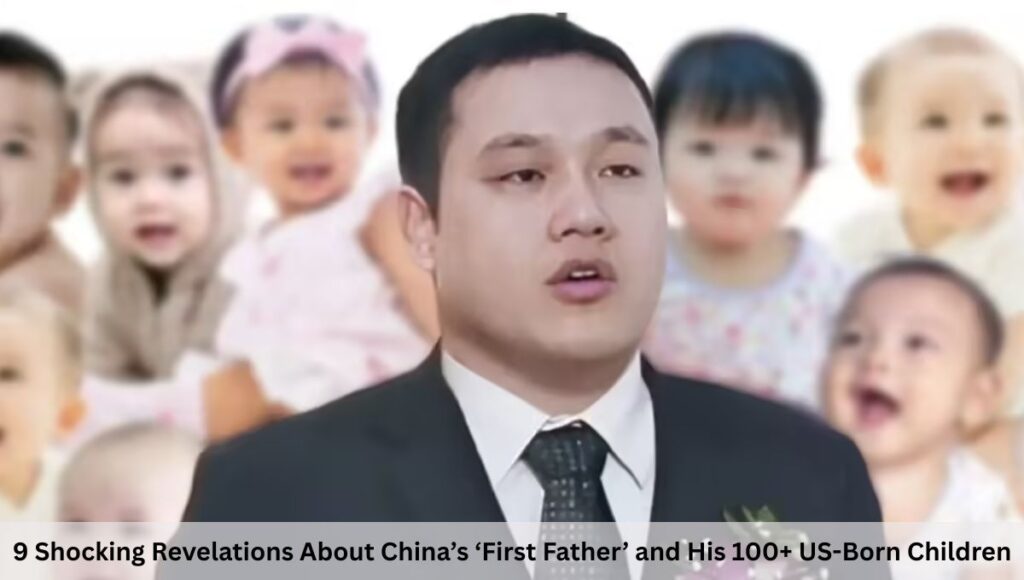
9 Shocking Revelations About China’s ‘First Father’ and His 100+ US-Born Children
Who Is Xu Bo?
Xu Bo is a billionaire entrepreneur best known as the founder of Duoyi Network, a Chinese online gaming company specializing in fantasy and strategy games. Publicly reclusive and rarely photographed in recent years, Xu nonetheless maintains a provocative presence online through posts attributed to him or his company.
He has:
- Referred to himself as “China’s first father”
- Publicly criticized feminism
- Spoken about creating a lineage capable of carrying on his business empire
Despite his low profile in interviews, Xu’s actions—and ambitions—have attracted intense scrutiny both inside and outside China.
Claims of Over 100 Children Through US Surrogacy
According to social media posts attributed to Duoyi Network and reporting verified by the Wall Street Journal, Xu has fathered more than 100 children via surrogacy in the United States.
These claims resurfaced dramatically in November, when Xu’s former girlfriend Tang Jing alleged that the real number could exceed 300 children.
“That number might even be undercounted, but it’s certainly not exaggerated,” Tang wrote on social media. Tang claims she personally raised 11 of Xu’s children for several years.
Xu has not directly addressed her claims about the total number of children but has accused Tang of owing him millions of dollars in expenses. The two are currently embroiled in a custody dispute over their two daughters.
A Viral Video and the ‘Daddy’ Moment
Public fascination with Xu intensified after reports emerged of a 2022 video allegedly linked to him. According to the New York Post, the video shows dozens of young boys sitting inside a large residence.
As the camera pans, the children rush forward shouting “Daddy!” in Chinese.
The caption reportedly read:
“Imagine a bunch of babies rushing towards you—how does that feel? Besides your loved one, what’s cuter than children?”
Xu’s company later told the Wall Street Journal that “much of what you described is untrue”, but declined to specify which details were inaccurate.
Inspired by Elon Musk?
Xu’s ambitions appear to be shaped by a worldview that treats reproduction as legacy-building.
According to the Wall Street Journal:
- Xu has expressed admiration for Elon Musk
- He has posted about hoping his children would one day marry Musk’s children
- He views large-scale reproduction as a way to shape future power structures
Musk, who has 14 known children, has denied claims that he encourages people to reproduce to expand his bloodline. Nonetheless, he has become a symbolic figure for pronatalist movements among certain ultra-wealthy circles.
Industry insiders say Musk is increasingly viewed as a role model by wealthy Chinese men seeking to build dynasties.
The California Court That Raised Alarm
The Xu Bo case came to public attention after a California family court hearing in summer 2023.
Court clerks noticed something unusual:
- The same name—Xu Bo—kept appearing in multiple surrogacy petitions
- Xu was seeking parental rights for four unborn children
- Records showed he had already fathered or was in the process of fathering at least eight more
Judge Amy Pellman summoned Xu for a hearing. Xu appeared via video from China, speaking through an interpreter.
Xu’s Courtroom Admissions
During the hearing, Xu reportedly told the court that:
- He hoped to father 20 or more US-born children
- He preferred boys, whom he believed could eventually take over his company
- Several children were already living in Irvine, California, cared for by nannies
- He had not yet met them due to work commitments
His long-term plan, Xu said, was to eventually bring the children to China once paperwork was completed.
A Rare Judicial Rebuke
Judge Pellman expressed deep concern. Surrogacy, she noted, is intended to help people build families—not function as a “baby factory.”
In a rare move, she denied Xu’s petitions for parentage, leaving the unborn children without legal parental recognition under California law.
Legal observers say such denials are highly unusual, highlighting how extreme Xu’s case appeared even within an industry accustomed to international clients.
Why Chinese Billionaires Turn to US Surrogacy
Surrogacy Is Illegal in China
Commercial surrogacy is illegal in China, and domestic cases often trigger public backlash and official condemnation.
However:
- Chinese law does not explicitly prohibit citizens from pursuing surrogacy abroad
- Enforcement remains limited
- Wealthy individuals can quietly bypass domestic restrictions
High-profile cases involving Chinese celebrities have sparked outrage at home, reinforcing the need for secrecy.
US Citizenship Is a Major Incentive
Children born in the United States automatically receive US citizenship under the 14th Amendment.
This has made US surrogacy especially attractive for:
- Wealth preservation
- Global mobility
- Political hedging
While the US government has cracked down on birth tourism, it remains unclear how those rules apply to international surrogacy arrangements.
A $200,000-Per-Child Industry
According to industry experts, US surrogacy for international clients can cost up to $200,000 per child, covering:
- IVF clinics
- Legal services
- Surrogacy agencies
- Delivery coordination
- Nannies and infant care
A sophisticated ecosystem has emerged, allowing parents to:
- Ship genetic material overseas
- Have children born in US hospitals
- Collect infants without ever entering the country
Chinese Elites and the Rise of ‘Mega-Families’
Xu Bo is not alone.
Other Notable Cases
- Wang Huiwu, a Sichuan-based education executive, reportedly fathered 10 daughters through US surrogacy
- Egg donors allegedly included models, academics, and musicians
- Each egg donation reportedly cost $6,000–$7,500
Chinese media later criticized Wang, accusing him of exploiting women and violating public morals. His company’s shares reportedly plunged following the backlash.
From One-Child Policy to Dynasty Building
For years, overseas births offered a loophole in China’s one-child policy, which ended in 2015. Early clients used surrogacy to avoid fines. Today’s clients, industry insiders say, are driven by dynastic ambition.
Nathan Zhang, CEO of IVF USA, said:
“The ultra-wealthy now want dozens—or hundreds—of children to forge an unstoppable family dynasty.”
The Numbers Behind International Surrogacy
Academic research underscores the scale of the trend:
- US surrogacy cycles involving foreign parents quadrupled between 2014 and 2019
- Nearly 40% of all US surrogacy cycles involved international parents
- 41% of those international clients were from China
Experts warn that oversight remains minimal, making it difficult to track how many children a single intended parent commissions.
Legal and Political Backlash in the US
The issue has drawn attention from lawmakers and federal agencies.
Recent Developments
- FBI and DHS have interviewed some US surrogates working with Chinese parents
- A federal human trafficking investigation is ongoing into a Chinese-American couple with more than two dozen surrogate-born children
- Senator Rick Scott has introduced a bill seeking to ban surrogacy access for citizens of certain countries, including China
Meanwhile, Donald Trump issued an executive order limiting birthright citizenship, which is currently under Supreme Court review.
Ethical Questions and Global Implications
Critics argue the trend raises troubling questions:
- Are surrogates being exploited?
- Is citizenship being commodified?
- Can parenthood be reduced to volume and logistics?
Supporters counter that:
- Surrogacy is legal in many US states
- Intended parents follow existing laws
- Reproductive autonomy should not be restricted by nationality
Xu Bo’s Silence and Public Mystique
Xu Bo remains elusive.
He has:
- Avoided interviews for nearly a decade
- Rarely appeared in public photos
- Declined all media requests through his company
Duoyi Network’s response to the WSJ was brief:
“The boss does not accept interview requests from anyone for any purpose.”
Conclusion: A Case That Exposes a Global System
The Xu Bo story is not just about one billionaire’s extreme ambitions. It exposes how global wealth, legal loopholes, and reproductive technology intersect in ways lawmakers never anticipated.
As governments debate citizenship, ethics, and regulation, one reality is clear: international surrogacy—once niche—is now shaping the future of families, borders, and power itself.
Whether Xu Bo ultimately fathers 100 children or 300, his case has already forced the world to confront uncomfortable questions about money, reproduction, and what it means to build a legacy in the 21st century.
Also Read: 5 Key Breakthroughs as Trump and Xi Seal Major U.S.–China Trade Reset
Related Posts:
- 7 Shocking Twists in Subramanyam Vedam’s 43-Year…

- 7 Powerful Insights into Zohran Mamdani’s Historic…

- Trump Honors Late Activist Charlie Kirk With…

- Carlo Acutis Becomes First Millennial Saint: Vatican…

- 5 Key Takeaways as Zohran Mamdani Wins Historic New…

- 7 Heartbreaking Facts About Venezuela's Earthquake Disaster