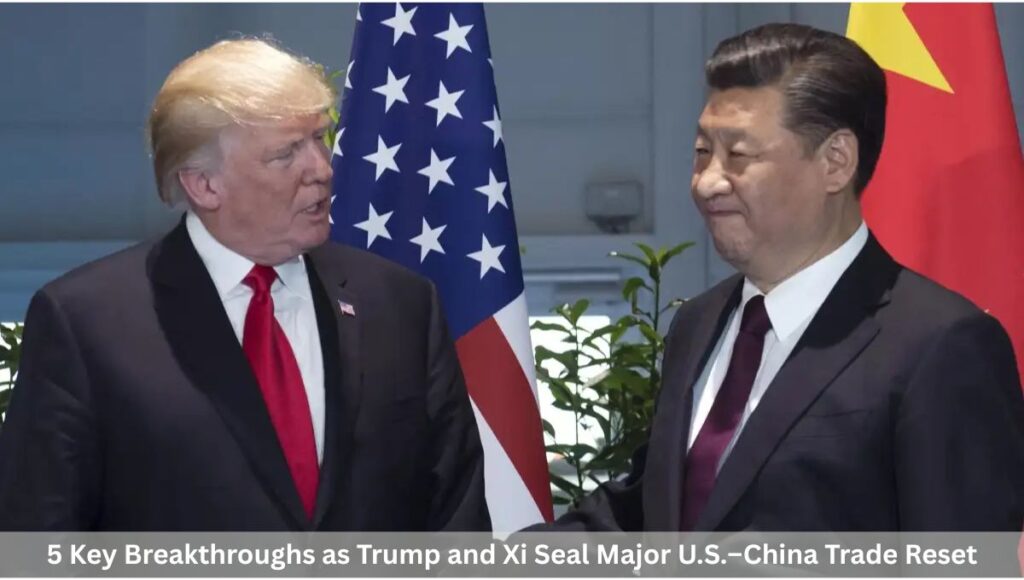
5 Key Breakthroughs as Trump and Xi Seal Major U.S.–China Trade Reset in landmark meeting in Busan, South Korea. US President Donald Trump and Chinese President Xi Jinping held their first face-to-face meeting in six years on Thursday, striking a series of economic and diplomatic agreements aimed at cooling tensions between the world’s two largest economies.
In a meeting Trump later described as “an amazing success,” the two leaders agreed to cut tariffs, restart agricultural purchases, restore rare-earth exports, and cooperate on curbing fentanyl — while pledging to work together on finding “common ground” over the war in Ukraine.
Speaking aboard Air Force One after the two-hour meeting in Busan, South Korea, Trump said, “We had an amazing meeting — a truly fantastic new beginning in US–China relations.” Below are the five key takeaways from the Trump–Xi Busan summit, a session that may mark a turning point in a strained relationship marked by trade disputes and geopolitical rivalry.
5 Key Breakthroughs as Trump and Xi Seal Major U.S.–China Trade Reset
1. Tariff Cuts Signal Easing of Trade Tensions
In a surprise move, President Trump announced that tariffs on Chinese goods would be cut from 57 percent to 47 percent, marking the first significant rollback in years of escalating trade measures.
Trump said he also agreed to cut fentanyl-related tariffs from 20 percent to 10 percent, effective immediately, after what he called a “constructive and positive” discussion with Xi on tackling the synthetic opioid crisis.
“I expect to be lowering that because I believe they’re going to help us with the fentanyl situation,” Trump told reporters. “The relationship with China is very good.”
He added that Xi had pledged to take stronger action against illicit fentanyl production and export, which US officials have blamed for fuelling the opioid epidemic in America.
Trump said the agreement reflected “a new framework of cooperation,” adding, “I believe he’s going to work very hard to stop the death that’s coming in.”
The tariff cut marks a significant policy shift after months of volatility. Earlier this year, Trump had floated raising tariffs on Chinese imports as high as 145 percent, before market backlash forced a reconsideration.
Thursday’s move signals a tentative truce after years of escalating trade pressure between Washington and Beijing.
2. Joint Efforts on Ukraine Conflict
Another notable outcome of the Busan meeting was Trump’s announcement that both sides would “work together” on the issue of Ukraine.
“Ukraine came up very strongly,” Trump said. “We talked about it for a long time, and we’re both going to work together to see if we can get something.”
Trump did not elaborate on specific steps but said that Xi expressed willingness to play a constructive role in addressing the conflict. “He’s going to help us, and we’re going to work together on Ukraine,” Trump added.
The comments mark one of the rare instances where the US and China have publicly aligned — even partially — on an issue of global security.
While the details remain unclear, Trump’s remarks suggest a potential diplomatic channel between Washington and Beijing on Ukraine — a development that could shape the next phase of international efforts to end the war.
3. Beijing to Resume ‘Large’ Soybean Purchases
In a move welcomed by American farmers, Trump announced that China will immediately resume buying US soybeans and other agricultural products.
“Large amounts of soybeans will be purchased immediately,” Trump said. “We’re in agreement on tremendous amounts of soybeans and other farm products.”
Beijing’s state-owned trading firm COFCO has already purchased three cargoes of US soybeans, marking the first such deals from the latest American harvest, according to trade sources cited by Reuters.
The soybean commitment comes after months of stalled trade, during which Chinese imports of American farm goods were largely halted amid tariff escalations.
The resumption signals an easing of agricultural tensions and provides a boost to US farming communities that have been hit hard by falling exports and price drops.
“China will immediately start buying soybeans again. That’s a big win for our farmers,” Trump said, emphasizing the deal as a key part of his broader trade reset.
4. Rare-Earths Deal Ends Months of Supply Chain Anxiety
Perhaps the most strategic breakthrough from the meeting was Trump’s announcement that the two leaders reached an agreement on rare earths, the critical minerals essential for manufacturing fighter jets, electric vehicles, semiconductors, and other high-tech products.
“All the rare earth issue has been settled,” Trump said, declaring that the deal will ensure continued exports of rare earths from China under a one-year extendable agreement.
China — the world’s top producer and processor of rare earth minerals — had tightened export restrictions earlier this month, triggering alarm across global supply chains.
Trump said the new arrangement guarantees that “no more roadblocks” will affect the flow of rare earths to the United States.
A senior US official traveling with Trump confirmed that Beijing agreed to maintain rare-earth exports for the next year, with both sides expecting to extend the deal annually.
The agreement is expected to provide much-needed relief to US tech and defense industries that rely heavily on Chinese rare-earth supplies.
“The rare-earths understanding alone removes a major cloud of uncertainty hanging over our strategic industries,” one US trade analyst said.
5. Trump to Visit China in April; Xi to Follow with US Trip
Concluding his remarks aboard Air Force One, Trump announced plans to visit China in April 2026, with Xi expected to make a return visit to the United States later in the year.
“I’ll be going to China in April, and he’ll be coming here sometime after that — whether it’s in Florida, Palm Beach, or Washington, DC,” Trump said.
The planned exchange of visits underscores a renewed diplomatic warmth following years of tension over trade, technology, and security.
Trump said he viewed his Busan meeting as the start of “a fantastic new chapter” in bilateral relations, praising Xi as “a tremendous leader of a very powerful country.”
Notably, Trump confirmed that the issue of Taiwan was not discussed during the meeting — a rare omission given its usual prominence in US–China dialogues. “It never came up,” he said.
Trump Calls Meeting an ‘Amazing Success’
Throughout his post-meeting remarks, Trump repeatedly referred to the Busan session as an “amazing” and “fantastic” meeting.
“On a scale from zero to ten, the meeting was a twelve,” he said. “Very importantly, you know, just the whole relationship is very, very important, and I think it was really good.”
He said “a lot of things were brought to finalization,” including trade issues that had been pending since early in his presidency.
“Many very important points were agreed upon,” Trump said. “We’re in agreement on so many elements, and I think we’ll be providing conclusions on very important things shortly.”
Trump’s comments reflected optimism that the Busan meeting could mark a fresh start for two nations whose relationship has been defined in recent years by tariffs, sanctions, and geopolitical competition.
The White House said it expects to issue a joint statement detailing the outcomes of the meeting later this week.
Also Read: Tariffs Down, Hopes Up, Rare Earths Flow: Trump And Xi’s “Amazing” Trade Deal Sparks Global Optimism
Xi Jinping’s Response: ‘Stable on the Whole’
For his part, Chinese President Xi Jinping expressed satisfaction at the tone and outcomes of the meeting, calling it a “great pleasure” to meet Trump again after several years.
“Under our joint guidance, China–US relations have remained stable on the whole,” Xi said. “Given our different national conditions, it is normal for the two leading economies of the world to have frictions now and then.”
Xi emphasized that cooperation, not confrontation, should define the relationship going forward. He described the talks as “frank and productive,” according to Chinese state media reports.
While Beijing has yet to release an official statement detailing its perspective, observers in China described the meeting as a strategic pause aimed at stabilizing bilateral ties.
A Tentative Truce, Not a Full Reset
While the tone from both leaders was notably positive, analysts caution that the Busan meeting represents a temporary thaw rather than a permanent resolution.
The two powers remain divided on a host of issues, from technology access to South China Sea security, and Trump confirmed that the question of Chinese access to advanced Nvidia chips was raised — but that no concessions were made.
“We discussed Nvidia, but I would not offer access to their most advanced Blackwell line,” Trump said.
Still, the agreements on tariffs, rare earths, and soybeans mark a clear step toward easing tensions that had rattled global markets.
“It’s a truce, but an important one,” said a senior trade observer in Washington. “Both leaders needed a win — Trump for domestic markets, and Xi for supply chain stability.”
Market Reaction and Global Implications
Initial market reactions were positive. Futures for soybeans and rare earth-related stocks rose sharply following Trump’s remarks, while analysts said the tariff cut could ease inflationary pressures in the United States.
The Busan meeting also appeared to calm investor nerves about the trajectory of US–China relations.
“The optics matter as much as the agreements,” said one Asian market strategist. “Just seeing both leaders smile and shake hands sends a strong signal of de-escalation.”
The rare-earths deal, in particular, is expected to have far-reaching implications for industries from defense to clean energy, reducing fears of supply disruptions.
Looking Ahead
Trump said he expected further “very significant announcements” following his planned April visit to China, which could include new trade frameworks and expanded agricultural cooperation.
He concluded his remarks by saying, “This was an amazing meeting. We’ve started something very special. I think we’ll have a fantastic relationship for a long time.”
As the world’s two largest economies signal a willingness to reset and cooperate, the Busan summit may mark the beginning of a cautious new phase in US–China relations — one driven by pragmatic interests rather than confrontation.
Also Read: U.S.–China Trade War 2025: 500% Tariff Threat Sparks Global Alarm