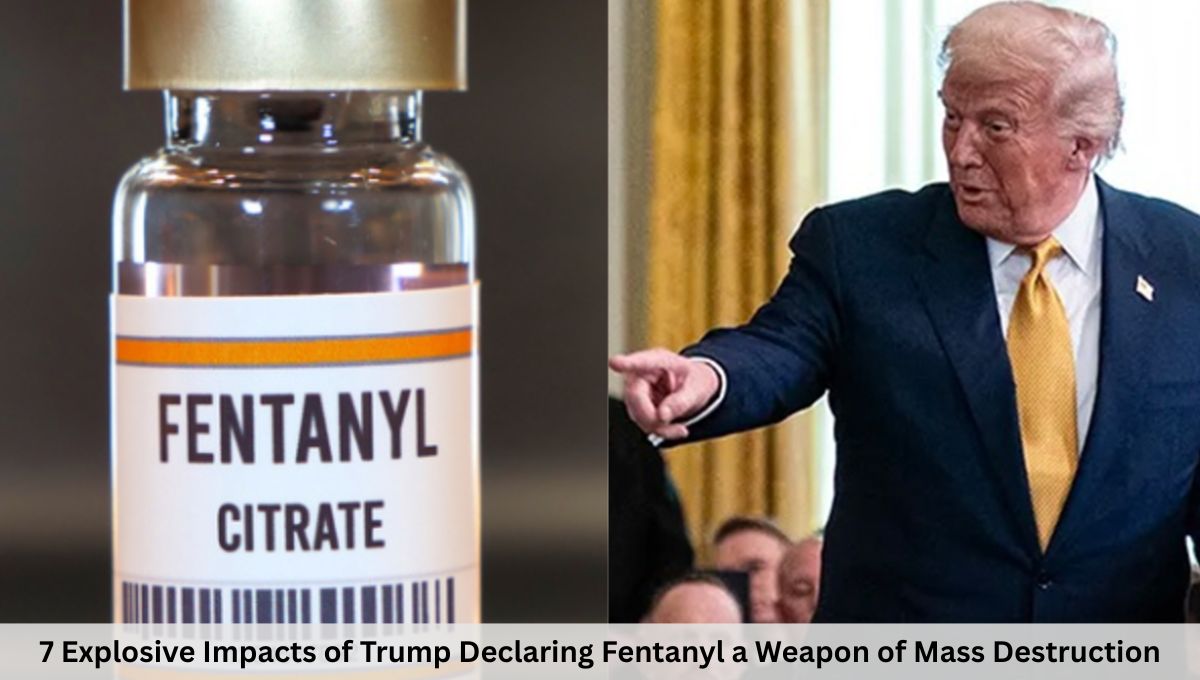
7 Explosive Impacts of Trump Declaring Fentanyl a Weapon of Mass Destruction, a move against drug trafficking networks.United States President Donald Trump has signed a sweeping executive order formally classifying illicit fentanyl and its core precursor chemicals as a “weapon of mass destruction” (WMD), dramatically escalating the language — and potentially the scope — of the administration’s campaign against drug trafficking networks.
The move, announced during a White House event on Monday, represents an unprecedented step in US drug policy. While fentanyl has long been treated as a public health emergency and criminal justice issue, Trump’s order reframes the synthetic opioid as a national security threat on par with chemical and nuclear weapons.
The decision has triggered sharp debate among lawmakers, legal experts, and human rights groups, who question both the practical impact of the designation and its implications for executive power, military involvement, and US foreign policy in Latin America.
7 Explosive Impacts of Trump Declaring Fentanyl a Weapon of Mass Destruction
A ‘Historic’ Executive Order
Speaking at the signing ceremony, Trump described the executive order as a necessary response to what he called the catastrophic human toll of fentanyl in the United States.
“Today I’m taking one more step to protect Americans from the scourge of deadly fentanyl flooding into our country,” Trump said. “With this historic executive order, we’re formally classifying fentanyl as a weapon of mass destruction. No bomb does what this is doing.”
Trump repeatedly emphasized fentanyl’s lethality, claiming it causes 200,000 to 300,000 deaths annually, and argued that its impact rivals that of traditional weapons.
The White House rapid response team later shared video footage of the announcement, underscoring the administration’s effort to frame the move as a defining moment in its anti-drug strategy.
What the Executive Order Does — and Does Not Do
Despite the dramatic language, the executive order does not change existing US law.
Under current federal statutes, a weapon of mass destruction is broadly defined as any weapon designed to cause death or serious bodily injury through the release of toxic chemicals, biological agents, radiation, or destructive devices such as bombs and missiles.
Because presidents cannot unilaterally rewrite statutory definitions, the order instead directs executive agencies to intensify actions against fentanyl trafficking within existing legal frameworks.
Specifically, the order:
- Directs the Attorney General to pursue investigations and prosecutions related to fentanyl trafficking
- Instructs the State Department and Treasury Department to target assets and financial institutions linked to fentanyl manufacturing and distribution
- Frames illicit fentanyl as a chemical weapon-like threat to US national security
- Casts drug trafficking networks as entities that fuel terrorism, insurgency, and domestic instability
The order explicitly states that “illicit fentanyl is closer to a chemical weapon than a narcotic.”
Militarised Language and ‘Narco-Terrorism’
The fentanyl designation fits within a broader pattern of militarised rhetoric used by the Trump administration.
Over recent months, the White House has:
- Repeatedly referred to drug smugglers as “narco-terrorists”
- Designated multiple Latin American drug cartels as foreign terrorist organisations
- Claimed that traffickers are not merely criminal networks but actors seeking to destabilise the United States
“There’s no doubt that America’s adversaries are trafficking fentanyl into the United States, in part because they want to kill Americans,” Trump said during the announcement.
This framing positions fentanyl trafficking not as a law enforcement challenge but as an act of hostile aggression, a shift that critics say lowers the threshold for military involvement.
Legal Experts Question Practical Impact
Former prosecutors and national security lawyers have raised doubts about whether the WMD designation will materially strengthen the government’s ability to combat fentanyl. Dennis Fitzpatrick, a former national security attorney, described the move as largely symbolic.
“There’s no practical reason to label fentanyl as a weapon of mass destruction,” he said. “We already have statutes on the books that are clear, tested, and accomplish the same goals.”
Fitzpatrick warned that introducing WMD language could actually complicate prosecutions by forcing investigators to navigate less familiar legal terrain.
Other experts argue that redefining narcotics as WMDs amounts to executive overreach, a power traditionally reserved for Congress.
Congressional Authority and Political Pushback
Several lawmakers have criticized the executive order as an attempt to bypass legislative authority.
Democratic Representative Jim McGovern highlighted what he described as contradictions in Trump’s approach, noting the president’s earlier pardon of the founder of a major online drug marketplace.
Former Republican congressman Justin Amash went further, arguing that the move reflects a broader trend of expanding executive power through semantic manipulation.
“It’s just the latest example of the state twisting the plain meaning of words to expand its power,” Amash said. Despite the criticism, the order does not require congressional approval unless it leads to actions that exceed existing statutory authority.
Link to Military Operations in the Caribbean
The fentanyl designation also intersects with ongoing US military operations targeting alleged drug-smuggling vessels.
Since early September, US forces have carried out more than two dozen strikes against boats accused of trafficking drugs in the Caribbean and eastern Pacific, resulting in nearly 90 fatalities.
The Pentagon has released limited evidence supporting the allegations, leading rights groups to question whether the strikes constitute extrajudicial killings.
While the administration claims each destroyed vessel saves thousands of American lives, experts note that:
- Most fentanyl enters the US overland from Mexico
- Maritime routes are primarily used for cocaine, not fentanyl
- South America is not a known hub for fentanyl production
Threats of Land Strikes in Latin America
Trump has repeatedly threatened to expand operations beyond maritime interdictions. “We’re going to start hitting them on land, which is a lot easier to do, frankly,” he said on Monday.
The president has cited Venezuela, Colombia, and Mexico as potential targets, arguing that aggressive action is necessary to dismantle trafficking networks.
These statements have alarmed regional governments and raised fears of unilateral US military action without congressional authorization.
Venezuela at the Center of Escalating Rhetoric
Despite the administration’s heightened focus on Venezuela, drug policy experts emphasize that the country is not a source of fentanyl.
John Walsh of the Washington Office on Latin America stated unequivocally:
“There is no fentanyl coming from Venezuela or elsewhere in South America.”
Nevertheless, Trump has accused Venezuelan President Nicolás Maduro of leading a so-called “Cartel of the Suns,” which the US recently designated a narco-terrorist organisation.
Washington has also offered a $50 million reward for information leading to Maduro’s capture — a move Caracas says confirms that drug enforcement is being used as a pretext for regime change.
Echoes of Past WMD Justifications
Some critics have drawn parallels between Trump’s fentanyl designation and the 2003 invasion of Iraq, which was justified by claims that Saddam Hussein possessed weapons of mass destruction — claims later proven false.
They warn that expanding the definition of WMDs risks normalising extraordinary measures without sufficient evidence or oversight. The comparison has resonated particularly strongly in Latin America, where memories of US intervention remain politically sensitive.
Data Disputes Over Fentanyl Deaths
Trump’s claim that fentanyl kills up to 300,000 Americans annually has also been challenged.
Federal data released earlier this year showed:
- Total US overdose deaths fell to the lowest level in five years
- Approximately 80,000 overdose deaths occurred last year
- About 48,000 involved synthetic opioids such as fentanyl
While fentanyl remains the leading driver of overdose fatalities, critics argue that inflated figures risk undermining policy credibility.
China, Mexico, and the Global Supply Chain
The executive order reinforces the administration’s narrative that fentanyl is part of a foreign threat network. Mexico remains the primary source of US-bound illicit fentanyl, while many precursor chemicals originate in China.
Trump has previously used fentanyl concerns to justify:
- Increased tariffs on Mexico
- Trade pressure on China
- Expanded border security measures
The order signals continued use of economic and diplomatic pressure alongside law enforcement and military tools.
A National Security Reframing
By classifying fentanyl as a weapon of mass destruction, the Trump administration has effectively repositioned the drug crisis as a national security emergency rather than a public health issue.
Supporters argue this approach unlocks greater resources and urgency.
Critics counter that it:
- Risks militarising addiction policy
- Undermines harm reduction strategies
- Concentrates power in the executive branch
- Blurs the line between law enforcement and warfare
What Comes Next
It remains unclear how aggressively agencies will interpret the executive order.
Key questions include:
- Will prosecutors pursue WMD-related charges in fentanyl cases?
- Will intelligence agencies play a larger role in drug enforcement?
- Could the designation justify expanded military operations abroad?
- Will Congress move to limit or codify the administration’s approach?
For now, the order stands as a powerful political statement — one that reflects Trump’s broader vision of reasserting US dominance in the Western Hemisphere and confronting perceived threats with maximum force.
Conclusion
Trump’s decision to label fentanyl a weapon of mass destruction marks one of the most consequential rhetorical escalations in modern US drug policy.
Whether it proves to be a symbolic gesture or a foundation for far-reaching operational changes will depend on how aggressively the administration acts — and how forcefully Congress, the courts, and the international community respond.
What is clear is that the move has reshaped the national conversation, pushing the fentanyl crisis out of the realm of public health and firmly into the arena of global security and power politics.
Also Read: Trump Warns India, Pakistan, China and 20 Others of ‘Serious Consequences’ Over Drug Trafficking
Also Read: Experts assess Trump’s declaration of fentanyl as weapon of mass destruction