5 Key Developments: Israel’s New Gaza Strikes Shake Fragile Ceasefire following death of Israeli soldier. Israel’s military has carried out new airstrikes in northern Gaza just hours after it claimed to have resumed a fragile ceasefire, killing at least two people and reigniting global concern over the truce’s durability.
The latest strike on Wednesday evening targeted the Beit Lahiya area, north of Gaza City, and came amid deepening uncertainty following a night of heavy bombardment that killed more than 100 Palestinians across the enclave.
According to officials at Gaza’s al-Shifa Hospital, two people were killed in the attack. The Israel Defense Forces (IDF) said it had struck a site storing weapons that posed “an immediate threat” to Israeli troops operating nearby.
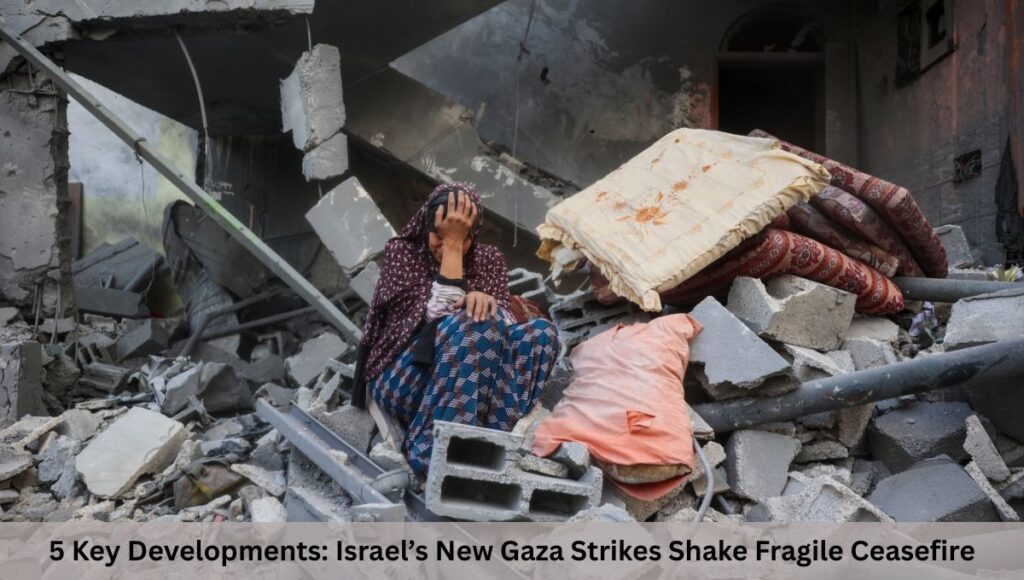
5 Key Developments: Israel’s New Gaza Strikes Shake Fragile Ceasefire
Ceasefire Shaken After Deadly Night of Strikes
The renewed violence came barely 24 hours after Israeli Prime Minister Benjamin Netanyahu ordered “powerful” retaliatory strikes in response to the killing of an Israeli soldier in Rafah, southern Gaza.
Tuesday night’s bombardment was among the most intense since the ceasefire took effect on October 10. Gaza’s Health Ministry said 104 people were killed, mostly women and children. Israel said it targeted “dozens of terror operatives” from Hamas and other armed groups.
Despite the violence, Israel announced mid-Wednesday that it would “resume the ceasefire,” a claim now in doubt following the latest airstrike in Beit Lahiya.
United States President Donald Trump insisted the ceasefire “is not in jeopardy,” saying Israel had a right to defend itself after what it claimed was a Hamas violation.
‘Calm Turned into Despair’
On the ground, residents of Gaza described the attacks as shattering the brief sense of relief that had followed days of relative calm.
“A brief hope for calm turned into despair,” said Hani Mahmoud, Al Jazeera’s correspondent in Gaza City. “For a lot of people, it’s a stark reminder of the opening weeks of the war, in terms of the intensity and the scale of destruction.”
Khadija al-Husni, a displaced mother living in Gaza’s Shati refugee camp, said the new attacks came just as people “started to breathe again.”
“It’s a crime,” she said. “Either there is a truce or a war — it can’t be both. The children couldn’t sleep; they thought the war was over.”
UN Condemns Civilian Deaths, Urges Renewal of Peace Efforts
United Nations Secretary-General António Guterres strongly condemned the civilian deaths from the latest Israeli airstrikes, calling the loss of life “unacceptable.”
His spokesperson, Stéphane Dujarric, said Guterres was “deeply disturbed” by reports of so many casualties, including many children.
UN rights chief Volker Türk described the situation as “appalling” and urged both Israel and Hamas “not to let peace slip from our grasp.”
Similar appeals came from Germany, the United Kingdom, and the European Union, all urging restraint and renewed adherence to the truce.
Hamas Denies Role in Israeli Soldier’s Death
The current wave of violence was triggered by the killing of an Israeli reservist soldier in Rafah on Tuesday. Israel accused Hamas of breaching the ceasefire by attacking its troops, prompting Netanyahu’s order for “powerful retaliatory action.”
Hamas denied any role in the incident, saying its fighters had “no connection to the shooting in Rafah.” The group reiterated its commitment to the ceasefire, accusing Israel of using the incident as a pretext for further escalation.
In response to the Israeli attacks, Hamas said it would postpone transferring the remains of a deceased captive, citing “truce violations.” It warned that continued escalation could “hinder the search, excavation, and recovery” of other bodies.
Trump: ‘Nothing Will Jeopardize the Ceasefire’
US President Donald Trump defended Israel’s right to respond to attacks, saying the ceasefire remained intact despite the violence.
“As I understand it, they took out an Israeli soldier,” Trump told reporters aboard Air Force One. “So the Israelis hit back — and they should hit back.”
He added:
“Nothing is going to jeopardize the ceasefire. You have to understand Hamas is a very small part of peace in the Middle East, and they have to behave. If Hamas does not behave, they will be terminated.”
Trump’s remarks echoed those of Vice President JD Vance, who said the ceasefire was “holding” despite ongoing Israeli strikes that have left dozens dead.
Night of Devastation Across Gaza
Witnesses described scenes of destruction across Gaza on Tuesday night. Strikes hit homes, schools, and residential blocks in Gaza City, Beit Lahiya, Bureij, and Khan Younis.
Gaza’s Health Ministry reported 104 deaths and more than 250 injuries. Among the victims were 46 children and 20 women.
In Khan Younis, mourners gathered at Nasser Hospital over the bodies of Bayan al-Shawaf and her four children, killed in a strike on a camp for displaced families.
“What kind of world is this? Is this the ceasefire?” said Bayan’s cousin, Umm Mohammed. “They were sleeping. They wanted to learn.”
The IDF said it had struck “dozens of terror targets,” including at least 30 commanders of armed groups. “The IDF will continue to uphold the ceasefire agreement and will respond firmly to any violation,” it said in a statement.
Disputed Hostage Remains Deepen Tensions
The violence also follows a dispute over the remains of deceased hostages. On Monday, Hamas handed over a coffin that Israel said contained the body of Ofir Tzarfati — a hostage whose remains had already been recovered last year.
Netanyahu’s office called the incident a “clear violation” of the ceasefire deal. Israel accused Hamas of staging a “fake recovery” of the body to mislead mediators.
The International Committee of the Red Cross (ICRC) confirmed that it had attended the scene “in good faith” at Hamas’s request but said it had no prior knowledge of what occurred.
“It is unacceptable that a fake recovery was staged when so much depends on this agreement being upheld,” the ICRC said.
Hamas rejected the allegations, accusing Israel of “fabricating false pretexts” to justify new attacks.
Marwan Barghouti and the Prisoner Debate
The Elders — a group of respected former world leaders — renewed calls for Israel to release Palestinian leader Marwan Barghouti, who remains imprisoned despite being included in Hamas’s proposed prisoner-exchange list.
“Marwan Barghouti has been a long-term advocate for a two-state solution by peaceful means,” The Elders said, urging President Trump to “ensure his release.”
Israel has refused to free Barghouti, who it says was involved in attacks against civilians. Barghouti denies the charges.
The group condemned the “torture and ill-treatment” of Palestinian prisoners and urged Israel to uphold its international obligations.
Red Cross Access Denied
Israel also officially barred Red Cross representatives from visiting Palestinian prisoners, citing security concerns.
Hamas said the ban violates international law and accused Israel of “systematic and criminal violations,” including “killing, torture, and starvation.”
The decision adds another layer of strain to already-fragile ceasefire conditions, with mediators warning it could derail the delicate prisoner-exchange process.
Trump’s Gaza Peace Plan Under Strain
The ceasefire was the first phase of the US-brokered 20-point Gaza peace plan, developed under President Trump with Egypt, Qatar, and Turkey as co-mediators.
Under the deal, Hamas was required to return all 48 living and deceased hostages within 72 hours of the truce taking effect on October 10.
By mid-October, all 20 living Israeli hostages had been released in exchange for more than 250 Palestinian prisoners. However, disputes over the return of the deceased remain unresolved.
Trump has warned Hamas to hand over the remaining bodies “quickly” or face international repercussions.
Regional Mediators Urge Patience
Qatar, one of the key mediators, expressed frustration over the latest escalation but said diplomatic efforts were continuing.
“Mediators remain focused on implementing the next phase of the truce, including humanitarian aid and discussions over disarmament,” a Qatari official said.
Egypt and Turkey also reiterated their commitment to maintaining the ceasefire, calling on both sides to avoid actions that could “destroy months of progress.”
Human Toll and Global Reactions
The Gaza Health Ministry says more than 68,600 people have been killed since the start of the conflict in October 2023, including over 200 since the ceasefire came into effect.
UN agencies warn that the humanitarian situation remains catastrophic, with more than two million people displaced and vast areas of Gaza City reduced to rubble.
The European Union said in a statement that “the cycle of violence must end,” calling for the full implementation of Trump’s peace plan and unfettered humanitarian access.
Meanwhile, protests erupted in London, Paris, and Amman, where demonstrators demanded accountability and an immediate end to airstrikes.
A Fragile Future
For now, Israel insists that it is still “observing the ceasefire,” even as its airstrikes continue. Hamas maintains that it will honor the truce but has warned of “grave consequences” if the attacks persist.
Analysts say the events of this week may mark a critical juncture in the conflict — testing whether the fragile ceasefire can survive amid mounting mistrust.
“This truce is like glass,” said one Middle East diplomat. “It reflects the light of hope, but it can shatter with a single strike.” As night falls again over Gaza, the sound of drones and distant explosions underscores that peace — for now — remains perilously out of reach.
Also Read: Trump’s Gaza Warning: ‘Kill Hamas’ Threat After Ceasefire Deal
Related Posts:
- 5 Key Developments as Israel Confirms Hamas Handed…

- Israel–Hamas Ceasefire Under Strain: 4 More Hostage…

- 7 Shocking Strikes That Expose Gaza Ceasefire Fragility

- Trump’s 20-Point Gaza Peace Plan Gains Urgent Global…

- Israeli Ground Invasion of Gaza City Escalates: UN…
- 5 Key Dimensions of U.S.–Israel Relations Amid…