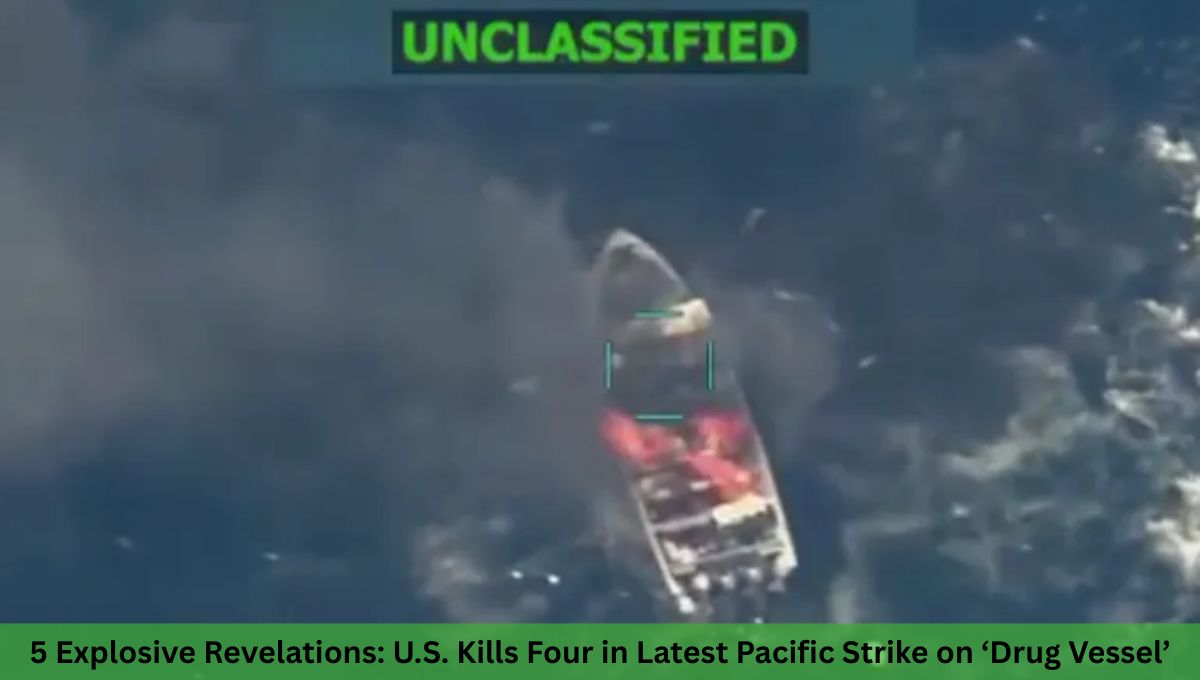
5 Explosive Revelations: U.S. Kills Four in Latest Pacific Strike on ‘Drug Vessel’ while critics say campaign lacks evidence. The United States has launched another lethal strike in the eastern Pacific Ocean, killing four men aboard what officials called a “narco-trafficking vessel,” in the latest escalation of President Donald Trump’s campaign against alleged drug smugglers operating in international waters.
Defense Secretary Pete Hegseth confirmed late Wednesday that the operation was carried out by the newly renamed Department of War — formerly the Department of Defense.
“This vessel, like all the others, was known by our intelligence to be involved in illicit narcotics smuggling, transiting along a known narco-trafficking route, and carrying narcotics,” Hegseth said in a statement on X, formerly Twitter.
He added that four male ‘narco-terrorists’ were killed during the strike, which took place in international waters in the eastern Pacific Ocean.
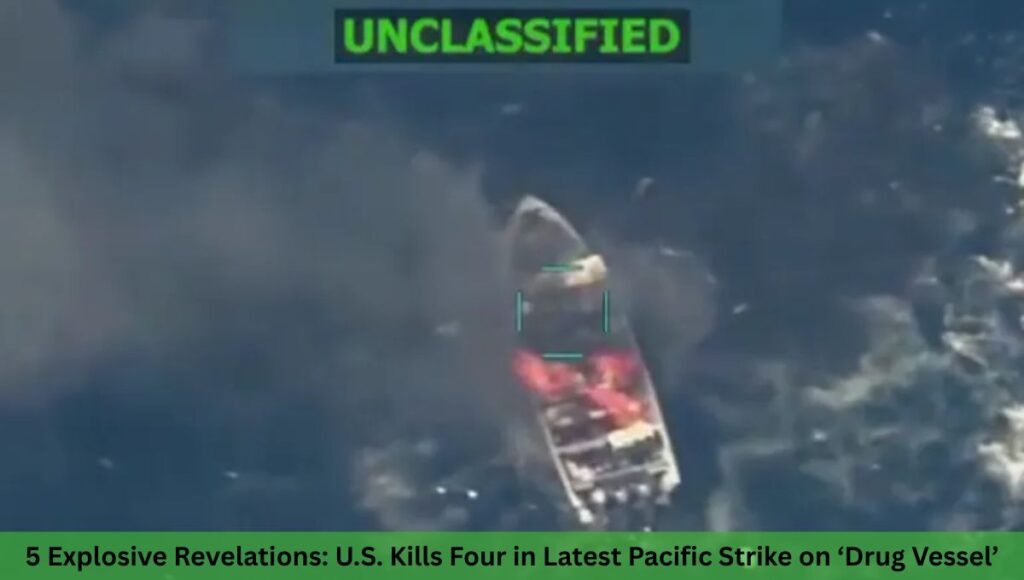
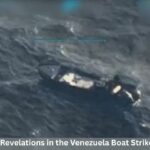
“No U.S. forces were harmed in this strike,” Hegseth said. “The Western Hemisphere is no longer a safe haven for narco-terrorists bringing drugs to our shores to poison Americans. The Department of War will continue to hunt them down and eliminate them wherever they operate.” A 22-second aerial video posted by Hegseth shows a small vessel being struck and exploding into flames — though the identities of those on board have not been confirmed.
5 Explosive Revelations: U.S. Kills Four in Latest Pacific Strike on ‘Drug Vessel’
Death Toll Rises to 61 After Two-Month Campaign
Wednesday’s strike marks the 15th maritime operation since early September, bringing the total death toll from the Trump administration’s ongoing campaign to at least 61 people.
The Pentagon has not released the names or nationalities of any victims, nor has it provided public evidence to substantiate its claims that the vessels were operated by drug-trafficking or terrorist organizations.
Earlier this week, Hegseth said U.S. forces carried out three separate strikes on alleged drug-smuggling boats on Monday, killing 14 people and leaving one survivor.
“Yesterday, at the direction of President Trump, the Department of War carried out three lethal kinetic strikes on four vessels operated by Designated Terrorist Organizations (DTOs) trafficking narcotics in the Eastern Pacific,” Hegseth said Tuesday.
According to Hegseth, Mexican authorities have since assumed responsibility for the search and rescue operation for the sole survivor of the earlier strikes.
Trump Frames Strikes as ‘National Defense’
President Donald Trump, currently on a three-nation tour of Asia, has publicly supported the maritime campaign, framing it as part of a “national security effort” to defend American lives from drug cartels.
“The Western Hemisphere will no longer be a playground for traffickers,” Trump said before departing for South Korea, where he met Chinese President Xi Jinping on Thursday.
Since September 2, the U.S. military has expanded its campaign from the Caribbean Sea into the Pacific Ocean, arguing that transnational cartels pose a direct security threat to the United States.
Trump’s administration formally notified Congress last month that the U.S. considers itself “engaged in an armed conflict” with drug cartels — labeling them “unlawful combatants.”
The move, detailed in a classified legal opinion reported by CNN, effectively authorizes the use of lethal force without judicial oversight, drawing comparisons to counterterrorism operations once reserved for war zones.
Department of War: A Rebranding and a Message
The rebranding of the Pentagon as the Department of War has drawn both political and legal scrutiny.
Hegseth has argued that the new name “reflects America’s renewed resolve” to confront what he calls “narco-terrorism and cartel warfare.”
“For decades, the Department of Defense defended other nations’ borders,” Hegseth wrote. “Now, we’re defending our own.”
But critics say the language marks a dangerous shift toward militarizing domestic and foreign drug policy, blurring the line between law enforcement and warfare.
Human rights groups warn that such framing could undermine international law, which limits the use of military force outside recognized conflict zones.
Mexico and Regional Reactions
Mexican President Claudia Sheinbaum acknowledged her government was informed of Monday’s operations but said they occurred in international waters.
“These events occurred in international waters,” Sheinbaum told reporters. “Our Navy Secretariat is coordinating with U.S. authorities to obtain more details.”
Diplomatic sources told CNN that Mexico, Ecuador, and Colombia were notified of the operations due to possible victims or survivors from their countries.
At least three survivors have been identified so far, though details remain classified.
Congress Demands Transparency
The House Armed Services Committee is set to receive a closed-door briefing on Thursday regarding the strikes.
Democratic House Minority Leader Hakeem Jeffries called for greater transparency:
“We’ll see whether the administration can finally come forward with evidence as to the nature of the people being killed, their connection to the drug trade, and what legal authority does the administration have to engage in what some have characterized as extrajudicial killings.”
In response, a senior Trump administration official said Congress had already received seven classified briefings on the campaign since early September.
“The administration has provided classified briefings to leadership and members of the House and Senate Armed Services, Intelligence, and Foreign Affairs Committees,” the official told CNN.
Critics Warn of ‘Extrajudicial Executions’
Legal experts and international observers have expressed concern over what they call unilateral U.S. military actions outside of declared war zones.
The United Nations’ Assistant Secretary-General for the Americas, Miroslav Jenča, recently told the Security Council:
“We continue to emphasize that all efforts to counter transnational organized crime must be conducted in accordance with international law.”
Human rights advocates argue that labeling suspected traffickers as “unlawful combatants” allows Washington to bypass legal accountability.
Some international lawyers have described the policy as a dangerous precedent, noting that it could justify similar actions by other nations under the same logic.
‘Blowing Up Fishing Boats Won’t Win the Drug War’
Critics also say the strikes represent a failed strategy that risks civilian lives while doing little to curb the global drug trade.
One long-time drug policy analyst wrote:
“The Trump administration has been blowing up fishing boats in the Caribbean — and now in the Pacific — claiming without evidence that they’re drug boats. These are extrajudicial executions outside any system of law.”
The analyst cited previous U.S. counter-narcotics missions gone wrong — including a 2001 incident in Peru where CIA contractors helped shoot down a missionary plane, killing Veronica Bowers and her infant daughter, and a 2012 DEA operation in Honduras that mistakenly killed four civilians, including two pregnant women.
“If he’s allowed to normalize this kind of international extrajudicial killing, it’s not a far leap for him to try it domestically,” the analyst warned.
Questions of Reciprocity and Legality
Critics have raised hypothetical scenarios questioning U.S. consistency on the use of force.
“Would it be acceptable for the Mexican military to blow up a U.S. fishing boat because they believed it was smuggling guns into Mexico — even if they offered no evidence?” one expert asked.
Mexico has long blamed the United States for the flow of weapons southward, a phenomenon dubbed the “River of Iron.” The smuggling of U.S.-made guns has fueled tens of thousands of killings in Mexico over the past two decades.
The comparison highlights the double standards in how nations interpret international law and self-defense.
Experts Say Drug War Policies Backfire
Economists and drug policy researchers argue that militarized approaches to narcotics enforcement tend to increase violence and profits for traffickers rather than suppress them.
“When you escalate the risk — such as the risk of getting arrested or blown up — the price of drugs rises along the supply chain,” the analyst explained. “That makes trafficking more profitable, not less.”
According to researchers, the U.S. drug war acts as a “price support system” for cartels, ensuring that higher risks translate into higher profits.
They point to alcohol prohibition in the 1920s as a historical parallel: a well-intentioned but counterproductive policy that enriched criminal syndicates until it was repealed.
“Addiction is a public health issue,” the expert concluded. “You can’t bomb it away.”
Growing Military Presence in the Hemisphere
Since September, the Trump administration has increased U.S. naval and aerial patrols across the Caribbean and eastern Pacific.
Pentagon data shows at least 14 maritime vessels destroyed in the two-month campaign. Satellite imagery from maritime monitoring firms also shows increased ship movements in areas near Ecuador, Panama, and Costa Rica.
Analysts believe the buildup may also serve a strategic political purpose — signaling pressure on Venezuelan President Nicolás Maduro, whom the U.S. has accused of narcoterrorism.
Officials deny the operations are related to regime change, but the scale and scope of the campaign have drawn comparisons to early-stage military blockades.
Legal Ambiguity and Global Precedent
The Trump administration’s legal justification hinges on interpreting drug cartels as “nonstate armed groups” engaged in hostilities against the U.S.
This interpretation expands the boundaries of wartime authority, allowing for lethal military force in areas traditionally governed by law enforcement.
Legal experts say this could erode global norms that separate criminal prosecution from armed conflict, potentially emboldening other states to take similar unilateral actions.
“It sets a dangerous precedent,” said one human rights lawyer. “If every country starts designating its criminal suspects as combatants, the world will be at perpetual war.”
Conclusion: Escalation or Strategy?
With at least 61 confirmed dead in a span of eight weeks, the U.S. maritime strike campaign marks a significant escalation in Washington’s global drug war.
While the Trump administration insists the operations are lawful, lack of transparency and evidence has fueled global debate about ethics, legality, and accountability.
For supporters, the strikes show decisive leadership against transnational crime. For critics, they signal a slide toward militarized impunity — where the lines between justice and vengeance grow ever thinner.
As investigations continue, one question looms: Can the United States win a drug war fought from the sky — or will it, once again, fuel the very problem it seeks to destroy?
Also Read: 9 Facts About Trump’s Drug Boat Strikes That Shook the World
Also Read: Mexico searches for lone survivor of US strikes on alleged drug boats that killed 14
Related Posts:
- Trump Says US Forces Launched Third ‘Lethal Kinetic…

- 9 Facts About Trump’s Drug Boat Strikes That Shook the World

- Second Signal Scandal: Defense Secretary Pete…
- 7 Critical Revelations in the Venezuela Boat Strike Scandal
- US Strike on Venezuelan Boat Kills 6 in Fifth…

- Over 20% of the Ocean Is Darkening: A Growing Threat…