Trump Ends 33-Year Pause: U.S. to Resume Nuclear Weapons Testing as analysts warn of new global arms race. US President Donald Trump has announced that the United States will resume nuclear weapons testing for the first time in over three decades, a decision he said was necessary to “keep pace” with rival nuclear powers Russia and China.
Writing on his Truth Social platform just before meeting Chinese President Xi Jinping in South Korea, Trump declared:
“Because of other countries’ testing programs, I have instructed the Department of War to start testing our Nuclear Weapons on an equal basis. That process will begin immediately.”
The announcement marks the most significant reversal of US nuclear weapons policy since the end of the Cold War. The last American nuclear test was conducted in 1992 at the Nevada Test Site. Trump said the US, which possesses the largest nuclear arsenal in the world, must not allow competitors to advance unchallenged. “Russia is second and China a distant third,” he wrote, “but China will be even within five years.”
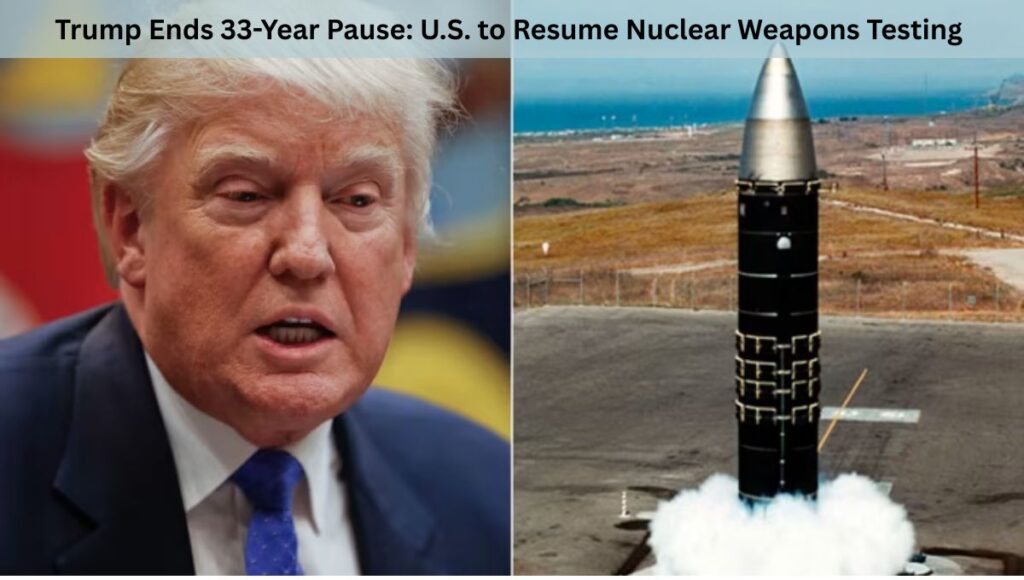
Trump Ends 33-Year Pause: U.S. to Resume Nuclear Weapons Testing
A Major Policy Shift After 33 Years
If carried out, Trump’s directive would end a voluntary moratorium that has been in place since 1992, when then-President George H.W. Bush halted all explosive nuclear tests following the collapse of the Soviet Union.
For more than three decades, Washington has relied on advanced computer simulations and subcritical testing—non-explosive experiments conducted underground—to maintain its nuclear deterrent.
Trump’s statement signals a dramatic break from that tradition. It also comes amid intensifying global military competition and deepening mistrust between the world’s major powers.
Historic Context: From Trinity to Divider
The United States first entered the nuclear age in July 1945 with the Trinity test in Alamogordo, New Mexico. That same year, it became the only country ever to use nuclear weapons in war—on the Japanese cities of Hiroshima and Nagasaki.
Between 1945 and 1992, the US conducted 1,054 nuclear tests, culminating in the Divider test on 23 September 1992. Since then, the Nevada Test Site—now called the Nevada National Security Site—has remained dormant but intact.
According to the National Museum of Nuclear Science and History, the site “could be authorized again for nuclear weapons testing if deemed necessary.”
Trump’s announcement suggests that day may have come.
Trump’s Reasoning: ‘No Choice’ But to Match Rivals
In his social media statement, Trump acknowledged the “tremendous destructive power” of nuclear weapons but said he had “no choice” but to act in response to other nations’ activities.
“Because of other countries’ testing programs, I have instructed the Department of War to start testing our Nuclear Weapons on an equal basis,” Trump wrote.
His remarks followed reports that Russia recently tested a nuclear-powered cruise missile—the Burevestnik—and an underwater nuclear drone known as Poseidon. Both systems, Moscow claims, are capable of evading US missile defences.
Meanwhile, China has dramatically expanded its nuclear arsenal in recent years. The Center for Strategic and International Studies (CSIS) estimates Beijing now possesses around 600 nuclear warheads, up from about 300 in 2020, and could exceed 1,000 by 2030.
Strategic Timing: Announcement Before Meeting Xi Jinping
Trump’s declaration came just minutes before his highly anticipated meeting with Chinese President Xi Jinping in Busan, South Korea, on the sidelines of the Asia-Pacific Economic Cooperation (APEC) Summit.
The post appeared while Trump was aboard Marine One, en route to meet Xi at Gimhae International Airport.
The timing was seen by analysts as both symbolic and strategic—underscoring Washington’s growing unease about Beijing’s nuclear ambitions even as the two leaders sought to stabilize relations through trade talks and security dialogue.
Inside the Trump-Xi Summit: Praise and Policy Contrasts
During the Busan meeting, both leaders exchanged unusually warm remarks. Trump hailed Xi as a “tremendous leader of a very powerful country,” while Xi praised Trump’s “great contribution to global peace.”
“Given our different national conditions, we do not always see eye to eye,” Xi said, “and it is normal for two leading economies to have frictions now and then.”
Despite the cordial tone, Trump’s nuclear testing announcement overshadowed the summit’s trade-focused agenda.
Reactions and Global Shockwaves
International reaction was swift. Analysts described the move as a “profound rupture” in decades of nuclear restraint.
Arms control experts warned that restarting nuclear testing could erode the global non-proliferation regime built around the Comprehensive Nuclear-Test-Ban Treaty (CTBT)—an agreement the US has signed but never ratified.
“If the United States resumes testing, it would give political cover for Russia, China, and possibly others to follow suit,” said Jeffrey Lewis of the Middlebury Institute of International Studies. “That would effectively end the nuclear testing taboo.”
Russia’s Foreign Ministry called the announcement a “dangerous provocation,” while China’s state media described it as a “return to Cold War mentality.”
The Strategic Picture: Arms Race on the Horizon
Trump’s decision comes amid a global surge in nuclear modernization programs.
- Russia is developing multiple new delivery systems, including hypersonic glide vehicles.
- China is constructing at least three new missile silos and has increased intercontinental ballistic missile (ICBM) testing.
- North Korea continues its weapons testing, most recently in 2017.
- The United States, under Trump’s directive, may now re-enter the testing arena after a 33-year pause.
These developments point to a renewed nuclear arms race, analysts say, reminiscent of Cold War rivalries but involving multiple powers rather than two.
Potential Sites and Legal Questions
Trump said the locations for testing would be “determined later,” but experts believe the Nevada National Security Site remains the most likely venue due to existing infrastructure and legal status.
However, any new testing would raise complex legal and diplomatic issues. The United States remains a signatory to the CTBT, which prohibits all nuclear explosions, even though it has not been ratified by Congress.
Violating the spirit of that treaty could trigger global condemnation and spark domestic legal challenges.
Global Nuclear Balances
According to the Arms Control Association, global nuclear stockpiles currently stand as follows:
- United States: ~5,225 warheads
- Russia: ~5,580 warheads
- China: ~600 warheads
- France: ~290 warheads
- United Kingdom: ~225 warheads
- India, Pakistan, Israel, North Korea: smaller but growing arsenals
The US and Russia together still control over 90 percent of the world’s nuclear weapons.
Trump’s announcement comes just months before the expiration of the New START treaty in February 2026—the last remaining arms control agreement between Washington and Moscow.
Trump’s Broader Strategic Vision
The move fits into Trump’s long-standing narrative of rebuilding American power and modernizing its nuclear deterrent.
During his first term, he oversaw major upgrades to the nuclear triad—submarines, land-based missiles, and strategic bombers—and withdrew the US from the Intermediate-Range Nuclear Forces (INF) Treaty, accusing Russia of violations.
“This is about strength, deterrence, and keeping our country safe,” Trump said aboard Air Force One after his meeting with Xi.
New Alliances: Green Light for South Korea’s Nuclear Submarine
In a related move, Trump said he had approved South Korea’s plan to develop a nuclear-powered submarine—a privilege shared only among a few nations.
“South Korea will replace its old-fashioned diesel-powered submarines with a modern nuclear-powered one,” Trump said, noting that construction would take place in Philadelphia, in partnership with Hanwha, a South Korean firm.
The decision positions Seoul among a select group of nations operating nuclear submarines: the US, China, Russia, France, the UK, and India.
South Korean President Lee Jae Myung reportedly pushed for greater flexibility in reprocessing spent nuclear fuel and enriching uranium for submarine propulsion—an issue that may require revising the US-Korea nuclear energy agreement.
Critics Warn of Escalation and Uncertainty
Opponents argue that Trump’s dual announcements—on nuclear testing and submarine technology—risk destabilizing the Asia-Pacific region and undermining decades of arms control progress.
“This is a watershed moment for nuclear non-proliferation,” said Daryl Kimball of the Arms Control Association. “If the United States resumes testing, others will follow. The result could be a dangerous spiral.”
Others see Trump’s strategy as a form of nuclear signaling aimed at pressuring rivals ahead of potential arms control talks.
Xi and Trump: A Diplomatic Balancing Act
Despite the nuclear backdrop, Trump and Xi used their Busan meeting to project warmth and continuity.
Xi told Trump that “China and the United States should be partners and friends,” while praising Trump’s role in the Gaza ceasefire and Southeast Asian peace efforts.
Trump responded in kind: “It’s an honour to be with a great leader of a great country. I think we’re going to have a fantastic relationship for a long time.”
Observers said the friendly optics could not fully mask the deepening strategic rivalry that now defines US-China relations.
Looking Ahead: A New Nuclear Era
Whether Trump’s order leads to an actual detonation or remains a symbolic gesture, experts agree that the announcement has already changed the global nuclear landscape.
“This is not just about testing,” said former US diplomat Rose Gottemoeller, who negotiated New START. “It’s about signaling—to allies, adversaries, and the world—that the US is willing to break with old norms if it feels threatened.”
If nuclear testing resumes, the first explosions could take place within months, potentially marking the dawn of a new nuclear era.
Key Takeaways
- Historic Reversal: Trump ends the 33-year moratorium on US nuclear tests.
- Global Ripple: Russia and China likely to respond with intensified programs.
- Strategic Timing: Announcement coincides with Trump-Xi summit in South Korea.
- Regional Shift: US greenlights South Korea’s nuclear submarine ambitions.
- Uncertain Future: Move could reshape global arms control for decades to come.
Also Read: Russia Issues Nuclear Warning After Trump’s New Weapons Pledge to Ukraine